PSA: Keep your High School Edgelord Poetry

I have been out of high school for 17 years now. It was not a nice time for me, and for the most part, I’ve blocked out the memories. However, I recently went to a poetry reading, and it triggered something in the back of my mind. Something I had written in high school. Something I had written in high school and liked. Something I had written in high school, liked, and thought I probably still had. Its last line echoed around in my head.

“But I didn’t understand, and that was too bad.”

Days passed, and I was still haunted by lines that were probably originally inspired by some nonsense high school drama. Or emotions that ran unregulated around my hormonal brain. Maybe a new literary obsession. Who knows? The intent behind my words has long since been lost to me.

“I don’t care that you’re sorry, and I know you messed up. But I didn’t understand, and that was too bad.”

Was I just over glamorizing something from my past in an attempt to save my brain from remembering how embarrassing it was? Or was it truly something worth digging out again?

I had to know.

Logically, if I had kept it for 17 years, written out on a loose piece of paper, over countless moves and life changes, I had to have seen something in it, right?

Where was that folder of-

Ah, yes. The folder of past writings.

“When I’m angry, you don’t understand. When I was destructive, you didn’t understand, and that was too bad.”

I dug out the poem and held my breath.

I read it.

I read it again.

And you know what? If I had reread this ten years ago, I would have cringed so hard I left the planet and set the paper on fire in my wake.

But time does funny things to perspective.

It wasn’t bad.

The full thing is as follows:

“When I’m sad, you don’t understand.

When I’m lonely, you don’t understand. That’s too bad.

When I’m normal, you don’t understand.

When I hide behind my smile, you still don’t understand, and that’s too bad.

When I’m angry, you don’t understand.

When I was destructive, you didn’t understand, and that was too bad.

I don’t care that you’re sorry, and I know you messed up, but I didn’t understand, and that’s too bad.”

Somewhere, under that stresso depresso cry for attention is a really interesting poem. All it needed is a little massaging.

So I massaged it.

“When I’m sad, you don’t understand.

When I was loud, you didn’t understand, and that was too bad.

When I’m happy, you don’t understand.

When I smiled to hide the sharp knife of my tongue, you didn’t understand, and that was too bad.

When I’m afraid, you don’t understand.

When I begged for peace with my white flags called teeth, you didn’t understand, and that was too bad.

I don’t care that you’re sorry, and you say it’s not fair. But I didn’t understand, and that was too bad.”

Which, if I do say so myself, is decent. Poetry is not my first language, but I dabble. Now, it still screams “Not like other girls” or “Manic Pixie Dream Girl”, but it’s BETTER. And better is better. It’s right there in the name.

If I were to take the heart of the poem and make it more about moving from one stage of life to another, I think it might even become something adjacent to ‘good’.

When ocean swells crash against freckled shores, you don’t understand.

When your deep sky eyes swallowed my desperation for summers past, you didn’t understand, and that was too bad.

When forests of laughter spring up under my leaps of faith, you don’t understand.

When the funeral procession for all my past selves crushed me under a white-hot weight, you didn’t understand, and that was too bad.

When winds of sweetly scented future draw me ever farther away, you don’t understand.

When the same tendrils that strangled my soul rocked you ever so gently to sleep, you didn’t understand, and that was too bad.

The golden past may have bought your loyalty like a devoted lover, but I didn’t understand, and that was too bad.

What do you think?

One Person’s Trash is Another Person’s Treasure. Sometimes.

People donate books for many reasons. The owner could be moving and has to downsize. Someone could have passed away, and their family is clearing out their estate. It could be that the reader has outgrown those particular stories. Perhaps it is related to a deep clean or the de-cluttering of a home. For the most part, though, I feel as if what gets donated has a positive correlation with perceived low re-readability by the owner. Which is admittedly a subjective quality. To a point.

Donations can go to many places. Libraries, literacy programs, charities, second-hand shops, and schools are just some of the options where books may receive a chance at a second life. My personal favorite is the local Rotary Club, which collects donations throughout the year and then hosts a massive book sale biannually to support their various community projects.

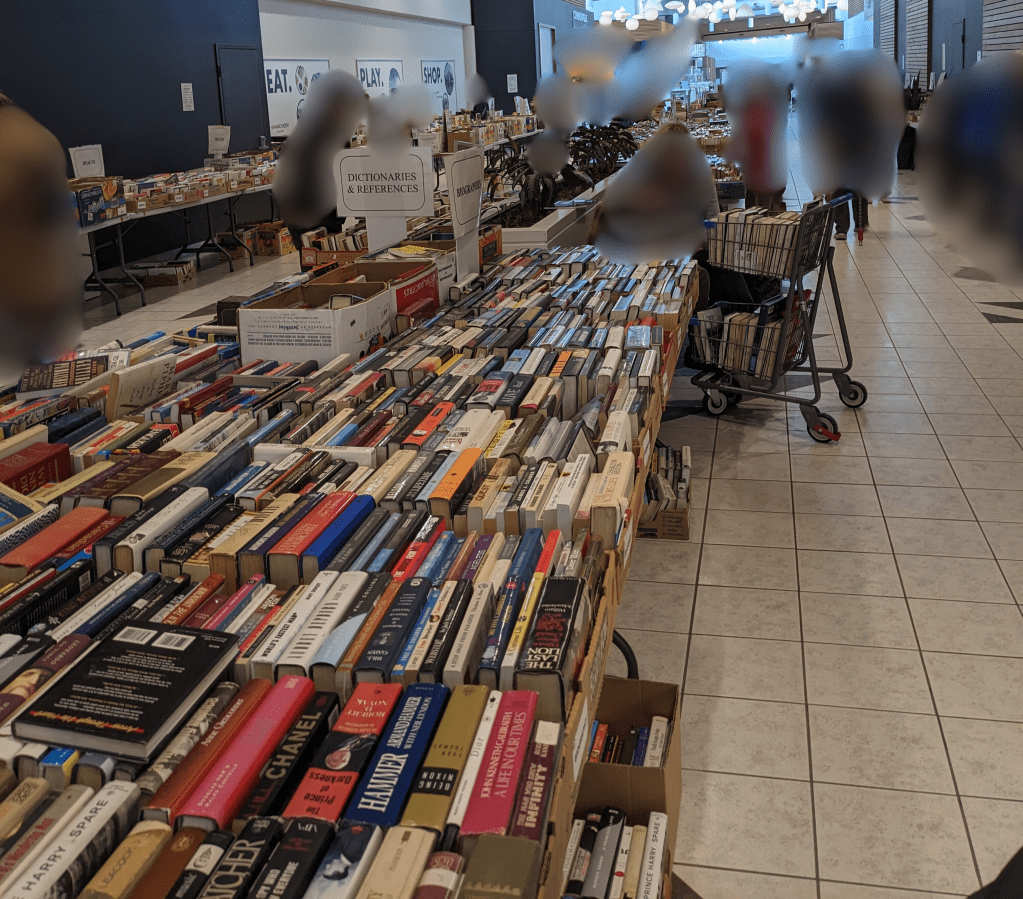
Large-scale used book sales are beautiful chaos. You never know what you’re going to stumble across. It’s a full day of wading through tables covered in boxes overflowing with thousands of titles, sorted loosely by genre and first letter of the author’s last name.

It’s also a roller coaster of emotion. There are shouts of joy as a certain edition of an old favorite is unearthed. Strangers work together to look for the third book in a five-part series – books one, two, four, and five are already clutched tightly in a young adult’s arms. It’s a gathering of book lovers, for better or worse, in jealousy and triumph, in disappointment and discovery.

As I became familiar with the ins and outs of this particular flavour of sale, I expanded my interest from books and authors I was actively seeking to books that seemed worthwhile to add to my TBR pile. From there, I found myself becoming curious as to which books showed up repeatedly. And now, I spend a lot of time looking at books and authors who have been donated en masse.

To be clear, the books offered during each sale are a mix of titles that did not sell during previous sales, as well as newly donated items. So prolific authors, such as Debbie Macomber, Nora Roberts, Terry Goodkind, and Stephen King, may have many titles represented, but those are generally gone by the end of the sale.

I’m not talking about those.

I’m talking about the duplicate copies of a single title. Let me show you an example.

Check out how many copies of “Steve Jobs” by Walter Isaacson and “Becoming” by Michelle Obama there are in these boxes. There were probably another three or four times that amount again on the upper tables in the biography section.

The city I live in is not particularly large. We’re talking 100,000 people. For there to be so many copies of a singular title, to me, means two things.

One. Either the marketing these books received was absolutely mind-blowing, the subjects these books were about are interesting to a wide and varied reader base, and/or the blurb on the back was spectacular.

Two. Once these books were actually purchased and read, people did not see them as re-readable novels. I could give it the benefit of the doubt and say that so many people bought it that these donated copies are all duplicates, but my suspenders of disbelief are not that strong. Fundamentally, a lot of people do not want to revisit these books.

Now, for biographies, that makes a little more sense than a fiction or fantasy title. The nature of the work is reflective and informative rather than woven and inventive. It is also usually more about the subject rather than the author. (Unless it’s particularly poorly written, but as “Becoming” has a 4.7 out of 5 on Amazon, 4.4 out of 5 on Goodreads, and 4.6 out of 5 on Indigo, while “Steve Jobs” has 4.7 out of 5 on Amazon and 4.2 out of 5 on Goodreads, I don’t think that’s the case here.)

What this comes down to for me is this: I never want to be that author with 200 copies of a singular title at a used book sale. I want to be the kind of author who makes people feel as though they’ve scored the jackpot if and when my work makes it into the used market.

And for that, I need re-readability. Secrets. Easter eggs. Clever full circle moments. Hints at different perspectives. I need depth.

This month’s round of edits and revisions will focus on just that.

Wish me luck.

Why My Job is Safe From AI. (For Now.)

Recently, my company asked whether we could use AI to help generate ideas for our content. Not to WRITE our content, but just to provide lists of material we could use as references or jumping-off points. This was met with different levels of uncertainty, but ultimately, my coworker was the first to sign up and try it.

She is the reason for this post. Let me tell you, I was IN TEARS reading the poor ChatGPT bot trying to defend itself. What was the stumbling block, you might ask?

Puns.

Puns are apparently NOT something AI currently understands. This is great news because puns make up at least 30% of my content. If you’re dubious about what ChatGPT is capable of, please, allow me to ease your mind with some ice cream.

For clarity, I am styling the interaction I had with ChatGPT so my questions and prompts are a heading, and ChatGPT’s response is the text under it.

Me: Good evening ChatGPT! I’m trying to write some jokes. Can you help me come up with some ideas for puns about ice cream?

ChatGPT: Good evening! I’d be happy to help you come up with some ice cream puns. Here are some ideas to get you started:

  1. “I tried to make an ice cream joke, but it was too soft to land!”
  2. “I’m on a diet… but I can’t resist ice cream, it’s a cone-troversial issue!”
  3. “I scream, you scream, we all scream… for puns!”
  4. “You’re ice cream my dreams!”
  5. “Life is short, but ice cream is forever.”
  6. “When it comes to ice cream, I’m totally cone-fused!”
  7. “Let’s have an ice cream social – it’s going to be a cool event!”
  8. “I had a pun about vanilla, but it was too plain!”
  9. “Do you want to hear an ice cream joke? Never mind, it’s a bit too sweet for you.”
  10. “I love ice cream so much, I’ll do anything for a scoop! You could say I’m really cone-nected to it.”
  11. “Why don’t ice cream cones ever get into trouble? They always keep their cool!”
  12. “I can’t believe it’s already winter… it feels like just yesterday we were chilling with ice cream!”

Hope these inspire some laughs! Let me know if you need more ideas!

Me: Some of those are cute, but I don’t understand joke #12. Can you please explain why it is a pun?

ChatGPT: You’re right to ask! Joke #12 was meant to be a playful pun on the idea of “chilling” with ice cream. The word “chill” can mean both “to relax” or “to cool down,” but it also refers to how ice cream is kept cold or “chilled.”

So, when I said, “we were chilling with ice cream,” the joke was trying to play on the double meaning of “chilling” – both relaxing with ice cream and keeping the ice cream cold. But I see how it might not have been as clear or punchy as some of the others.

I hope that helps explain it! Let me know if you’d like more ideas or further clarification!

Me: Joke #5 is also confusing. Can you please explain why it is a pun?

ChatGPT: You’re right again! Joke #5, “Life is short, but ice cream is forever,” isn’t exactly a classic pun. Instead, it’s a play on a popular phrase, “Life is short,” which is often used to encourage people to enjoy life and make the most of it. The twist comes from replacing the second part with “ice cream is forever,” which is a humorous exaggeration.

The “pun” aspect comes from contrasting the idea of something fleeting like life with something perceived as indulgent and everlasting, like the joy or obsession people have with ice cream. While it’s not a pun on a specific word (like “cone” or “scoop”), it’s more of a playful comparison.

I can see how it might be confusing as it doesn’t follow the same pun structure as some of the other jokes. Thanks for pointing that out! Let me know if you’d like more clearer puns!

Me: Do you think that “more clearer puns” is proper English?

ChatGPT: You’re absolutely right to point that out! “More clearer” is not proper English because “clearer” is already a comparative form of “clear,” so adding “more” is redundant. The correct way to say it would be:

  • “clearer puns” (just the comparative form)
  • “more clear puns” (though this is less common and a bit awkward, it’s technically acceptable in some cases)

Thank you for catching that! Let me know if you have any other questions or if you’d like more puns!

Me: ChatGPT, can you please define what a pun is for me?

ChatGPT: Certainly! A pun is a form of wordplay that exploits multiple meanings of a term or similar-sounding words to create a humorous or clever effect. Puns often rely on words that have more than one meaning (a double entendre) or on words that sound alike but have different meanings (a homophone).

For example:

  • “Time flies like an arrow. Fruit flies like a banana.”
    This is a pun because “flies” is used in two different ways: as a verb (time passing quickly) and as a noun (the insect “fruit flies”).
  • “I used to be a baker, but I couldn’t make enough dough.”
    The pun here comes from “dough,” which can refer both to the money (“dough”) and the mixture used in baking.

Puns are often playful and can add humor through unexpected or witty uses of language!

Me: Using that definition you just provided, why is Joke #5, “Life is short, but ice cream is forever”, a pun?

ChatGPT: You’re absolutely right to question this! Upon reviewing the joke again, it seems that “Life is short, but ice cream is forever” is not actually a pun by the definition I provided.

A pun relies on a play on words—either a word with multiple meanings or words that sound alike but have different meanings—and this joke doesn’t quite fit that pattern. Instead, it’s more of a play on contrasting ideas: “Life is short” (a common saying about the brevity of life) versus the idea that ice cream brings lasting enjoyment, though obviously, ice cream itself doesn’t last forever.

So, I misspoke when I called it a pun! It’s a humorous contrast, but not a pun in the traditional sense. Thank you for catching that!

If you’re looking for more puns, I’d be happy to help clarify or come up with some new examples!

Me: Thank you! Can I please have 5 new puns about ice cream?

ChatGPT: You’re very welcome! Here are five fresh ice cream puns for you:

  1. “I’m trying to cut back on sugar, but ice cream keeps scooping me back in!”
  2. “The ice cream truck pulled up and I topped my day off with a scoop of joy!”
  3. “If you don’t like ice cream, you’re really conefusion!”
  4. “I made an ice cream joke, but it didn’t have enough punch… I guess it was a sundae one!”
  5. “I scream for ice cream, but the real question is, does ice cream scream for me?”

Hope these give you a good laugh! Let me know if you need more!

Me: I don’t think joke #3 is grammatically correct. Can you please rewrite it so it makes sense?

ChatGPT: You’re absolutely right! Joke #3, “If you don’t like ice cream, you’re really conefusion!” doesn’t quite make sense as written. Here’s a revised version:

“If you don’t like ice cream, you’re really in a conefusion!”

This makes it clearer, using “cone” to play on the word “confusion.” Thanks for pointing that out! Let me know if you’d like more puns or further revisions!

Me: Wouldn’t it have worked better if you changed it to “If you don’t like ice cream, you’re just conefused!”?

ChatGPT: Yes, absolutely! “If you don’t like ice cream, you’re just conefused!” is a much smoother and more clever pun. The play on “confused” and “cone” works perfectly here.

Great suggestion! Here’s the updated pun:

“If you don’t like ice cream, you’re just conefused!”

Thanks for the improvement! Let me know if you’d like more puns or help with anything else!

Me: Can we please revisit joke #4? I don’t understand that either.

ChatGPT: You’re absolutely right to ask for clarification on joke #4. Upon rereading, I see that it may be a bit confusing and not as clear as it could be.

The joke was:
“I made an ice cream joke, but it didn’t have enough punch… I guess it was a sundae one!”

The idea was to play on the word “punch” (as in a strong or impactful joke) and “sundae” (the ice cream dessert), but it doesn’t quite land as a straightforward pun.

Here’s a revision that works better:

“I tried to make an ice cream joke, but it was just too soft… I guess it needed a little more scoop!”

This plays on the idea of ice cream being “soft” and needing more “scoop” (or impact) to make it funnier.

I hope this clears things up! Let me know if you’d like further adjustments or more puns!

Me: Is “scoop” really a form of impact?

ChatGPT: You’re right again! “Scoop” isn’t quite a synonym for “impact,” and using it in that context doesn’t quite fit. I appreciate your patience as we refine the joke. Let’s try another version that makes more sense.

Here’s a revised version of the joke that better fits the idea of needing more impact:

“I tried to make an ice cream joke, but it was a little too soft… I guess it needed a bit more chill!”

This works better because “chill” can refer to both the cold nature of ice cream and the idea of something being cool or impressive. It plays on the idea that the joke didn’t land well and needed a little more “chill” to make it better.

Thanks for your feedback! Let me know what you think!

Me: That works! Good job!

ChatGPT: Thank you! I’m so glad that works for you! 😊 If you need more puns or jokes, feel free to reach out. I’m happy to help!

Me: Thank you! Using the definition you have given me, can you please tell me 5 more ice cream puns?

ChatGPT: Of course! Here are five more ice cream puns, using wordplay for some fun:

  1. “I don’t trust ice cream. It’s always up to some kind of scoop!”
  2. “I used to be a professional ice cream taster, but I got burned out.”
  3. “Ice cream is proof that good things come in scoops!”
  4. “I’m trying to stay cool, but with all this ice cream around, it’s hard not to melt.”
  5. “I told my ice cream it was churn-ed up, and it just gave me the cold shoulder.”

I hope these give you a good laugh! Let me know if you’d like more!

Me: None of these are puns based on the definition you gave.

ChatGPT: You’re absolutely right again! I appreciate your patience. Let’s focus on creating proper puns based on the wordplay I described earlier—using words with double meanings or words that sound similar. Here are five new ice cream puns that fit the definition:

  1. “I scream, you scream, we all scream for conefusion!”
    (Play on “confusion” and “cone.”)
  2. “What did the ice cream say to the toppings? You’re the cherry on top!”
    (Play on the phrase “cherry on top” to express something extra special.)
  3. “I told my friend that ice cream is my favorite. She said, ‘I conecur with that!'”
    (Play on “concur” and “cone.”)
  4. “That joke was so bad, it was almost vanilla.”
    (Play on “vanilla” as something plain or basic.)
  5. “When the ice cream truck broke down, it was a real sundae driver!”
    (Play on “Sunday driver” and “sundae.”)

I hope these are more in line with the puns you were expecting! Let me know if you’d like more!

Me: No, thank you. I hope you have a good night!

ChatGPT: You’re very welcome! I hope you have a wonderful night as well! If you ever need more puns or anything else, feel free to reach out. Take care! 😊

In Cone-clusion

Even after getting ChatGPT to define a pun, it could not give me proper, sensical examples. Instead, it replaced arbitrary parts of sayings and speech with ice-cream-related words. Sometimes this worked sort of fine (“Why don’t ice cream cones ever get into trouble? They always keep their cool!” was acceptable to me.) and other times it did not make one iota of sense. (“You’re ice cream my dreams!” was so far off something I understood that I skipped right over it.)

Prompting ChatGPT to identify its own mistakes seemed successful in that it always agreed with me when I pointed something out, but it could not take those breakthroughs and apply them with any level of understanding.

All in all, I think using AI to write snippets and barks, puns and jokes, is probably a lost cause. It’s like talking to potting soil. The potential’s there, but nothing’s growing.

Let me know about your AI interactions in the comments, and I’m curious to know if you’ve had better luck than I have!

Spellcheck and AI

For those of you who don’t know, I get paid for writing. I know I’m lucky and I wouldn’t change what I do or the company I work for. Even when people tell me AI is coming for my job and how programs like chatGPT will make me irrelevant in my field.

Now, maybe you’re intimately familiar with AI programs. Maybe you’re laughing to yourself about how the technology is promising but it’s far from being able to replace writers in long-form content. Or maybe you’re biting your nails because you’re the kind of person who knows very little about AI writing programs and it seems like they WILL take our jobs from us.

Either way, for laughs or reassurance, please allow me to tell you about a very frustrating thing that AI is fully capable of, but doesn’t do.

Spelling and grammar checks.

When I was growing up, we were assured computers were only as good as the information we put in them. It seemed kind of like casting a spell because you had to be really specific, you had to give it all the raw data or ingredients for what you wanted, and you needed to make sure it had the capabilities to actually process/think/calculate the thing you wanted it to do.

In today’s day and age, EVERYTHING is online. Including dictionaries. Including encyclopedias. Including translation rules. Including grammar. Including very detailed timelines of the evolution and modifications of the English language.

SO WHY THE HECK CAN’T AI SUCCESSFULLY CHECK MY SPELLING FOR ME!?

I have Grammarly installed, which is great for spelling and basic grammar. I write my drafts in Google Documents, which has spellcheck built in.

The other day, I submitted a draft and the word “accidently” got through Google’s spell check. (I believe they use Oxford but I have my suspicions.) When it got flagged by a coworker I panicked, thinking I had submitted the draft without doing my regular check. Pulling the original up, I re-ran it through the spellcheck and…

nothing

Nothing? Why wasn’t it at least flagging the “accidently” I KNEW was there?

Well, turns out “accidently” is defined by Merriam-Webster! It’s in the dictionary! MW, how could you do this to me!? Hopped into the Oxford Dictionary, and it was there too! Just to be thorough, I jumped into the Cambridge Dictionary, but it was completely absent! Same with dictionary.com. This, of course, sent me down a rabbit hole of searches.

What is the difference between “accidently” and “accidentally”? Where has “accidently” been used before? Why, when you google “accidently” vs “accidentally” does it not give you the concrete information that it’s incorrect?

Essentially, it has cropped up enough times in enough publications that “accidently” has now been defined and added to dictionaries.

Out of curiosity, I also searched for “nevermind”, which is one of my personal pet peeves. Oxford? It’s in there. And NOT JUST for the singular usage of “pay it no nevermind”. Merriam-Webster? No entry. Cambridge? Also no entry. The last one I checked was dictionary.com and to my delight, it was in there as JUST for the use of “pay them no nevermind.”

So, what I’m proposing is teaching AI English. All English. Every English. It’s a HARD language to learn, and honestly, that’s where I want AI’s powers of logic to go. Not into creating a procedural story with WAY too many keywords. Play around with an AI pickup line generator sometime! It’s a lot of fun, and the lines you get are SO STRANGE. Like, it takes all the information you give it, but it doesn’t understand how an actual human brain would take that information and put it together in a way that makes sense. No one would swoon over those lines.

This is fine. Styles are different across all writers. Why are we trying to make AI replicate THAT when it would be a million times more useful to make it tell us when we’ve used a word that’s only technically in the dictionary because SO MANY PEOPLE mess it up?

I’d love to set my location to “Canada” and have it ACTUALLY tell me how things are spelled in Canada. We have this gross soup of British English, American English, and French Canadian spellings, and it’s ROUGH to navigate! Especially when my location is set to Canada, but my work needs to be submitted in American English, preferably only using words that are in circulation as of this century. Can I please set my location to “Portland, OR” and have it prompt me to correct spellings and remove all my extra Canadian letters?

So here we are. This is where I think AI should be utilized. Please help everyone like a strict teacher, instead of like that weird kid who you pay to do your homework and only get a C.

References

Opinion: New York Times Bestseller Achievement Does Not Promise a Good Read

Maybe I’m old and getting grumpier, or maybe the world I live in is truly getting sneakier and less whimsical. I remember times when I would go to the bookstore and be drawn in by things like “#1 New York Times Bestseller!” written on the cover. However, it wasn’t until recently that I learned exactly how one gets on the New York Times Bestseller list. If you’re like me and were living in the land of assumptions, let me lay it out for you.

The New York Times takes in information from certain vendors both brick-and-mortar and digital. Each week, it’s essentially a popularity contest of sales – Who in which genres sold the most copies that week, as reported by the vendors who report to the New York Times (which will be abbreviated to NYT moving forward in this opinion piece). There are different parameters for digital media and ebooks, but the general idea is the same.

When I found out that not all bulk sales were immediately discounted for this contest, I became a little disillusioned. Now, MOST bulk sales are discounted, but not ALL OF THEM.

The next thing I found out was that there is no criteria for the content of the book, just the parameters of genre. The NYT Best Reviewed list is something else entirely.

Think about that for a minute. If someone wrote a book, marketed it as fiction, wrote 300 pages of paragraphs filled with sentences like “And then I saw”, “And then I went”, and “And then I thought” over and over and over, and 10,000 people bought it because they thought it was funny… that would make it on the list. The book could be written as though dictated by a child in their rambling story phase, with many grammar and spelling errors, but as long as it is reported as selling well, then it makes it on the list.

What started me on this whole rabbit hole was listening to an opinion piece about Lani Sarem’s Handbook for Mortals. Now, the events that sparked the YouTube video I was listening to happened back in 2017, so it is by no means new news. However, if you live under a rock like I do, you may have missed it. If that’s the case, allow me to paraphrase it for you.

Handbook for Mortals upstaged The Hate U Give by Angie Thomas on the NYT Bestseller list. Position #1. It was widely unknown by the online reading community prior to this. The displacement sparked controversy because it was thought Lani Sarem bought her way to the top of the list for her debut novel.

Before I looked into this more, I thought that had to be an obnoxious and very well-coordinated effort on the part of the author and the author’s friends to go and buy at least 5,000 individual copies of this book over the period of one week.

Silly me, there are companies to do that for you!

Companies like Result Source Inc. If you go to their website, which it blew my mind to find out was still active, you can submit your contact information. The entire thing has been stripped down to a simple “contact us” link. Probably because of the unwanted attention scamming a bestseller list got them.

Now, this is not the first time a book has been flat out removed from the NTY Bestseller list, but in my opinion, it is certainly the most interesting.

I wish I could say that there was a source of reviews I trusted. Goodreads was a promising effort, but the amount of 1-star review bombing that’s happening there based on the author’s behaviour or opinions. Can we please implement a 2-tiered system? This author gets 1-star because of reasons X,Y, and Z. Their book, A Tale of Mischief, 5 stars. Amazing. This tells me that I might have a good time if I find this book at a used bookstore, but not to order from the author themselves, or from a standard bookstore.

What’s your opinion on good books written by questionable people? I’d love to know in the comments!

References

Have You Heard the 2023 Word of the Year?

Rizz: Pertaining to someone’s ability to attract another person through style, charm, or attractiveness, this term is from the middle part of the word ‘charisma’, which is an unusual word formation pattern.

Oxford University Press

Okay. You know what? I’m not mad. There were a lot of contenders for the word of the year I would have been far more upset with. For example “Swiftie” was in the running. I don’t think that counts. It’s a nickname. Just like “Belieber” or “Blockheads”.

And I will never NOT be big mad that the 2015 word of the year was an EMOJI.

But rizz? It’s fun for a couple of reasons. First, it’s one of the few words where the shortened form is taken from the middle of the bigger word. The examples that Oxford University Press gives are “fridge” from the word “refrigerator” and the word “flu” from “influenza”.

The second reason I think it’s fun is that it’s similar to other slang words from the 1920’s or thereabouts. Razzmatazz was documented in and around 1917 and meant showy, or sparkle, or robust and enthusiastic. Razz appeared around the same time but also meant something completely different – to heckle someone or to give them a hard time.

Language is always evolving, and it’s interesting to see what happens as we move forward, especially with how things trend on social media and the internet. For those of you who have read 1984, do you remember the dictionary department? They were continuously working on making the dictionary smaller and smaller. Ignoring the fascist ideology behind their reasoning for doing so, I feel as though we are moving consistently in the opposite direction. Expanding our ability to understand and communicate with one another in a society that is progressing through movements and trends at break-neck speeds. Scary, but also interesting.

So tell me! Are there any words voted “Word of the Year” that angered you? Or are there slang words that have recently cropped up that just tickle you the right way? I’d love to know in the comments!

References

A Sandwich by Any Other Name

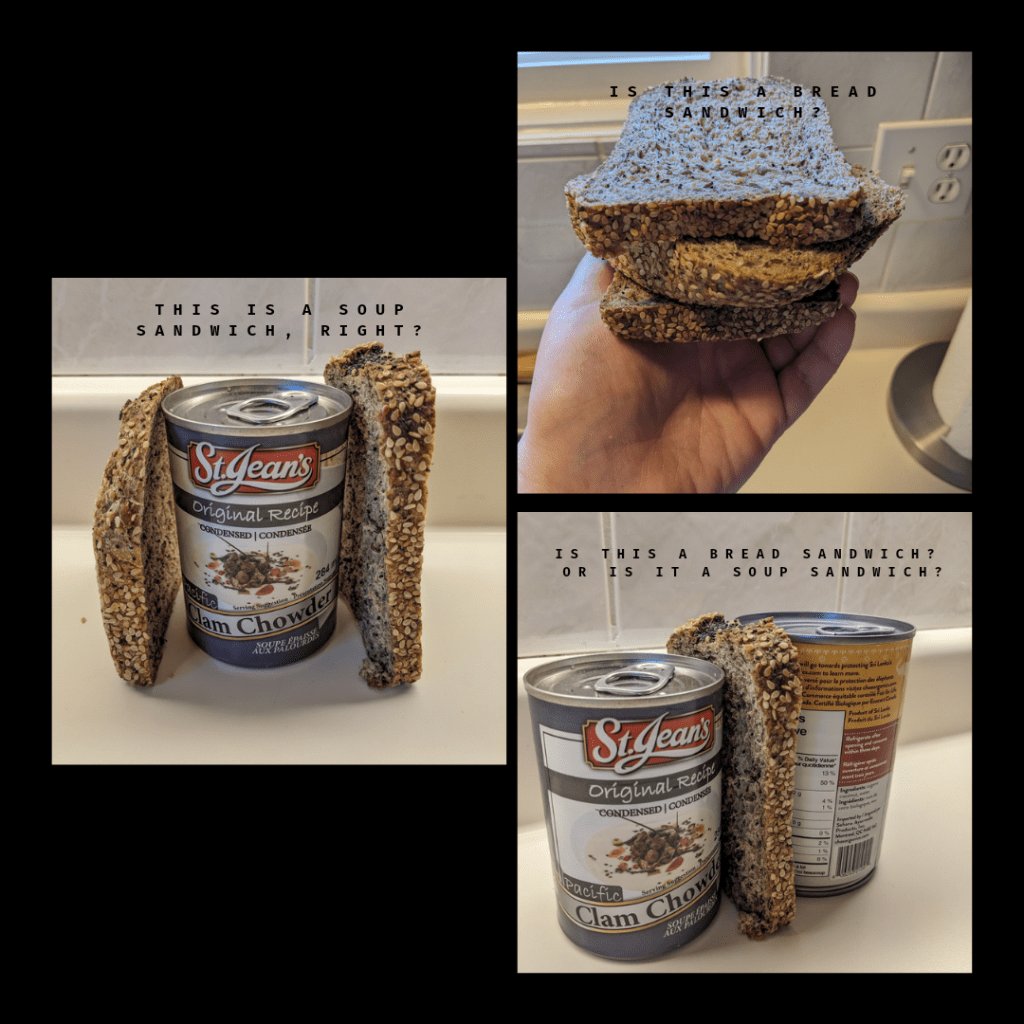
Sandwich. Noun. A type of food where there are two or more pieces of bread (or a split roll, or other starch) with filling in between. Eaten as a light meal. Alternatively, it can be two structural elements that secure a low-strength core. Lastly, it can be an open-faced sandwich when there is only one piece of bread or starch, and ingredients are placed on top of it.

Sandwich. Verb. To insert or enclose something between two other things, typically of a different material, quality, or character from the bit being enclosed or inserted.

Nope, this is not a post on my opinions regarding whether pizza is an open-faced sandwich or vice versa. Neither is it a deep dive into the myths and legends of where the term originated. I’m starting this post with a definition of “sandwich” so it can lend some professionalism to the rant that follows. I want it to descend into madness with a shred of credibility.

This post is about constructive feedback/criticism and the term “compliment sandwich.”

When was the last time you had a delicious sandwich loaded with ham, swiss cheese, fancy pickles or preserves, and greens, and called it a “rye sandwich” because it was on rye bread? In the same vein, if you told someone you were having a rye sandwich for lunch, they would likely assume you were trying to be clever and were drinking alcohol instead of eating.

So why on earth do we call it a “compliment sandwich” when the thing in the middle is something that needs to be worked on, and the outside “sandwiching” components are compliments? To make this feedback tactic reflect its name, we would need to offer up an issue, a compliment, and another issue. Alternately, we could call it an “issue sandwich”… But who wants the boss to come down and tell them they have an “issue sandwich” to deliver? Sounds ominous in the same way a “knuckle sandwich” sounds ominous to a kid on the playground.

Personally, I feel as though this tactic was introduced because of bad bosses. They didn’t communicate with their employees unless there was an issue, and that breeds all kinds of resentment.

A long time ago, I worked for a large corporate company. As an employee, I never heard a peep from head office or the regional directors unless they were unhappy with something. When I was promoted, there was a weekly call with corporate. They, without fail, offered a compliment, gave us something to work on, then ended with another compliment.

Know what’s worse than knowing you’re getting a weekly issue to work on? Knowing that your boss is obligated to come up with something you can be complimented on. Compliments don’t mean much if the person giving the compliment is required to think of something good you are doing in order to deliver something they want you to change.

In my current position, feedback is a near-daily experience. I don’t mind it (usually). We’re all trying to create the best version of our writing possible for the game. Extra eyes for things like spelling and grammar, the validation that others think lines are funny or particularly appropriate, and even the comments requesting changes are all welcome and appreciated.

When your higher-ups are not required to give you a compliment and you get one anyway, it feels genuine. It feels earned. Even if it’s just a comment that says “haha” or “lol” you know you got it because your writing was actually funny, not because they had to single it out in order to provide you with something else they didn’t like.

Effective feedback will give you a path to follow. “I don’t like the way this is written, can it be funnier?” or “I see where you’re going with this, but I don’t think it works in this context. Can I see some alternate ideas?” or even “This doesn’t sound as romantic as it should.” Point one! Ham up the punchline! Point two! Come up with a couple different ideas! Point three! Make it cheesier/more romantic!

The higher-ups here are clear with WHY they don’t like something. This may be shocking, but most employees are not psychic. The employees in this scenario are given direction and provide lines and work that is closer aligned with the collective vision for the submission.

Doesn’t this sound like a win-win? Something that would reduce time waste as employees and employers alike are clear on their path forward?

So throw out that grody compliment sandwich, make an effort to tell people when you like something, and always be open to talking something out!

Let me know if you have any favourite deliveries for criticism or feedback! I’d love to hear people’s preferences!

References

Inspiration, Creativity, and Writing Prompts

One of the things my new job has given me is an appreciation for the use of writing prompts. Don’t get me wrong, I utilized this tool when I was bored or wanted to do a writing exercise, but I had never considered it useful beyond that. Now I write for 7 hours a day (more or less), 5 days a week, and I have been gifted with the revelation of how writing prompts can be a weaponized tool against stale characters, stale scenes, and writer’s block.

We’ve all heard the advice of “just get something down,” in one iteration or another, right? Using brackets when you’re stuck [Hero does something clever], throwing the general idea down in all caps “I can’t believe you think I’m a child! I’m SOMETHING THAT’S NOT THAT, and it’s time you recognized it!”, highlighting a section, flagging it with comments, whatever, just keep going. Sound advice, right?

As one popular meme says, “Well yes, but actually no.”

Returning to where I’ve left off in a section can be like arriving in the bedroom to find my coffee pot. Why is it there? What was I doing? What were my intentions with it?

This is to say, I feel like returning to a section I’ve left off to insert content can be choppy and ultimately confusing for me and the reader.

So! Weaponizing writing prompts. Have you ever seen those “642 things to write about” books? I’ve had one since 2016 (ish) and I picked it up in the situations I mentioned in my opening paragraph. When I wanted to do a writing exercise or was bored. Admittedly, these things didn’t happen often, so roll forward to 2023, and maybe 50 have been filled in?

My plan was to write 1 full page, back and front, every day. Without fail. No matter what. I would not go in any set order, I would just flip through until I found one I thought I could do and then do the page. I’d flip through again, and select a second page, for a total of one, back and front equivalent, page.

May 31, 2023. I FINALLY got the thing completed.

I learned a few things from it. One, this necessity of having to do a set number of writing prompts really raised my productivity. Two, my willingness to push the traditional script boundaries has not only been more prevalent but has been met with more acceptance. Three, I feel as though my wit has become a little faster, a little sharper.

Most of the prompts were fun, and I challenged myself creatively to fill in the space provided with each exercise. There were definitely ones I kept passing again and again because I just had no ideas.

For interest’s sake, the two that remained until the last day, the ones that I found most challenging and least inspiring were “Find a passage in your favourite novel. Re-tell it, using only one-syllable words.” & “You are suddenly unable to recall any words that are not proper nouns. Excuse yourself from a very formal dinner party without drawing much attention to this fact.”

So, even though some days it was a slog to come up with something I thought was good, I can say I recommend this exercise. If you’re not the kind of person who wants to go out and buy a book, take one of your thousand blank journals, and grab some prompts from the internet. My personal favourite is whoever runs the writing prompt Tumblr (now apparently available on facebook?) I’ve left the URL in my reference section.

If you are at all extroverted, then I recommend taking it one step further. Go to an improv class. Having to come up with and actually articulate ideas on the fly with other people providing input is a bit scary, but trust me, by the end of it, you will be a faster brainstormer. You will feel less stigmatized about throwing out ideas which you feel may or not be good at. Let others build off of you, and in turn, build off them. Learn different ways to approach lines of logic by paying close attention to the other participants and how people react to their ideas.

It’s worth your time, I promise.

If nothing else, it will make you a little more brave, socially. If you’re anything like me, every little bit helps.

References

12 Books You HAVE to Read Before You Die!

Okay, okay. The title is clickbait. No one cares if you have read these twelve books, and nothing in your life will be harmed if you’ve never heard of these books. Except maybe April’s read – it depends on how many nerds you know and interact with.

So I don’t know about you, but I hated the time in high school when they would demand we read certain books. They said it was important. That the ideas in them were integral to our manifestation of self to think about. Be made aware about. Animal Farm, One Flew Over the Cucoo’s nest, the Catcher in the Rye, Life of Pi, and the Giver are the titles that stick out in my mind. And I’m going to add my thoughts as a grain of sand in an entire opinion beach full of other people’s grains of sand.

The Giver? I couldn’t tell you what that was about. I think it made me sad and frustrated at the end so I put it out of my head. “But Emma,” you might say. “The book was supposed to evoke feelings!” Okay, cool, but my child-self did NOT like sad books and as such I said “Thank u next” to whatever that lesson was.

Life of Pi? A child deals with the trauma a series of unfortunate events evokes by referring to everyone as animals and takes a really depressing sea voyage. Obviously that’s been paraphrased within an inch of its life, but you get the idea. A bunch of people thought it was an important enough story to make it into a movie, so that’s cool. I don’t know, I’m not sure what they were trying to teach us with this one. Maybe just deal with your trauma as much as you are able?

The Catcher in the Rye? I have no idea. Some kid skips school and wanders around and thinks about things. It’s supposed to be a ‘coming of age’ story. I can’t decide if the coming of age is just an outdated concept within the narrative, or if I didn’t get it because I’m a girl.

One Flew Over the Cucoo’s nest. This doesn’t even get a question mark at the end. Did it make me think? Yes. It made me think about how terribly we treat other people, how terribly we have treated other people, and how shitty it was to have any kind of “mental illness” in the past.

Animal Farm? This one I got. I thought that it should have been taught in social studies/humanities/history; whatever it’s called where you’re from. Where should it have gone in the curriculum? Right before you learned about the holocaust and all the terrible things that were done there. Or right before you learned about residential schools and all the terrible things that were done there. Or right before you learned about any other genocide! Cultural, racial, religious, I give 0 fucks which. Too many people have the “Well it wouldn’t happen here and now” mentality, but surprise! It’s happening right now! Giving a plain example of the small changes and slimy pitch tactics required from politics to completely change a country’s mentality will never stop being important.

Where was I going with this? Oh right. Sorry, I got on a little tangent there. Let me just get down off of my soapbox.

Books. You might be looking at the above and thinking to yourself “Well this girl hates reading if she has such a low opinion of those books.”

BUT JUST WAIT, THERE’S MORE!

I stumble upon lists with dramatic titles such as “100 books to read before you die” and “10 most popular books of 2023, how many have YOU read?” and “You can’t count yourself a lover of classics if you haven’t read these 50 titles!”.

Normally, I don’t really pay attention to these outrageous claims. I don’t really care what I ‘should’ and ‘should not have’ read and what I should have taken away from each experience. Do you want to make someone hate reading? Give them a huge list of titles that were written between 1800 and 1920. Tell them that if they don’t make it through the list, they can’t say they’re a reader. Boom. Resentment.

This year, I decided to take a look at the books that were currently being harped on as ‘must reads’ and you know what? I was pleasantly surprised. I think the last time I looked at similar lists was in 2008. Spoiler, back then 95% of all the titles were written by old white male Europeans. The other 5% was a white Englishwoman and like… 3 people of colour from Europe. This year? I saw a lot more diversity. It’s a good trend people, keep it up.

One more thing I should probably go over is that I’m white. I’m SO white. I have a Ukrainian background, but I was born and raised in Canada. My parents were born and raised in Canada. Half of my Grandparents were born and raised in Canada. My Great Grandparents were from Ukraine and surrounding areas. But I’m still white enough to make mayonnaise jealous and I’m not connected enough with my heritage to claim to be anything aside from Canadian. That DOES NOT MEAN I want to read a whole bunch of old white guy literature. It may be really good stylistically or thematically, but if you only ever get one sociopolitical, socioracial, or socioeconomic viewpoint, how is reading supposed to broaden your horizons?

Thank you for coming to my Ted Talk, hosted out here remotely on the hill I will die on.

So you’ve stuck with me to this point, I’ll deliver the goods. I picked 12 books that showed up repeatedly on ‘should read’ lists from multiple sources, and I assigned them all to a month of 2023.

MONTHTITLEAUTHORYEAR PUBLISHEDPAGE COUNT
JANUARYThe Count of Monte CristoAlexandre Dumas18461250
FEBRUARYFahrenheit 451Ray Bradbury1953250
MARCHThe Master and MargaritaMikhail Bulgakov1967430
APRILThe HobbitJ. R. R. Tolkien1937310
MAYMemoirs of a GeishaArthur Golden1997450
JUNEDon QuixoteMiguel de Cervantes16201100
JULYThe Time MachineH. G. Wells1895100
AUGUSTOne Hundred Years of SolitudeGabriel García Márquez1967410
SEPTEMBERMoby DickHerman Melville1851430
OCTOBERCirceMadeline Miller2018400
NOVEMBERJane EyreCharlotte Brontë1847540
DECEMBERPride and PrejudiceJane Austen1813430
2023 book a month reading list

Yes, there are still a lot of white men on this list. Yes, there are some titles on there that I personally feel I should have read by now. Take, for example, Pride and Prejudice. I’ve only had a copy sitting on my bookshelf for 10 years. Have not read it yet.

At the time of writing this, I somehow managed to make it through the Count of Monte Cristo in January. Fahrenheit 451 is in my hot little hands and things are looking good to be done in February. The Master and Margarita has a huge waitlist in my local library, so we’ll have to see if I manage to get it for March.

I’m simply not going to write a review about the Count of Monte Cristo in this blog. It’s not going to happen. The rest of them I’m hoping to cover in an alternating fashion with grammar advice and other writing tidbits.

Why does the Count of Monte Cristo get the boot? Honestly, I started to write one up, but it went all over the damn place. There’s so much that happens. To talk about any one particular part that’s not strictly structure, thematic timing, and/or literary style, you have to set up the whole damned plot. At the end of the day, you can go read a review for this book that covers the structure, timing, style, etc from someone much smarter than me, or who has a fancy degree from a nice university. Spark Notes or Wikipedia will provide you with the plot. Myself? If I know people who like Sherlock Holmes, I’ll tell them to read it. Otherwise, I probably will just wear my badge of honour for getting through 1250 pages in 3 weeks while working a full time job and also not becoming a hermit.

I’d love to hear other people’s reading lists for this year, or suggestions of things I should check out!

If you have the time or the brainpower, leave me a comment about it!

Did Not Many People Apply For This Or…?

A small window into anxiety and imposter syndrome

Well hi.

It’s been a hot minute.

Why might that be?

I got a job.

Well, another job.

That turned into my main job somehow.

And this, after five months of freelance and another three and a half months of full-time salary – STILL feels like I’m being punk’d. Okay, okay, bring out the cameras. I’m ready to face the fact that I have to go back and get a real-person grown-up job that crushes my soul. Anyone? Hello? Ground control to Major Tom? No? We’re still doing this? Perfect.

A quick look into how I got here and why the title.

Everything that I’ve read says that to get published in today’s market you need an agent, especially for the fantasy genre. To get an agent, you need to have prior published works. To get published works, you need to have a writing resume. To get a writing resume, you need to get things ~out there~ in the social sphere. Thus the Linked In connection, thus the Instagram connection, thus the blog, thus the whole bit.

So there’s me, trolling around with Linked In, trying to figure out how I can connect with pages and people that I can use to start exploring freelancing opportunities. What comes across my page instead? An advertisement for a job opportunity writing in the video game industry.

I looked at it and shrugged. You miss 100% of the shots you don’t take, right? Someone in pop culture said that right? Or maybe it was hockey? I’m Canadian so lets be real, it was probably hockey.

With what felt like a crayon in my hand (it was a keyboard) and a piece of construction paper (it was my computer) I scribbled (typed) my bid for why I, a gaming industry noob, should be considered to write speaking lines for video game characters. Chuckling under my breath at the sheer audacity I had found tucked in the deepest reaches of my soul, I clicked ‘send’.

I assumed that the HR department doing the hiring would likely have a bit of a laugh at my expense. I wondered if I could put the fact that I applied for it on my writing resume?

Then they called me.

An interview.

Another interview.

A job offer.

Continuing to write things with my crayon (keyboard), I submitted a script. They liked it. I submitted another one. They liked that too. At this point, they were paying me too much for it to be a joke, right? And if it was a trial, why would they have offered me full-time employment? I did more work. More submissions. They are saying they like my stuff and to provide evidence, it’s actually going into the game. It’s not sitting on some shelf for them to consider at a later time. (Well some of it is but that’s not the point I’m making.)

Let’s circle back to the subheading of this post.

First, for those of you who may be reading this and don’t know, Imposter Syndrome, as defined by the good ol’ Merriam-Webster dictionary, is the psychological condition where you have persistent doubts concerning your abilities or accomplishments accompanied by the fear of being exposed as a fraud, despite evidence of your ongoing success.

One thing that I would like to interject is that – I’m not afraid of being exposed, I feel like I’m already exposed and I’m just currently ‘the best they can do’.

So, like, did I get this job because no one else in the universe applied? Or I’m one of seven that applied with a fundamental grammar ability? Knows how to use spell check? Has pursued one or two extracurricular writing classes? Remembered to actually attach a writing sample?

Imposter Syndrome is bad enough as it is, but it often comes to people who are already suffering from some sort of anxiety problem. I’m not here to tell you you can or can’t have one, both, or multiple. What I am here to do is let you know the current mathematical and completely scientifical equation that is guiding my life right now is as follows:

SOCIAL ANXIETY + IMPOSTER SYNDROME = REPLACEABLE AT THE DROP OF A HAT

I really quite like this job, and I am already grieving for it. I haven’t even lost it yet! I’m waiting for them to receive an application from an actual writer and they’ll celebrate, throw a little party with some cake, and boot me.

Now, the logical thing to do here, would be to touch base with some of my coworkers and ask if there are any concerns that I can address, any areas that I can improve on, any work that I can do so my work better aligns with the vision of the company. I have already done this.

Poll to the room:

How many times can you ask someone if they still like you before the fact you’re asking them makes them not like you, whereas they would have continued to like you before you started to compulsively ask them if they liked you?

Asking for a friend.

References