Inspiration, Creativity, and Writing Prompts

One of the things my new job has given me is an appreciation for the use of writing prompts. Don’t get me wrong, I utilized this tool when I was bored or wanted to do a writing exercise, but I had never considered it useful beyond that. Now I write for 7 hours a day (more or less), 5 days a week, and I have been gifted with the revelation of how writing prompts can be a weaponized tool against stale characters, stale scenes, and writer’s block.

We’ve all heard the advice of “just get something down,” in one iteration or another, right? Using brackets when you’re stuck [Hero does something clever], throwing the general idea down in all caps “I can’t believe you think I’m a child! I’m SOMETHING THAT’S NOT THAT, and it’s time you recognized it!”, highlighting a section, flagging it with comments, whatever, just keep going. Sound advice, right?

As one popular meme says, “Well yes, but actually no.”

Returning to where I’ve left off in a section can be like arriving in the bedroom to find my coffee pot. Why is it there? What was I doing? What were my intentions with it?

This is to say, I feel like returning to a section I’ve left off to insert content can be choppy and ultimately confusing for me and the reader.

So! Weaponizing writing prompts. Have you ever seen those “642 things to write about” books? I’ve had one since 2016 (ish) and I picked it up in the situations I mentioned in my opening paragraph. When I wanted to do a writing exercise or was bored. Admittedly, these things didn’t happen often, so roll forward to 2023, and maybe 50 have been filled in?

My plan was to write 1 full page, back and front, every day. Without fail. No matter what. I would not go in any set order, I would just flip through until I found one I thought I could do and then do the page. I’d flip through again, and select a second page, for a total of one, back and front equivalent, page.

May 31, 2023. I FINALLY got the thing completed.

I learned a few things from it. One, this necessity of having to do a set number of writing prompts really raised my productivity. Two, my willingness to push the traditional script boundaries has not only been more prevalent but has been met with more acceptance. Three, I feel as though my wit has become a little faster, a little sharper.

Most of the prompts were fun, and I challenged myself creatively to fill in the space provided with each exercise. There were definitely ones I kept passing again and again because I just had no ideas.

For interest’s sake, the two that remained until the last day, the ones that I found most challenging and least inspiring were “Find a passage in your favourite novel. Re-tell it, using only one-syllable words.” & “You are suddenly unable to recall any words that are not proper nouns. Excuse yourself from a very formal dinner party without drawing much attention to this fact.”

So, even though some days it was a slog to come up with something I thought was good, I can say I recommend this exercise. If you’re not the kind of person who wants to go out and buy a book, take one of your thousand blank journals, and grab some prompts from the internet. My personal favourite is whoever runs the writing prompt Tumblr (now apparently available on facebook?) I’ve left the URL in my reference section.

If you are at all extroverted, then I recommend taking it one step further. Go to an improv class. Having to come up with and actually articulate ideas on the fly with other people providing input is a bit scary, but trust me, by the end of it, you will be a faster brainstormer. You will feel less stigmatized about throwing out ideas which you feel may or not be good at. Let others build off of you, and in turn, build off them. Learn different ways to approach lines of logic by paying close attention to the other participants and how people react to their ideas.

It’s worth your time, I promise.

If nothing else, it will make you a little more brave, socially. If you’re anything like me, every little bit helps.

References

I Before E Except After C is a Joke

Many a day, I review things I write, or things I say, and think to myself “I’m so glad English is my first language.” Not because of the inherent advantage it gives me, but because honestly? It’s a sheer disaster of a language. I would not want to learn it, especially if my foundational language was something nice and orderly.

Teachers try and make it easier on us. They try and come up with fun little sayings to help students learn how to spell.

How many of you spell ‘beautiful’ by mentally saying “Bee-e-a-utiful”? Or ‘nauseous’ by mentally breaking it up into “Na-use-o-us” (‘No use of us’ in a Scottish accent)? How about ‘amateur’ as “A-mate-u-r” (A mate you are)?

One of the ‘fun’ rules teachers LOVED to pound into me as a kid was “i before e, except after c,” which, did you know there’s a second part? I didn’t. It ends with “or when sounding like ‘a’ as in neighbour and weigh,” which… I suppose, shortens the list of words that don’t follow the rule.

I will not lie, I sat here sounding out words when I discovered that. Science. Psy- ANCE? Sigh-Ance? Sss-iiiiiii-ence??? Weird. Wee-rd. Forfeit. Fore-fit. For-feet? Nope. Still writing this post.

Was it Terry Pratchett that said English is 4 languages in a trenchcoat?

Thieves. We’re all a bunch of dirty word-thieves. Thieving words from every language we come across. Which is funny to me, because Old English is the root of the problem with the i before e exceptions, so not only are we thieves, but we can’t even get our OWN garbage together. Now we have words like guru. Kindergarten. Cafe. Glitch. Patio. Ketchup. How are we supposed to keep a straight face when teaching people how to grammar in this Frankenstein’s Monster of a language?

Statistically, the odds are about 3 to 1 that an i comes before an e.

Why can’t we just say that?

Any kid that knows the word ‘ballet’, or is learning how to spell ‘hors d’oeuvre’ already knows words are a disaster, it will NOT surprise anyone to hear “if you’re unsure, do ‘ie’ as it is statistically more probable.” Except, obviously, worded in a way small humans would appreciate.

Why maintain the lie “i before e, except after c” is a rule? It messes with people. I have had a lot of arguments with other adults both as one and before I was one about this.

It’s believed that spelling bees are only done in English. I mean, take German and Japanese for example. German, if you can sound it out, you can spell it. Japanese has 3 different writing systems. One, is for foreign words – typically phonetic as per their language rules. Another is the general writing system. The last is Kanji, the complicated pictorials similar to or taken from Chinese. These can be difficult, but it’s not a spelling thing, it’s a word association thing.

All this to say, please, can we stop making up “rules” for kids to learn? Especially if they have more than like… 5 native exceptions?

References

“That’s Neat”! “That’s Neat!” Or… “That’s Neat,”!

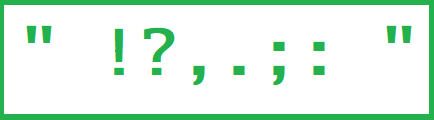
Do you know what grammatical duo are complete bullies? Quotation marks and punctuation. I hold this to be true because I feel like my editing journey can sometimes be entirely derailed by the gaslighting they provide. There are 6-ish rules for using them. There are 15-ish situations where you may have to stop and think about what you are doing and what the punctuation is saying. Here I’ll talk a little more about the ones that are most relevant to my day-to-day writing.

The first word in a direct quote should be capitalized, even when it doesn’t look like the punctuation suggests it should be. For example,

It was hardly a whisper, “Did you hear that?”

Except when you are splitting it up, of course, and are continuing a quotation already started earlier in the sentence.

“I was just thinking,” it was more to himself than her, “we’re not very well hidden.”

To boot, the above example also illustrates another point. When you are breaking up someone talking to interject additional information or context, induce a mental pause for people by slapping a comma at the end of the break. More clearly:

“Could you,” slowly the idea was coming to her, “reach behind that box,” her nod indicated which one she was talking about, “and get that board loose?”

Okay, okay, it’s not the most eloquent I’ve ever been, but it belabours the point and repetition is the key to remembering.

The comma continues to take the spotlight as we continue. When you have a direct reference to the person speaking, even if you think you want to use a full stop, it is not a full stop. It’s only a full stop after your preferred synonym for ‘said’.

“I think so,” he replied.

This comma rule *might* not apply if you are using the quotations for when the speaking character is quoting another character – quoteception, if you will. In this case, it’s entirely possible that there’s no punctuation at all until you are well away from whatever the quote within a quote is.

“Are you serious? There’s no ‘I think so’ about it! Yes or no!”

Now that I’ve spent an obnoxious amount of time talking about commas, let’s shift gears for a little bit. Let’s talk about more specialized punctuation, like question marks.

A question mark! Where do you put it? Always inside the quotation marks? Where all good punctuation gets tucked in? Not always.

If the speaker is asking specifically about a quote, then the question mark goes on the outside of the quote. So, what if you are questioning or seeking clarification about a question?

“Wasn’t it you that said ‘How bad could it be?’?”

Look how stupid that looks. I regret typing it with my own fingers. Luckily, that is not proper. Not the capitalization part, that’s proper, because ‘How bad could it be’ is a full and complete sentence by itself. If it was a fragmented thought or a partial quote, then it would NOT be capitalized. So, to accommodate the proper punctuation, it should have been:

“Wasn’t it you that said ‘How bad could it be’?”

The punctuation at the end, because it would legitimately be a double question mark, is just removed. If the quotation ends the speaking line, then typically, as a courtesy, you would end the quotation with the single quotation, leave a space, then end with the double quotation mark. Are you with me still? There are three things I want to talk about left, and I promise I’ll tie it up in a neat bow after.

“I can’t believe you’re blaming me! YOU’RE the one who suggested it! ‘It’ll be fun,’ you said!”

See that there? You thought we were done with commas, but they really are the star of the show here.

She adjusted herself as best she could against her bindings, and peered out through the slatted closet door. “Of course I said it would be fun! I was flirting with you! I was happy you seemed receptive!
“Besides. Don’t you think it’s kind of romantic to go somewhere scary? With someone you like, who offers to protect you from anything bad that might happen?” There was a chill to her tone.

When you’re splitting a person’s speech over a paragraph break, you leave the initial paragraph with open double quotations and begin the next paragraph with quotation marks again. This, as far as I can tell, is a simplified indicator to the reader that it is still the same person droning on. Like when you have them delivering an evil villain speech.

The last point is something I want to be careful about. Using quotation marks to indicate something’s name, or to indicate sarcasm. Too many times, people use quotation marks to emphasize things. Please never use quotation marks for emphasis. A great man said that. Weird Al Yankovic. If you go against those wise words, it makes people think there’s something wrong with the thing you are emphasizing.

“I can’t help it if my ‘friend’ hyped it up! She said it was popular! ‘Teen Scene’ ran a whole article on it,” his cries echoed loudly. Footsteps, heavy on the old wooden floors, started approaching.

When you read that, you didn’t think that the person who recommended this was *really* a friend, did you? ‘Friend’ being in quotations immediately implies sarcasm. Hopefully, I can hammer home my point with the following example:

If you put out a cup of bucatini (a long spaghetti-like pasta with a hole running all the way down the middle) in a cup, it would be perfectly acceptable to label it “straws” WITH quotation marks. Why? Well, they sure as hell AREN’T straws, but they’ll work like a straw!

The difference between single and double quotation marks is for reasons of clarity. Since things within the speaking line still need punctuation to indicate that it is a quote or emphasized within the line, using the single markings is common practice.

Now! Remember when I said I would tie it all up for you in a nice little bow? This whole thing makes a passage. It includes most instances of quotation marks and their associated punctuation frequently used in creative writing exercises.

It was hardly a whisper, “Did you hear that?”
“I was just thinking,” it was more to himself than her, “we’re not very well hidden.”
“Could you,” slowly the idea was coming to her, “reach behind that box,” her nod indicated which one she was talking about, “and get that board loose?”
“I think so,” he replied.
“Are you serious? There’s no ‘I think so’ about it! Yes or no!”
“Wasn’t it you that said ‘How bad could it be’?”
“I can’t believe you’re blaming me! YOU’RE the one who suggested it! ‘It’ll be fun,’ you said!”
She adjusted herself as best she could against her bindings, and peered out through the slatted closet door. “Of course I said it would be fun! I was flirting with you! I was happy you seemed receptive!
“Besides. Don’t you think it’s kind of romantic to go somewhere scary? With someone you like, who offers to protect you from anything bad that might happen?” There was a chill to her tone.
“I can’t help it if my ‘friend’ hyped it up! She said it was popular! ‘Teen Scene’ ran a whole article on it,” his cries echoed loudly. Footsteps, heavy on the old wooden floors, started approaching.

So tell me! Is something like this helpful? Do you have your own ways of remembering the many rules of punctuation and quotation mark bullies? If you have a clear way of explaining the dreaded colon and semi-colon, I’m looking forward to hearing it!

Resources

Make a “Top 5 Tracks” List

Jobs that pay by the word are common. In those cases, bust out your inner Victor Hugo or Kronk from the Emporer’s New Grove. “And here you have a moment of confirmation – the poison. The poison for Kuzco. The poison chosen especially to kill Kuzco. Kuzco’s poison. That poison?” Some companies pay 3 CENTS a word. THREE cents. If they’re going to be like that, pull out all the stops. Craft beautifully written, 12-line sentences.

I want to talk about one of my favourite editing techniques for when the word count does not influence your pay. The “Top 5 Tracks” technique.

By default, I am a fairly wordy writer. I write things out like I am talking to someone face to face. My punctuation tends to indicate where, in my mind, a speaking voice would pause. I’m sure my university professors loved receiving my essays that were NOT concise and NOT succinct.

Please take a moment of silence for the head writer in my department. She is likely one more instance of a comma splice away from throwing her whole computer at me.

So what is this editing technique that from the sounds of things, has nothing to do with punctuation?

Have you ever been speaking with someone and suddenly noticed they say ‘um’ or ‘like’ a lot? This technique is like calling yourself out for exactly that behaviour.

Pick five words that “weaken” your writing. Ones you know you are bad for. Here are mine:

WORD:WHY’S IT BAD:
ThatNine times out of ten, when I delete it, the sentence doesn’t change. At all.
Sort ofNine times out of ten, when I delete it, the sentence doesn’t change. At all.
JustNine times out of ten, when I delete it, the sentence doesn’t change. At all.
VeryNine times out of ten, when I delete it, the sentence doesn’t change. At all.
ReallyNine times out of ten, when I delete it, the sentence doesn’t change. At all.

Do you see where I’m coming from?

If we were to talk in person, I’m SURE a quarter of my vocabulary would be those five. (Not really, but it feels like it.)

Now, you may be thinking to yourself “yes. There are many words that water down sentences.”

I agree! A quick google search of “weak words” will show you hundreds of articles detailing which words you should or should not use, ways to catch yourself, things to replace, etc. I have a problem with absolutes, so I don’t like this. Case in point, many guides out there will tell you not to use adverbs ending in -ly. At all. Because it’s telling instead of showing. Okay, but sometimes it fits the tone! Sometimes I’m going for a tone! Or sometimes, the moment is not important enough for me to expect the reader to pick up on the subtleties of the context cues! For example, what if the maid gently excused herself? What if I just want to say that and move on, rather than describing her movements when she’s not an important character?

With that being said, this is where the Top 5 Tracks comes in. Review your writing. Read a few articles about weak words. I’m sure you will find one or two you KNOW you overuse. If you don’t, try using CTRL + F on something you’ve written recently, and start testing words. The results might SHOCK you.

The articles you may read during your research will outline anything from 4 to 600+ words experts and professionals caution not to use. Know what’s going to be impossible to remember? An arbitrary number of words you may or may not be in the habit of using. This is why you pick the biggest offenders.

Biggest offenders are going to fluctuate depending on genre and style, but should be fairly (Adverb ending in -ly, take that list!) stable for each individual. Pick five of the ones you have trouble with, and focus on those.

CTRL + F within your document for each of the 5 offenders and delete them, or judge them an exception.

“What? Don’t just delete them!?” No! Because look! There’s a “just” in that sentence, and if you deleted it, you’d lose your meaning! “Don’t delete them” implies that you keep them all! “Don’t just delete them” implies that there are additional steps to consider before the action is taken. I guess you could reword it. “What? Don’t delete them without consideration!?” Which I guess gets the point across, but all this to avoid the word ‘just’? Why?

Especially when the words you are using are common, you can’t wholesale delete things.

So.

Read a bunch of your work, pick your Top 5 Tracks, and happy editing!

References

English – Why Are You Like This?

Would you like to know what this post was supposed to be about? This post was supposed to do a bit of an outline on when to use spacing in your words versus when you should leave them together. I spent a little while brainstorming what kind of words I wanted to use as examples and I was all prepared to write them up and discuss if there was some hard and fast rule of when to use them together versus spaced out.

Instead, I found myself down this rabbit hole of word definitions.

Let me explain.

The words that my brain goblin really likes to second guess are things like into/in to, onto/on to, altogether/all together, ahold/a hold, setup/set up, onboard/on board, and nevermind/never mind.

So first. Things like in and on are usually prepositions. For those that need a reminder, a preposition is the part of a sentence that will explain where in relation to another thing the subject is. For example, Mary is on the bed. Mary is the subject, and ‘on’ dictates where she is in relation to the bed. If we change the preposition to ‘in’, that adjusts our understanding of where Mary is. In the first example, she exists on the bed as a whole. Once it is changed to ‘in’, this implies that she is likely under the covers as she is now inside the bed as a whole. Unless there was an unfortunate murder, it is safe to say that ‘in’ the bed would only be comfortable if you were in amongst the blanket parts.

Okay sweet. Now how about in to vs into? Well, into is also a preposition. Usually. If we stick with the example from the last paragraph, Mary can get into bed, just as she is in bed. This is just the difference between whether it is an action that you are talking about, or whether it is the location you are talking about. Can you bring the groceries into the house? Otherwise, if you want to know where the groceries are, they are in the car, because no one’s brought them inside yet.

I have two rules of thumb here because there are always exceptions to the rules of how you use these words and using the two of them together is ALMOST foolproof. (Except for English deciding that to shapeshift, or to undergo metamorphosis is to change into something else. That’s a rant for another day.)

Rule ONE: Is the space, concept, object, or state something you can abstractly or concretely put your subject in or access? Shock, kitchen, desk drawer, meditation. She went into shock. She went into the kitchen. She went into the desk drawer. She went into meditation.

Rule TWO: Can you put a comma between ‘in’ and ‘to’ and it still makes sense as proper English and doesn’t change the meaning? Shock, kitchen, desk drawer, meditation. She went in, to shock. To shock what? Not a sentence. She went in, to the kitchen. She went inside the house. She stood like a sim, aimless at the kitchen border, not entering, just staring. Okay, I’m sure someone somewhere used that as a real sentence, but hopefully, you’re picking up what I’m putting down? She went in, to the desk drawer. Again, she goes there and just stands, staring at the drawer. Maybe she doesn’t have a key. She went in, to meditation. This isn’t conjugated properly so is not a sentence.

Happily, everything I’ve said above applies to ‘onto’ vs ‘on to’ with the adjustment of instead of the subject being abstractly or concretely being able to be in or access, the subject can be placed abstractly or concretely on top of something.

This sadly does not carry over to altogether, all together, ahold, a hold, setup, set up, onboard, on board, nevermind, and never mind!

Before anyone says anything about these all being conjugated words versus prepositions, no. Up and on are prepositions.

So let’s take all together and altogether. Different words. Because sometimes language be like that. Altogether is an adverb. If you can replace it with ‘wholly’ or ‘completely’, you are using the right form. All together is an adverb, modified by a determiner. If you remove “all” and the sentence still more or less makes sense, then you’ve got it. If it no longer makes sense, perhaps you should be using ‘altogether’.

Example! Mary was altogether fed up with John’s behaviour. Mary was all together fed up with John’s behaviour. Mary was ‘completely’ fed up with John’s behaviour sounds okay, but Mary was together fed up with John’s behaviour doesn’t make much sense. The correct usage is then ‘Mary was altogether fed up with John’s behaviour.’

Example again! The group was excited to be altogether again. The group was excited to be all together again. The group was excited to be ‘completely’ again does not make sense, but the group was excited to be together again makes sense. The correct usage is then ‘The group was excited to be all together again.’

Are you still with me? This is turning out to be a long one. In an effort not to waste your time with filler and fluff, I’m heading right into talking about ‘setup and set up’.

Setup is the noun. Person place or thing. Set up is the verb. Action, occurrence, or state of being. You can be set up because you are the subject and the thing is happening to you. You can’t be setup. You are not a computer, and you do not need all your settings adjusted to function. A smart toaster that is voice-activated can be set up (placed upright on a surface) and requires setup (programming to toast your toast and recognize your voice). If you yourself are not this toaster, you can’t be both.

Now for another relatively straightforward one with a bonus hyphenated occurrence! Onboard has the corporate definition of training people and amalgamating them into a company’s structure and ideologies. On-board reflects the location of something within a vessel that travels over land, through the sea, or in the air. On board is the term for being present in the vessel whether it is moving or stationary at the time. If you are thinking you don’t see that much difference between the last two, the third example is when it is used as a preposition, and the second is when it is used as an adjective. I don’t have a trick for this one. I looked for a few days to see if the internet had anything better to say but came up empty. I’d love to hear from you if you have something that works for you!

I will start the next section with a little filler and fluff. This choice might have been made because there’s no point in pretending I’m perfect and just know all this stuff. Guess what I learned while I was researching my little trouble phrasings?

That I should not be using ‘nevermind’. Like, ever. Why? Because it currently belongs specifically to the turn of phrase ‘no nevermind’. Haven’t heard of it? No. Me neither. Apparently, if something is bothering you, someone may tell you to pay it ‘no nevermind’. I’ll let you draw your own conclusions on this one. I personally don’t know how I feel about it.

The last combo I had on my little list was ‘a hold’ vs ‘ahold’. I debated leaving it out because it’s a slippery slope between accepting ‘ahold’ as a word, and accepting ‘alot’ as a word which I am absolutely against.

In fact, please see exactly how I feel in the timeless Hyperbole and a Half blog.

http://hyperboleandahalf.blogspot.com/2010/04/alot-is-better-than-you-at-everything.html

Ahold is an informal word that has been recognized by dictionaries. You can use it in the context of grabbing ahold of something or getting ahold of someone. What I want you to notice is that in both cases, the ‘ahold’ is followed by an ‘of’. This is it. This is the whole trick. If the phrasing is ‘This television show has a hold on me’, you can’t replace ‘a hold’ with ‘ahold’, there is no ‘of’! Since ‘ahold’ is informal anyway, if you are ever unsure, err on the side of ‘a hold’!

So there you have it. Something that was supposed to take me a few hours this weekend to type up and get ready for you ended up taking much longer and now has me questioning everything English does. I hope you found this interesting or useful, and I would love to hear about the words that sometimes give you trouble, or if you have any tricks to share about the above!

REFERENCES

Did Not Many People Apply For This Or…?

A small window into anxiety and imposter syndrome

Well hi.

It’s been a hot minute.

Why might that be?

I got a job.

Well, another job.

That turned into my main job somehow.

And this, after five months of freelance and another three and a half months of full-time salary – STILL feels like I’m being punk’d. Okay, okay, bring out the cameras. I’m ready to face the fact that I have to go back and get a real-person grown-up job that crushes my soul. Anyone? Hello? Ground control to Major Tom? No? We’re still doing this? Perfect.

A quick look into how I got here and why the title.

Everything that I’ve read says that to get published in today’s market you need an agent, especially for the fantasy genre. To get an agent, you need to have prior published works. To get published works, you need to have a writing resume. To get a writing resume, you need to get things ~out there~ in the social sphere. Thus the Linked In connection, thus the Instagram connection, thus the blog, thus the whole bit.

So there’s me, trolling around with Linked In, trying to figure out how I can connect with pages and people that I can use to start exploring freelancing opportunities. What comes across my page instead? An advertisement for a job opportunity writing in the video game industry.

I looked at it and shrugged. You miss 100% of the shots you don’t take, right? Someone in pop culture said that right? Or maybe it was hockey? I’m Canadian so lets be real, it was probably hockey.

With what felt like a crayon in my hand (it was a keyboard) and a piece of construction paper (it was my computer) I scribbled (typed) my bid for why I, a gaming industry noob, should be considered to write speaking lines for video game characters. Chuckling under my breath at the sheer audacity I had found tucked in the deepest reaches of my soul, I clicked ‘send’.

I assumed that the HR department doing the hiring would likely have a bit of a laugh at my expense. I wondered if I could put the fact that I applied for it on my writing resume?

Then they called me.

An interview.

Another interview.

A job offer.

Continuing to write things with my crayon (keyboard), I submitted a script. They liked it. I submitted another one. They liked that too. At this point, they were paying me too much for it to be a joke, right? And if it was a trial, why would they have offered me full-time employment? I did more work. More submissions. They are saying they like my stuff and to provide evidence, it’s actually going into the game. It’s not sitting on some shelf for them to consider at a later time. (Well some of it is but that’s not the point I’m making.)

Let’s circle back to the subheading of this post.

First, for those of you who may be reading this and don’t know, Imposter Syndrome, as defined by the good ol’ Merriam-Webster dictionary, is the psychological condition where you have persistent doubts concerning your abilities or accomplishments accompanied by the fear of being exposed as a fraud, despite evidence of your ongoing success.

One thing that I would like to interject is that – I’m not afraid of being exposed, I feel like I’m already exposed and I’m just currently ‘the best they can do’.

So, like, did I get this job because no one else in the universe applied? Or I’m one of seven that applied with a fundamental grammar ability? Knows how to use spell check? Has pursued one or two extracurricular writing classes? Remembered to actually attach a writing sample?

Imposter Syndrome is bad enough as it is, but it often comes to people who are already suffering from some sort of anxiety problem. I’m not here to tell you you can or can’t have one, both, or multiple. What I am here to do is let you know the current mathematical and completely scientifical equation that is guiding my life right now is as follows:

SOCIAL ANXIETY + IMPOSTER SYNDROME = REPLACEABLE AT THE DROP OF A HAT

I really quite like this job, and I am already grieving for it. I haven’t even lost it yet! I’m waiting for them to receive an application from an actual writer and they’ll celebrate, throw a little party with some cake, and boot me.

Now, the logical thing to do here, would be to touch base with some of my coworkers and ask if there are any concerns that I can address, any areas that I can improve on, any work that I can do so my work better aligns with the vision of the company. I have already done this.

Poll to the room:

How many times can you ask someone if they still like you before the fact you’re asking them makes them not like you, whereas they would have continued to like you before you started to compulsively ask them if they liked you?

Asking for a friend.

References

Change Paragraphs Every Time You SPIT

Have you heard the “Tip Top” trick for knowing when to break paragraphs? Create new paragraphs each time you change – TIme, Place, TOpic, Person.

TIme – Make a new paragraph any time that you are skipping either forward or backward in time.

Place – Make a new paragraph any time that you are moving to a new place. If your piece was a film, this would be a transition. If your piece was a play, this would be a set change.

TOpic – Any new topics, ideas, or subjects need to have their time to shine and grab the reader’s attention. Do this by introducing them in their own paragraph.

Person – When you are writing in an omnipotent point of view and change focus to a different person change paragraphs. When a new person is speaking, new paragraph. When you are introducing a new character then guess what? New paragraph.

I have one I like a little better than that.

Change paragraphs every time you SPIT.

Or, for a catchier/morally questionable option –

SPLIT WHERE YOU SPIT.

S – Speaker

You HAVE to break paragraphs each time a new speaker takes the spotlight, or every time the speaker changes within a dialogue. I know this is a modern rule but it was implemented for clarity. Dante did not follow this rule. I never knew if he or Virgil were speaking in the Divine Comedy. I would punch Dante if I had that power. It’s hard to follow and in modern writings can stall the flow of the text.

P – Place

Please change a paragraph when the focus of your narrative moves to a different place. Place is not just geographical. It can also be emotional or a state of mind, if you care to debate philosophy. This point is nearly identical to the one in TIP TOP. If your piece was a film, a new paragraph would happen every time there was a scene transition. If your piece was a play, a new paragraph would happen every time you struck the stage. When I refer to the emotional place or state of mind, I have found that it can be helpful to really accent and emphasize that change or difference between the two states when you break.

I – Introduce

“Introduce” is kind of my cheater point. If you are introducing a speaker, a place, a state of mind etc you likely already have made the necessary paragraph breaks. Consider this though, I needed a vowel to make my acronym work.

Okay but on a more serious note, I wanted a catch all for introducing new ideas, new plot points, new non-speaking characters, and anything else that you would care to bring into your work in progress. “Introduce” is a fairly good way to emphasize that everything in your writing, if it is worth mentioning, is worth a proper introduction and should be relevant to your work. If you are struggling to give the element its own paragraph, consider if it is really necessary or if there is a way to acknowledge it in an alternate way.

T – Time

This point is the same as the one in TIP TOP. Any time you are moving either forwards or backwards in time, you should be creating a new paragraph. If nothing else, the new paragraph will force your reader to pause which can create enough mental space for you to ease your reader into the alternate time stream.

I used a couple of references to help me lay out the above thoughts.

I would love to hear thoughts on the above, or what other writers (regardless of genre) have found helpful in their paragraph splitting journeys!

My OTN -> One True Nemesis

Affect vs. Effect

So the hope in writing a post on my OTN super duper early in this website is twofold.

1) I will get a handle on it a bit more and maybe help others in the future.

2) If this website takes off my deep dark grammatical failure will be hidden away in the recesses of time.

Not to be dramatic though.

I have read a lot of descriptors about how to use affect and effect. I have heard all of the tips and tricks. A is for Action and that is Affect (a verb!). E is for End result and that is Effect (a noun!). I have put it in order so it spells RAVEN (Remember! Affect is a Verb! Effect is a Noun!) If it was as easy as that, then I wouldn’t be here, lamenting my inability to keep the two straight.

Affect

Let’s start with Affect. The Verb. A refresher on verbs? Merriam-Webster considers the essential meaning of a verb “a word that is usually one of the main parts of a sentence and that expresses an action, an occurrence, or a state of being.”

If you are impacting something, you are probably affecting it. If you act on something, you are affecting it. If you change something, you are affecting it. If you influence or improve something, you are affecting it. Now, just in case you are thinking “well of course this is all very straight forward” I have two more for you. If you have steady, unchanging, baseline emotions, you have flat affect. Another, in case you were still feeling confident. If you are pretentious, or you are pretending to be someone you’re not trying to impress other people, you affect that trait. You can affect an accent. I mean, please don’t. But you could.

If Thing A is doing something to PRODUCE a desired result, then it is affect.

Effect

The noun! Similarly to its precursor, I will start with the Merriam-Webster definition. “A word that is the name of something (such as a person, animal, place, thing, quality, idea, or action) and is typically used in a sentence as subject or object of a verb or as object of a preposition.” I personally find this one helps me less but in the interest of treating these words fairly I pursue.

If the subject experiences the thing, it is effect. If you can replace “effect” with the word “result” or “consequence” then you have used it right (for most applications). If you are effective, you are successful. This is the end result.

Examples? Sure.

“This will take effect tomorrow.”

“Despite how many he had downed, the beer seemed to have no effect.”

“Nurse April handed over the husband’s personal effects.”

Closing thoughts

I read that if there’s an “a”/”an”/”the” in front of the subject/object then that’s a pretty good way to determine that the correct word is effect. I haven’t tested this myself but it seems to check out so far.

Just because I am an Agent of Chaos I will give you a counterintuitive example. It is better to effect change than it is to affect change. To affect change means that you are impacting the change, which is pretty good. To effect change is to create and bring about change. That is a much stronger movement in most everyone’s opinion.

Because affect and effect are my OTN, this post was hard to write. Even though I spent a week reading articles on the difference. This is a call to all Grammar Nazis. Please comment if you see something in this post that represents affect and effect poorly (besides my attitude). I’d love the opportunity to reign victorious over my nemesis!

Primary Sources:

Book Review – January 23rd

The Starless Sea – Erin Morgenstern

Rating: 5 out of 5.

So I feel tricked by this book. It was a gift from a good friend of mine.

“Here” she said. “I think you’ll like this book.” she said.

I began to read. It was beautiful. It was like meeting an incredibly attractive stranger at a fancy party you snuck into. Here is a whiff of their perfume/cologne. There you hear them laugh softly somewhere in a crowd of people. You can feel a brush of their fabric against your skin as again you just miss them. Their name, you must have their name!

Instead you find a scrap of paper. On it, there are three numbers. Could it possibly be a phone number? Or maybe a time. You know it’s important, but right now you don’t know just how.

You keep following the story, desperately drinking the magnificent word choices and the startlingly consistent tenses of the passages. Deeper it draws you in. You feel cradled.

The exploration of character was not a forward theme of this novel and yet by the end you feel as though you know each intimately. Like you share something private with them. Each piece of the split plot falls into place and the feeling of pride when you stand back and look at the whole thing is true. This is one of the most beautiful journeys that I have been on in a long time and my hat is off to the author for bringing this art into a readable format.

Heads up I did get to about here and started screaming – “IT HAS 30 PAGES TO REDEEM ITSELF!”
It did but please know in advance that it’s coming.

The Beginning of a Blog

My Mom’s favourite story is that I wanted to be an author before I could write. Apparently I would bring her a marker/crayon/whatever and a piece of paper and say “Mummy write?” and I would give her some really well thought out and grammatically sound babble to write for me.

My favourite story is not that.

Why?

At this point in my life, it’s connected really haphazardly to the rest of my writing journey. Took a few creative writing classes in grade school. Then a few literary classes to fill my options in university. Tried to get published with my first complete manuscript and have the rejection letters to prove that I truly did give it a shot.

Fast forward almost ten years. I considered freelance. I looked up the process of self-publishing. I took some more courses, one about editing. Another about plot and creating a “good” story. A third about content marketing and how to sell yourself. What was one of the things that kept coming up?

Write a blog.

Now, my first reaction to writing a blog is “No, I like to read books. I like to look at books and touch them and feel them and fold their pages and get a little high off the smell of the ink and paper breaking down in old bookshops. A BLOG!? ME!? No. Yuck.

Books in the Sherlock Holmes Museum, Baker St. London, England

Firstly, I am not that funny. Or personable. Someone who has the social skills of a paperclip should not be running a blog. Second, what the heck am I going to write about aside from the things that I am doing in an attempt to get myself published? That isn’t going to fill the website with relatable and shareable content that I can be proud of.

The more I thought about it the more I realized that my anti-blog stance was really a fear of rejection. Getting rejected by a publishing company was one single big rejection and any writer proud of their work can site things like “Harry Potter was rejected by 12 publishers! Dr. Seuss was rejected 27 times! I’m only on rejection 8!”

A blog and freelance work though? That’s a handful of little daily rejections and I wasn’t ready to face that.

Well, it’s 2022 and everyone is tired. I myself have become so tired that any reservations I had about “What if the iNtErNeT doesn’t like me!?” have died with the last of my patience for this pandemic.

So Hello World – let’s give this a shot.