Murder and a Skeleton Crew

This post is about a lot of things. About the Bechdel Test, about killing your darlings, about disposable characters, about fridging a character’s partner, about running your story on a skeleton crew, and about how to navigate a cast of characters in a way that is optimal for the reader.

Let’s start with some definitions.

The Bechdel Test is a pop-culture guide designed to determine if a piece of writing or media has “significant” female characters or appropriate female representation. I’m neither here nor there on the applicability of this line of reasoning, but I understand the motivation behind it. For those of you who don’t know what the test questions are, they are as follows:

  • A piece of media or writing must FEATURE two female characters.
  • These two female characters must have at least one conversation with each other.
  • The conversation MUST NOT be about a man. (interpret: must not be about love interest)

Take from this what you will, but I want to highlight the fact that if you have added a girl best friend that exists solely for your other vanity character to talk about love with… maybe don’t. Maybe employ an internal monologue. A diary entry. A fight between the main character and said love interest. When a female character is added for what feels like the sole purpose of talking about another character… it’s sloppy. Find a different way.

Killing Your Darlings is a piece of writing advice where even though you LIKE having an element in the story, if it’s not adding to the story, take it out. Things that fall under this category are subplots, romantic partners, background characters, certain settings, or flowery descriptions. Ever read a “love triangle” where it’s really 2 characters that are into one another and then one sad sop you feel bad for because they are super in love with one of the other two and can’t catch a break or be included in anything plot-relevant? Take a GOOD. HARD. LOOK. Is this love triangle actually making your story better/more effective? Or do you just like it? Do you have a chapter where you explain a really cool magic tree, and you’re so proud of it, but it does nothing for the wider story? Maybe time to chop it down.

Kill your darlings, kill your darlings, even when it breaks your egocentric little scribbler’s heart, kill your darlings.

Stephen King’s On Writing: A Memoir of the Craft

Disposable Characters fall into the category of “Killing Your Darlings” as well, but it is specifically about people you have written or created JUST to have them die and cause emotional levity in the story. Now, I’m not saying you should never kill your characters – but often if an author knows in advance a character isn’t going to make it through the whole story, that character isn’t as fleshed out as the rest of the cast and it’s really obvious.

Going hand in hand with Disposable Characters is the term “Fridging your Wives” which is a personal favourite of mine. I didn’t know the origin of the phrase until I was pulling articles/fact-checking myself for this post. If you’re curious, it’s from Green Lantern: A New Dawn when the antagonist shoves the dead body of the superhero’s love interest into a fridge for the hero to then discover later. It was to do emotional damage and propel the plot. The term “Fridge your Wife” now refers to when a character’s significant other is killed, hurt, maimed, assaulted, or otherwise traumatized to motivate another character. The issue with this is we’re not treating characters as people. We’re treating the person SOLELY as a plot device. It’s a lot of work to create a character simply simply to sacrifice them to get the hero off their butt. Think bigger. Think better.

The last definition before I talk about my point is Skeleton Crew. To keep it short and sweet, a Skeleton Crew is the minimum quantity of individuals required to successfully maintain an item or corporation.

So. The point of murder and skeleton crews is this: As writers, we are in charge of populating worlds and making them feel real. Lived in. Working. But this ultimately can bog down the progress of your story and confuse the reader. It’s exactly the same as writing dialogue. Real dialogue is filled with meandering, “um” and “wha-yeah-huh”s. But we don’t include that in novels. We want it to be clear and purposeful when a character speaks, while still maintaining that fascimile of reality. How many characters do you really need?

How many of you have read a fantasy novel where it felt damn near impossible to keep track of the characters because their names were unique in that fantasy-name kind of way? Or did you need to continually reference a list in the front of the book as to who was in which role? Or even worse, have you ever stopped reading and had to flip back a couple chapters because you have two characters mixed up?

All of these are symptoms of the same thing. Either the characters are so plentiful that you legitimately can’t keep track of who is who, or the characters are too similar to one another (or just don’t have a clear enough voice!).

Kill your darlings. Make a list of all the characters you make specific mention of in your work in progress. Divide them out into characters that are actually necessary, and characters that support the others. Find the fridged partners and the disposable characters, and try to figure out if there is a non-human way of motivating your protagonist or plot. If you can’t, that’s okay too, but think about it.

Something we did in theatre, was if there were not enough “background” actors to fill up the lines, we would just reassign lines to the background actors. The baker had the shopkeep’s lines, or the blacksmith became the general store so he could reference the price of apples. Townswoman 1 through 4 could be cut to two without it harming the clarity of the scene.

So look at your support character list again. How much of the information they provide to the protagonist can be delivered by someone else? How many of these roles can be combined to clean up this list – not only for yourself, but for your reader?

Now, obviously, if you have a sprawling space epic where your characters are going to multiple planets every chapter and are meeting with representatives from each of those planets, there’s no sensible way to combine roles. The places I’m asking you to target are the faces in the crowd, the people you have in your world that are just there to make it bigger.

In the space epic example, target the crew. How many crew members does the main character talk to and the audience are expected to keep track of and remember? Do we have to name your crewmembers and give them a backstory for them to show up on page and deliver bad news about the functioning of the ship? Or can the holoscreen flicker to life, the engineer sweating bullets as she tells the captain that the slipdrive is drifting and there’s nothing she can do? Can you decrease the size of the ship? Or is it important for it to feel busy and populated because you’re implying the military ship is heavily manned?

Does your story take place in a school? Can the school be smaller? How many professors do you need to actually make it operate? How many students would viably be accepted into the school at the same time? How much of this can you imply without directly mentioning and forcing the reader to keep track of your complicated roster?

Think about it, and take some names off your support character list, even if you like that character. Take some settings away if the same goal can be achieved by staying put. Take that cute subplot away that you worked on for a month, even though you love it. Kill your darlings. Strip your WIP back to a skeleton crew and press forward. Your story will be cleaner, easier to keep track of, and ultimately, the reader will thank you.

Everything you remove, put it in a file. Post it to your fanpages or your blog. Fans will find it if they want it. They’ll be delighted to see it exists, without the pressure of it being forced into the story.

References

Inside Out or Outside In?

The class I’m taking on writing for video games recently raised a point I can’t stop thinking about. To put it plainly, the point was whether it’s better/easier to create a character from the inside out, or the outside in.

For context, when you are writing for a video game character you are often a cog in the wheel of production. Even as a head writer, you may not have any say in what a character looks like. You may not have a say in the way they are programmed to walk, to move, when they speak, or how much they can say. It is up to you to take every piece decided by the narrative director, the programmers, the artists, and the other writers and make a GOOD character out of it.

This is why looking from the outside in may be more beneficial.

It’s irritating to play a video game where the player character or the NPC don’t seem to jive with the surroundings. Their entire family was murdered by assassins, but they hire assassins on a regular basis? That’s a little sus. Oppressed by the local monarchy but is seen cheering earnestly in the crowd when royalty drives by? Hmm. They have a limp but it’s never addressed, it’s just an empty character trait? Boo. The character’s backstory says they were a lazy orphan, but yet they talk about their fond memories of lavish parties because it suits their archetype? Frustrating, and usually the catalyst for me putting down the game and doing a quick internet search because… did I make that up in my head? Or is it a narrative error? Either way, I’ve PUT THE GAME DOWN and have gone to do something else. Not the reaction a game designer wants.

So how could this apply to writing?

Not everyone just sits down to write a story and has the perfect character walk into their brain immediately. Not everyone gets to start with a character at all! In one of my most recent works, I had “NAME1” as a placeholder for 80 pages before I figured out who the late-stage character was.

Sometimes you have to start with the story you want to tell and build the character from all the bits and pieces you find along the worldbuilding way. Is medicine difficult, expensive, and risky? Maybe this gives your character a glass eye and a whole bucket of resentment that fuels their desire to overthrow the government with a secret society. Is education restricted to one gender of one social status? Maybe your character is neither of those and it made them start a study ring when they were younger. Maybe this leads to a core personality trait of being a patient teacher.

Planning a book, a short story, a game, or other media doesn’t always go as planned. It doesn’t always go in order. Being able to consciously flip your character design from internal to external could be a valuable way to unstick your writing process.

It could also make you realize something about your character that would cause some readers to be pulled out of their immersion.

This means there’s the potential for rewrites but it’ll be worth it. Having characters that feel real, in a world that feels real, relating to each other in a believable way, is SO valuable. Trying to put a bandaid on a plot hole or misalignment of character to their environment is very noticeable to the reader. Even more so than not addressing it at all.

I’m sure you could tell me many instances of a hastily-thrown-in paragraph or page explaining something that otherwise doesn’t matter at that point. Or matters to the reader but not to the character. Fourth Wing and Violet’s early habit of spewing history facts while trying to calm herself down in a dangerous situation comes to mind. It’s a lazy way to deliver exposition. How many people do you know that can rattle off a concise history of their school while people are trying to harm them?

I can’t even remember my name under pressure.

There also haven’t been many events in my life where I just lore drop because I think the people I’m talking to might need context. Can you imagine how weird it would be if everyone justified their thoughts with an immediate context comment? That’s not how conversation works. And when someone forces the pattern, you notice. For example, I had the following conversation with a landlord and it was jarring.

It went like this:

“There’ll be a dog coming for the weekend, we’re pet-sitting. Is that okay?” – Landlord

“May I ask what kind of dog? Big dogs make me really nervous.” – Me

“Oh, they’re little. Kickable size. Are you afraid of dogs because you were attacked by one?” – Landlord

First note, this is not in reference to the cute white dog I’ve previously posted about. Second note, I do not condone someone referring to a dog’s size as “kickable”. Third note, that comment made me uncomfortable. I now had the option to talk about why I was nervous about big dogs (spoiler, I was NOT attacked by a dog) or I could abruptly cut the conversation off.

Which can narratively serve a purpose, but certainly doesn’t feel natural. Another example would be a conversation recently had with a neighbour.

This is the FIRST time I was in a conversation with her and the second time I had ever met her. She talked about how she never cooks anymore. How her family doesn’t come and visit as much as she’d like. How she can hear the neighbour above her burp and fart and walk, and what he does with his girlfriend. How she wanted to insulate her ceiling. How one of her sons was going to open a shop now that he’d graduated from university. How she knows someone on the strata council. She showed me her house. She pointed out all the parts about it she thought were stupid. She gave me a cabbage and half a bottle of oil from her fridge.

Affectionally, she is now the crazy neighbour lady.

It was a non-standard interaction. It felt weird in real life, and it feels weird when you’re forced to read it.

So. Coming back around to my point. Write your characters from the inside out. Then write them again from the outside in. Make your characters bloom naturally within your book. Make your characters make sense in your world. Make your readers consider your characters well-built, and NOT the crazy lady next door.

Spellcheck and AI

For those of you who don’t know, I get paid for writing. I know I’m lucky and I wouldn’t change what I do or the company I work for. Even when people tell me AI is coming for my job and how programs like chatGPT will make me irrelevant in my field.

Now, maybe you’re intimately familiar with AI programs. Maybe you’re laughing to yourself about how the technology is promising but it’s far from being able to replace writers in long-form content. Or maybe you’re biting your nails because you’re the kind of person who knows very little about AI writing programs and it seems like they WILL take our jobs from us.

Either way, for laughs or reassurance, please allow me to tell you about a very frustrating thing that AI is fully capable of, but doesn’t do.

Spelling and grammar checks.

When I was growing up, we were assured computers were only as good as the information we put in them. It seemed kind of like casting a spell because you had to be really specific, you had to give it all the raw data or ingredients for what you wanted, and you needed to make sure it had the capabilities to actually process/think/calculate the thing you wanted it to do.

In today’s day and age, EVERYTHING is online. Including dictionaries. Including encyclopedias. Including translation rules. Including grammar. Including very detailed timelines of the evolution and modifications of the English language.

SO WHY THE HECK CAN’T AI SUCCESSFULLY CHECK MY SPELLING FOR ME!?

I have Grammarly installed, which is great for spelling and basic grammar. I write my drafts in Google Documents, which has spellcheck built in.

The other day, I submitted a draft and the word “accidently” got through Google’s spell check. (I believe they use Oxford but I have my suspicions.) When it got flagged by a coworker I panicked, thinking I had submitted the draft without doing my regular check. Pulling the original up, I re-ran it through the spellcheck and…

nothing

Nothing? Why wasn’t it at least flagging the “accidently” I KNEW was there?

Well, turns out “accidently” is defined by Merriam-Webster! It’s in the dictionary! MW, how could you do this to me!? Hopped into the Oxford Dictionary, and it was there too! Just to be thorough, I jumped into the Cambridge Dictionary, but it was completely absent! Same with dictionary.com. This, of course, sent me down a rabbit hole of searches.

What is the difference between “accidently” and “accidentally”? Where has “accidently” been used before? Why, when you google “accidently” vs “accidentally” does it not give you the concrete information that it’s incorrect?

Essentially, it has cropped up enough times in enough publications that “accidently” has now been defined and added to dictionaries.

Out of curiosity, I also searched for “nevermind”, which is one of my personal pet peeves. Oxford? It’s in there. And NOT JUST for the singular usage of “pay it no nevermind”. Merriam-Webster? No entry. Cambridge? Also no entry. The last one I checked was dictionary.com and to my delight, it was in there as JUST for the use of “pay them no nevermind.”

So, what I’m proposing is teaching AI English. All English. Every English. It’s a HARD language to learn, and honestly, that’s where I want AI’s powers of logic to go. Not into creating a procedural story with WAY too many keywords. Play around with an AI pickup line generator sometime! It’s a lot of fun, and the lines you get are SO STRANGE. Like, it takes all the information you give it, but it doesn’t understand how an actual human brain would take that information and put it together in a way that makes sense. No one would swoon over those lines.

This is fine. Styles are different across all writers. Why are we trying to make AI replicate THAT when it would be a million times more useful to make it tell us when we’ve used a word that’s only technically in the dictionary because SO MANY PEOPLE mess it up?

I’d love to set my location to “Canada” and have it ACTUALLY tell me how things are spelled in Canada. We have this gross soup of British English, American English, and French Canadian spellings, and it’s ROUGH to navigate! Especially when my location is set to Canada, but my work needs to be submitted in American English, preferably only using words that are in circulation as of this century. Can I please set my location to “Portland, OR” and have it prompt me to correct spellings and remove all my extra Canadian letters?

So here we are. This is where I think AI should be utilized. Please help everyone like a strict teacher, instead of like that weird kid who you pay to do your homework and only get a C.

References

Strategic People Watching and Stealing Everything That Isn’t Nailed Down

Okay maybe the title of this is a little dramatic, but I’m sure you’ve heard the joke that if you date a writer, you’re gonna end up in a book. Or that if you’re a Game Master for a tabletop RPG, you steal everything that isn’t nailed down. When I first heard this, I was in grade school and thought to myself: “The author isn’t doing a very good job if the person can recognize themselves as a character in someone’s book…”

Ah, young self. You missed the point completely.

If I had been an artist, I would have been one of those horrible people who thought copying/tracing as an exercise or as practice is against the law or something.

So let’s talk a little bit about people watching and stealing things. Ideas. Concepts. Characters.

Are you looking at your screen in disgust? Hear me out. How many of the most popular books right now are retellings of fairytales? How many websites out there host fanfiction from well-known series such as Harry Potter, Hunger Games, Twilight, etc? How many times are there “waves” of books of one central trope that become really popular? How many authors see these tropes and it inspires them to write their own take on something?

Hopefully you’re still reading after that explanation.

Characters and stories are MEANT to be inspiring. They’re meant to stick in your imagination, make you think about their wider world, long to know them, long to explore different scenarios with the same base framework.

So where does watching people strategically fit into this?

As part of creating a character, you should know their likes and dislikes. As part of that, you should know where they like to hang out. If that is a real place, and a safe place, go there! Don’t just assume you know what kind of atmosphere a place has or what kind of people hang out there from TV and other books.

Is your character a gym buff? Join a gym. Hang out on the bikes or walk on a treadmill. Put in your headphones but don’t turn on any music. What do you see? What do you feel? What do you hear? What do you notice?

Is your character a regular at a bar? Find one that’s similar to the one you’d see your character at (if it’s safe to do so) and order yourself a drink and sit at a booth with a notepad! Copy down snippets of conversations. Sketch the lighting. Review the menu. Freak the staff out! But not in a creepy way, in a you-might-be-a-food/bar/beer-critic kind of way.

Does your character go to the park to think things out? Go to the park (if it’s safe to do so) and find a place you can imagine them sitting. Are there a bunch of bugs there? Does it smell like pine? Are there dogs barking? Would that annoy your character?

These little observations make the reader feel. Feel like these are places they have been to or could go to. Like your characters and story exist within a realm of near-possibility.

So strategically people watch. Steal everything that isn’t nailed down.

It’s an age-old tactic! How many legends and stories do you know that are similar to one another, with one or two details changed? Things such as names, local landmarks, or the result of such a story?

I mean, Joseph Campbell didn’t make all that money explaining a Monomyth for nothing!

So, I’d love to know… what are some of your favourite retellings of fairytales or other legends?

What’s in a Holiday?

Whether you are writing something that takes place in our world or a world you’ve made up yourself, likely you’ll at least be mentioning some kind of holiday. Maybe it’s a feast day, a civic holiday, a festival, or a ceremony to honour the dead. Maybe you’re expected to spend it with your family, with your friends, or with your neighbours. Is there food involved? Do you bring some with you, or are you expected to fast? There are so many facets to holidays that I think it’s always worth thinking about the little pieces that go into making up a holiday, and how you can utilize real-word knowledge to build believable celebrations for your own story.

Anyone can make a holiday – but how do you get yours observed?

Who has heard of National Talk Like a Pirate Day? How about National Love Your Pet Day? Now what about Valentine’s Day? And Easter? These are all called holidays, but they all have different functions. Easter, you may get offices and city workers getting one or two days off to observe Good Friday and Easter Monday. Valentine’s Day, people know when it is, it is widely recognized, but it is typically not taken off work (unless you have big plans). National Talk Like a Pirate Day is more obscure. Most people don’t know when it is, why it came about, or what exactly you’re supposed to do to celebrate it.

You can actually register a day as a national holiday of your choosing, but it means next to nothing without widespread knowledge about what the day is for, what you are supposed to do with it, and when it is.

Here in Canada, we recently phased in a new holiday. National Day for Truth and Reconciliation.

What is it for? To increase awareness of the First Nations children who did not return home from residential schools, and the ongoing and very real impact residential schools had on families. In Canada, the Gordon’s Indian Residential School remained open until 1996. I was 5 years old. This is not ancient history.

What are you supposed to do on this day? Well hopefully, you’ll attend some First Nations run events. Speeches. Reconciliation Ceremonies. Performances. Or maybe just look up an article about the history of abuses around you.

When is it? September 30th.

It took the Canadian government 2 years to phase in this holiday. Phase one was announcing the day as approved by the government giving the civil servants that day off, and encouraging events and demonstrations linked with the Every Child Matters movement. Phase two was to roll out the holiday as a civic holiday for salaried employees. It is now celebrated every year.

So. If you are making a holiday for your story, consider whether the government would approve it to be a civic holiday. If not, would there be any exceptions to that? How about backlash? Would the citizens work around this judgement, carrying out their celebrations in the evening when everyone had finished their daily duties? Or would they take it upon themselves to call in sick and celebrate anyway? In a capitalist and consumerist hell such as the one we currently live in, would they need to use their vacation to get the time off? Would this cause upset and dishonesty?

I’m not saying you should know the answers to all this. I’m just saying you should think about how a character REALLY FEELS about the holiday you mention, the holiday you create on a whim as an excuse to have a cool festival or a day off work. Holidays impact people’s emotions and mentalities regardless of who they are in the great machine that is society.

Why do we Celebrate the Days we do?

Do you live in a religious country? How many of your religious holidays are civic holidays? In Canada, there are two. Easter and Christmas. You still have to go to work and/or school on things like Ascension Day. What pushes a country to observe some religious holidays but not others? Why is it only Christian denomination holidays that are considered for civic holiday status here?

Well, Canada is (as of the 2021 census) 52% Christian or similar. That’s not a big majority, but it is still the largest of any singular other group. Besides. Those that don’t care about Easter (such as myself) can plug themselves into video games and thank the unrelated religious views for the extra day off.

At the end of the day, I can choose not to celebrate the holidays I don’t have any attachment to because our holidays are very centred around the family. Family events. Family dinners. Sure, some community events happen too, but there are rarely any social consequences for not appearing at gatherings. Not on a large scale anyway.

But what would happen if that wasn’t the case? What if it was a mandatory religious observation? What if they took attendance? What if there were very real and very severe consequences to skipping a holiday’s traditional activities?

Things to Consider When Making a Fake Holiday

What is the basis of the holiday? Is it purely a political observation? A religious observation? A seasonal festival? Something to do with your ancestors? The fertility of the land or people? Is celebration or observation restricted to a certain gender, race, religion, occupation, or class?

Is the holiday still celebrated in the spirit of the reason it was created? Are some of the older generations going to feel one way about the festival or holiday while the children feel another? Are there protests against it? Are there conflicting views about how to celebrate it? Does it cause a societal divide if certain characters are seen observing certain rituals or superstitions?

Does it matter to your character? Are they expected to be a part of it by their family or their peers? Would they prefer to stay at home and read or play video games while the world celebrates without them? Do they want to avoid certain people so they don’t have to explain for the millionth time why they’re not celebrating? Is it inconvenient because their favorite stores or attractions are closed?

Of course, the reader doesn’t need to explicitly know any of this. You don’t have to give them a background on the last 100 years of celebrations and a graph showing attendance. What it WILL do, is build up the environmental storytelling when your character navigates through the day, making comments that imply a world that lives on past the reader’s experience.

After all, you want to build a full world that the reader is eager to explore through the character, or you create a character that the reader is eager to explore through the story. And if you can manage both, you’ll be golden! These are the two most successful ways to retain a reader, and if your world lacks the depth created by social and societal interactions, that severely limits your avenues of interest.

References

Have You Heard the 2023 Word of the Year?

Rizz: Pertaining to someone’s ability to attract another person through style, charm, or attractiveness, this term is from the middle part of the word ‘charisma’, which is an unusual word formation pattern.

Oxford University Press

Okay. You know what? I’m not mad. There were a lot of contenders for the word of the year I would have been far more upset with. For example “Swiftie” was in the running. I don’t think that counts. It’s a nickname. Just like “Belieber” or “Blockheads”.

And I will never NOT be big mad that the 2015 word of the year was an EMOJI.

But rizz? It’s fun for a couple of reasons. First, it’s one of the few words where the shortened form is taken from the middle of the bigger word. The examples that Oxford University Press gives are “fridge” from the word “refrigerator” and the word “flu” from “influenza”.

The second reason I think it’s fun is that it’s similar to other slang words from the 1920’s or thereabouts. Razzmatazz was documented in and around 1917 and meant showy, or sparkle, or robust and enthusiastic. Razz appeared around the same time but also meant something completely different – to heckle someone or to give them a hard time.

Language is always evolving, and it’s interesting to see what happens as we move forward, especially with how things trend on social media and the internet. For those of you who have read 1984, do you remember the dictionary department? They were continuously working on making the dictionary smaller and smaller. Ignoring the fascist ideology behind their reasoning for doing so, I feel as though we are moving consistently in the opposite direction. Expanding our ability to understand and communicate with one another in a society that is progressing through movements and trends at break-neck speeds. Scary, but also interesting.

So tell me! Are there any words voted “Word of the Year” that angered you? Or are there slang words that have recently cropped up that just tickle you the right way? I’d love to know in the comments!

References

Writing Craft – Is it Actually Useful?

I am constantly on the lookout for ways to improve my writing. Online classes, YouTube videos, writing clubs, craft books, peer review, essentially whatever I can get my hands on and fits into my schedule, I’m happy to try. Recently, one of my coworkers has gotten into craft books to help support her career development.

Everyone and their dog has written a craft book. A few examples are:

  • Stephen King – On Writing – A Memoir of the Craft
  • Neil Gaiman – Neil Gaiman Teaches The Art Of Storytelling
  • Ursula K. Le Guin – Steering The Craft
  • Ray Bradbury – Zen in the Art of Writing
  • Margaret Atwood – On Writers and Writing
  • Elizabeth Gilbert – Big Magic
  • William Strunk & E. B. White – The Elements of Style
  • Dean Koontz – How to Write Bestselling Fiction
  • Angie Thomas – Find Your Voice
  • Les Edgerton – Hooked

Which is in no particular order, just ones I remember passing in my sphere of consciousness within the last 6 months or so.

Some of those you probably have heard of. Some of them you might be seeing for the first time.

Now. Google a few of those titles. How many come up with results that say “This is the best advice I’ve ever read!” or “Hands down the best advice for writers out there!” or even “This is the writer’s BIBLE!”? Were there any books on that list that made you think, “Oh, I don’t like that author”? (I hope so, I tried to get a bunch of different styles in there.)

Are there some titles you would consider useless? Some you yourself consider necessary and important?

Here’s the problem. There’s already a Stephen King out there. There’s already a Neil Gaiman, a Margaret Atwood, an Elizabeth Gilbert. We’ve already had Ursula K. Le Guin, Ray Bradbury, and E. B. White. So taking your favourite author and emulating them based on their career, their advice, and their books will in the very best scenario, produce work that is just like theirs.

Taking your favourite author’s advice as gospel can produce some good results. But it more often than not causes a situation where you are trying to force your style, your thoughts, and your ideas into forms that they are not. I’m not telling you that you are perfect and amazing and I don’t know why you’re not a best-selling author already, I’m saying I do not agree with trying to make your style an exact copy of another person’s.

So go shopping!

I don’t really like Stephen King’s books, but he has some good advice. Margaret Atwood is emotionally intense and thought-provoking. She has captivated a good percentage of people with her books and her topics. That will never be me, but using some of the tools she speaks about has helped me write more emotionally intense scenes.

Pick and choose concepts from everyone. A little bit of this and that. Put it into your writer’s shopping cart and press “Check out”.

Gather your resources from as many different places as you can. Decide what resonates with you and what you can merge comfortably with your style.

Writing Craft books are a good resource for style shopping. But there are also hundreds of them to choose from. It can be intimidating to try and pick one, and it can be really easy to fall down a black hole of reading these books and their instructions and never actually get any writing done.

Set yourself a schedule. Pick one this month you’re interested in reading, and read it. Then take a month off. Write. Don’t look for your next book, don’t research new resources, just let the information digest and percolate into your writing and your life. When you are all done with your break, make a note in a study journal about the main piece of advice that stuck with you, and resonated with you.

Now that you’re done, pick up the book and read through it again. Wash, rinse, and repeat. If you didn’t like the one you read, didn’t think it was helpful, OR didn’t feel as though any of the advice resonated with you, move on. Head to the library or the second-hand bookstore. Get a new book. Do the same thing.

You don’t need to use every spare moment to study. Too many good pieces of advice slip through your fingers that way. Your brain can only integrate so much into your style and habits at a time. Be kind to your brain. Support it as much as you can. You’ll enjoy the process more and in turn, retain more.

Conclusion: Writing Craft books can be helpful, but only if you don’t take any one source as pure gospel and allow yourself the luxury to learn over time.

I’d love to know if you have a favourite craft book! Tell me in the comments below!

When Can Distractions Help Us Focus?

While I am writing this, I am watching a show with my friend online. It means that I am going slowly, but it is also keeping me in one place to complete this post which I have been procrastinating for almost a week. Similarly, when I have book scenes to write, I jump into some related ambiance. If I am drawing or colouring then I load up the latest podcast from Morbid and listen to that.

At school, I caught all kinds of flack for “multitasking”. I was told that my attention span was short. I was told that I would do a better job if I just did one thing at a time and focused on that. I was told that I couldn’t possibly be retaining information from studying if I was also blasting punk rock into my ears.

Okay, maybe they were right about that last one, but that’s because I just wanted to sing all the songs and my textbook was really boring.

The average attention span for a single-factor task is about 8 seconds. Do you know what the average goldfish’s attention span is? 9 seconds.

Notice that I said a single-factor task. This would be something that stimulates your senses on a very basic level. Think of scrolling YouTube Shorts, or TikTok. Not mindfully looking for videos, but just letting the media come, one after the other. It doesn’t necessarily pertain to your interests, it doesn’t necessarily provide any information, but it does stimulate you visually. For a few seconds.

One more thing I want to touch on before I talk more about attention is why I put multitasking in quotation marks above.

Multitasking implies that you are actively attempting to accomplish more than one thing at a time. Please take note of the word ‘accomplish’ there.

Do I think I am accomplishing watching this show with my friend? Nope. It is on in the background, but I am more or less ignoring it while I write. I am accomplishing writing. I am not accomplishing active consumption of this show.

So then if this isn’t multitasking, what is it?

Selective attention is the ability to filter out stimuli that aren’t important in favour of stimuli that are important.

Part of the problem with attention spans is that there are SO many distractions available at the tips of our fingers. How many people have their phones around them at all times? How many different notification settings are there? Blinking lights, vibrations, sounds, little icons, screen activation, and the list goes on.

So when you have notifications coming at you, emails to check, noises coming from outside, maybe a pet distracting you, maybe a roommate or a child commanding your attention, it can be a lot. This is where the selective attention comes in. Get yourself a good pair of headphones. Find something that you can ignore. Put that thing on to intentionally ignore. While you are busy ignoring that thing, do your actual thing.

What’s the difference between this and multitasking? Multitasking you are doing more than one thing with the intention of making progress or consciously interacting with all the things you are doing. Selective attention is when you only anticipate making progress or being a conscious and mindful consumer of one thing, regardless of what else is happening. With our attention being pulled in many different ways, it’s super easy to interrupt your train of thought. Ping! An email. Bark! Your dog sees something outside. If you have one thing that is bigger, better, louder, and more forward than the other things, it drowns out all those little attention grabbers and distractions. Then you can commit much less effort to ignoring the one thing, and focus on your task.

Music without lyrics, ambient music mixers, shows you’ve seen before or don’t care about, podcasts that have hosts with nice voices, movies you’ve nearly memorized at this point, white noise, sensory videos for babies, and video game soundtracks are all great choices to actively ignore.

TL;DR – Multitasking is bullshit, but if you utilize one distraction to drown out the invasive attention-grabbing stimuli around you, and then actively ignore your selected distraction, you can conquer tasks easier.

I’d love to hear what kinds of things you do to help you focus! Let me know!

References

Same, Same, Different

how to make an impact with lists

I don’t know about you, but I really, REALLY like descriptors.

For example, if I saw a puppy, I won’t stick with “Hey friends! I saw a puppy!”. Instead, I want you to know I saw the smallest, cutest, fuzziest, energetic, happy white puppy! Which is fine when you’re speaking about puppies. But when you’re reading or writing about puppies? Too many words.

By trying to give specificity to the kind of puppy I saw, I might as well be writing you a list.

The puppy I saw was

  • Small
  • Cute
  • Fuzzy
  • Energetic
  • Happy
  • White

It’s clear, and for how many words I have there, it is well laid out. The problem comes when you can’t break your paragraph within your literary work to make a list like this. Yet, mashing all these words together puts you into a structural faux pas anyway. There are many ways to avoid this. I’m going to explain my favourite way – same, same, different.

A lot of people have heard of the rule of three. It’s a psychological and marketing trick, taking advantage of the human brain’s habit of seeking out patterns in things. For some reason, the number three is a fan-favourite pattern. Maybe because it’s related to the triangle, which is the strongest shape? That’s purely a guess, of course.

Anyway. Lists of three words feel complete. They make our brains feel happy when they read them. So if you use three descriptors to market your product, people will instinctively have a higher opinion of it than an identical product using more or less words.

Three words to make an impact. But which three words?

This is where the “same, same, different” tactic comes in.

Can you see it in these popular phrases?

  • Sex, drugs, and rock and roll
  • Stop, drop, and roll
  • Life, liberty, and the pursuit of happiness

Sex, drugs, and rock and roll. Short, short, long. Same, same, different. Stop, drop, and roll. -op word, -op word, not an -op word. Same, same, different. Life, liberty, and the pursuit of happiness. L-word and short, l-word and short, not an l-word and long. Same, same, different.

I saw the cutest, happiest, white puppy! -est word, -est word, not -est word. Same, same, different. Try it out! Let me know some sets of three that you’ve come up with. I’d love to hear about the examples you’ve used!

Also, because I’m not a jerk, here’s the puppy I’ve been talking about! His name is Mochi.

References

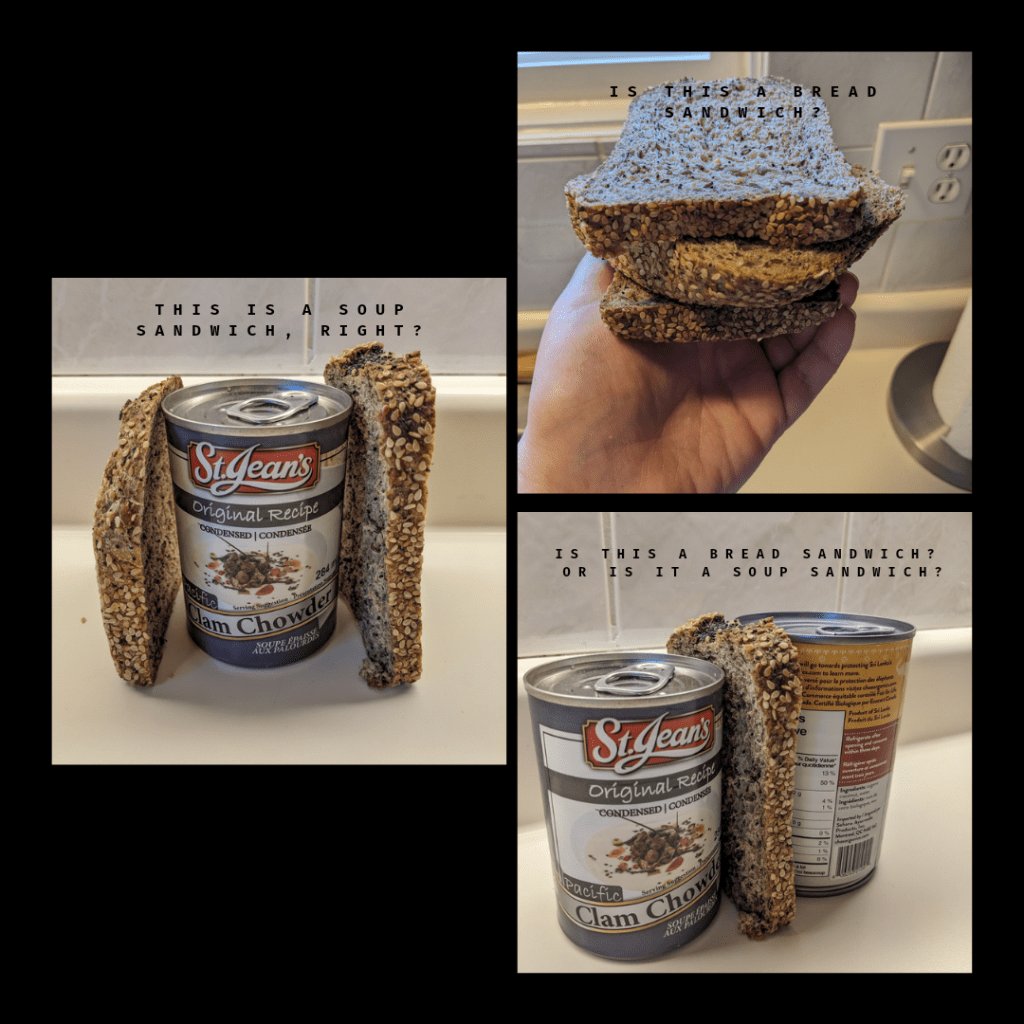
A Sandwich by Any Other Name

Sandwich. Noun. A type of food where there are two or more pieces of bread (or a split roll, or other starch) with filling in between. Eaten as a light meal. Alternatively, it can be two structural elements that secure a low-strength core. Lastly, it can be an open-faced sandwich when there is only one piece of bread or starch, and ingredients are placed on top of it.

Sandwich. Verb. To insert or enclose something between two other things, typically of a different material, quality, or character from the bit being enclosed or inserted.

Nope, this is not a post on my opinions regarding whether pizza is an open-faced sandwich or vice versa. Neither is it a deep dive into the myths and legends of where the term originated. I’m starting this post with a definition of “sandwich” so it can lend some professionalism to the rant that follows. I want it to descend into madness with a shred of credibility.

This post is about constructive feedback/criticism and the term “compliment sandwich.”

When was the last time you had a delicious sandwich loaded with ham, swiss cheese, fancy pickles or preserves, and greens, and called it a “rye sandwich” because it was on rye bread? In the same vein, if you told someone you were having a rye sandwich for lunch, they would likely assume you were trying to be clever and were drinking alcohol instead of eating.

So why on earth do we call it a “compliment sandwich” when the thing in the middle is something that needs to be worked on, and the outside “sandwiching” components are compliments? To make this feedback tactic reflect its name, we would need to offer up an issue, a compliment, and another issue. Alternately, we could call it an “issue sandwich”… But who wants the boss to come down and tell them they have an “issue sandwich” to deliver? Sounds ominous in the same way a “knuckle sandwich” sounds ominous to a kid on the playground.

Personally, I feel as though this tactic was introduced because of bad bosses. They didn’t communicate with their employees unless there was an issue, and that breeds all kinds of resentment.

A long time ago, I worked for a large corporate company. As an employee, I never heard a peep from head office or the regional directors unless they were unhappy with something. When I was promoted, there was a weekly call with corporate. They, without fail, offered a compliment, gave us something to work on, then ended with another compliment.

Know what’s worse than knowing you’re getting a weekly issue to work on? Knowing that your boss is obligated to come up with something you can be complimented on. Compliments don’t mean much if the person giving the compliment is required to think of something good you are doing in order to deliver something they want you to change.

In my current position, feedback is a near-daily experience. I don’t mind it (usually). We’re all trying to create the best version of our writing possible for the game. Extra eyes for things like spelling and grammar, the validation that others think lines are funny or particularly appropriate, and even the comments requesting changes are all welcome and appreciated.

When your higher-ups are not required to give you a compliment and you get one anyway, it feels genuine. It feels earned. Even if it’s just a comment that says “haha” or “lol” you know you got it because your writing was actually funny, not because they had to single it out in order to provide you with something else they didn’t like.

Effective feedback will give you a path to follow. “I don’t like the way this is written, can it be funnier?” or “I see where you’re going with this, but I don’t think it works in this context. Can I see some alternate ideas?” or even “This doesn’t sound as romantic as it should.” Point one! Ham up the punchline! Point two! Come up with a couple different ideas! Point three! Make it cheesier/more romantic!

The higher-ups here are clear with WHY they don’t like something. This may be shocking, but most employees are not psychic. The employees in this scenario are given direction and provide lines and work that is closer aligned with the collective vision for the submission.

Doesn’t this sound like a win-win? Something that would reduce time waste as employees and employers alike are clear on their path forward?

So throw out that grody compliment sandwich, make an effort to tell people when you like something, and always be open to talking something out!

Let me know if you have any favourite deliveries for criticism or feedback! I’d love to hear people’s preferences!

References