PSA: Keep your High School Edgelord Poetry

I have been out of high school for 17 years now. It was not a nice time for me, and for the most part, I’ve blocked out the memories. However, I recently went to a poetry reading, and it triggered something in the back of my mind. Something I had written in high school. Something I had written in high school and liked. Something I had written in high school, liked, and thought I probably still had. Its last line echoed around in my head.

“But I didn’t understand, and that was too bad.”

Days passed, and I was still haunted by lines that were probably originally inspired by some nonsense high school drama. Or emotions that ran unregulated around my hormonal brain. Maybe a new literary obsession. Who knows? The intent behind my words has long since been lost to me.

“I don’t care that you’re sorry, and I know you messed up. But I didn’t understand, and that was too bad.”

Was I just over glamorizing something from my past in an attempt to save my brain from remembering how embarrassing it was? Or was it truly something worth digging out again?

I had to know.

Logically, if I had kept it for 17 years, written out on a loose piece of paper, over countless moves and life changes, I had to have seen something in it, right?

Where was that folder of-

Ah, yes. The folder of past writings.

“When I’m angry, you don’t understand. When I was destructive, you didn’t understand, and that was too bad.”

I dug out the poem and held my breath.

I read it.

I read it again.

And you know what? If I had reread this ten years ago, I would have cringed so hard I left the planet and set the paper on fire in my wake.

But time does funny things to perspective.

It wasn’t bad.

The full thing is as follows:

“When I’m sad, you don’t understand.

When I’m lonely, you don’t understand. That’s too bad.

When I’m normal, you don’t understand.

When I hide behind my smile, you still don’t understand, and that’s too bad.

When I’m angry, you don’t understand.

When I was destructive, you didn’t understand, and that was too bad.

I don’t care that you’re sorry, and I know you messed up, but I didn’t understand, and that’s too bad.”

Somewhere, under that stresso depresso cry for attention is a really interesting poem. All it needed is a little massaging.

So I massaged it.

“When I’m sad, you don’t understand.

When I was loud, you didn’t understand, and that was too bad.

When I’m happy, you don’t understand.

When I smiled to hide the sharp knife of my tongue, you didn’t understand, and that was too bad.

When I’m afraid, you don’t understand.

When I begged for peace with my white flags called teeth, you didn’t understand, and that was too bad.

I don’t care that you’re sorry, and you say it’s not fair. But I didn’t understand, and that was too bad.”

Which, if I do say so myself, is decent. Poetry is not my first language, but I dabble. Now, it still screams “Not like other girls” or “Manic Pixie Dream Girl”, but it’s BETTER. And better is better. It’s right there in the name.

If I were to take the heart of the poem and make it more about moving from one stage of life to another, I think it might even become something adjacent to ‘good’.

When ocean swells crash against freckled shores, you don’t understand.

When your deep sky eyes swallowed my desperation for summers past, you didn’t understand, and that was too bad.

When forests of laughter spring up under my leaps of faith, you don’t understand.

When the funeral procession for all my past selves crushed me under a white-hot weight, you didn’t understand, and that was too bad.

When winds of sweetly scented future draw me ever farther away, you don’t understand.

When the same tendrils that strangled my soul rocked you ever so gently to sleep, you didn’t understand, and that was too bad.

The golden past may have bought your loyalty like a devoted lover, but I didn’t understand, and that was too bad.

What do you think?

It’s Levi-OH-sa, Not Levioh-SA: Spellbound by the Spoken Word

Recently, I was invited to a poetry reading. An amateur poetry reading. Visions of a room full of beret-wearing college kids filled my mind, all snapping after one word is spoken into a microphone on a sparse, poorly-lit stage. It could be any word, but it’s spoken artistically. If you don’t see the way ‘balustrade’ perfectly reflects the social situation of racial tensions in some faraway country, then you’re not artsy enough to be here.

Of course, that’s nothing close to what it was like.

A historical building converted into a coffee shop. Mismatched tables and chairs are crammed into any space available. A great, old, carved bar serves as the order counter. The smell of coffee and pot pies hangs in the air, and soft acoustic music allows for hushed conversation and the sound of scratching pencils against notebooks. Yeah, okay, the building itself passed the vibe check.

But the people? They were all sorts.

A traditional Goth sat in one corner with her drink. A couple on a date shared desserts off of fine china. My own soda bubbled, and my sister’s tea steamed. A raggedy man, a middle-aged businesswoman, and an artsy type share a table and some sort of card game. Peppered throughout the building are young adults dressed in black. Someone knits. Another crochets. A third is drawing with confident strokes in a sketchbook. A couple of people are reading.

This is the scene I joined, waiting to find out what kind of experience the event would offer.

The first poet stood with trembling hands and a downcast gaze. She read her words as she had rehearsed. Her voice was even, but it seemed as though a tremble waited for only the smallest opportunity to creep in. Her poetry was good, but at the end of her segment, I was left uninspired. Unmoved. But not uninterested. Hers were words to devour with your eyes, not the sort that called to your imagination as a siren calls to a sailor.

The second poet took the stage. Feet rooted as those of mountains are, she began with a bang. Or rather, a swear.

Now, I don’t typically enjoy things that use vulgarity for shock value, but somehow, this time, it was perfect.

Galaxies and bones stirred my mind. Heartbreak and betrayal, alien to me, haunted my fabricated memories. It was raw. It was uncomfortable. It was captivating. Yet if I had just read it, with the emotions it sought to evoke confined to a page, I doubt I would have liked it.

The third poet took the stage and compared life to peanut butter. He had stage presence and a nice voice. The pomp and absurdity of his words should have endeared me to him. It didn’t.

I’m currently in a period of my life that requires me to read aloud nearly daily. I had already noticed that things which were pleasant to read weren’t always pleasant to speak. I was trying to get my thoughts together for a post about it when I was invited to the poetry reading.

And I saw my point in three parts.

What is it about a good storyteller that enchants us? What is it about the voice that can draw us into something we may not relate to? How can a good orator transform mediocre words into ambrosia?

I hopped on Google. I searched for what makes a good storyteller. It provided me with some tips on how to connect with an audience and how to enhance my writing. I switched to Google Scholar. I searched for articles about the parts of the brain that activate when being told a story. That yielded articles on lying, body language, learning, and culture. I tried to reword it. I came away with some, honestly, really very good tips on presenting. What I didn’t find was a consensus on what a good speaker does to us in the context I was looking for. An interesting link between listening to stories and listening to music, though.

So, until science (or the internet) comes to prove me wrong, I’ll go with this:

Some people just have magic in their voice.

One Person’s Trash is Another Person’s Treasure. Sometimes.

People donate books for many reasons. The owner could be moving and has to downsize. Someone could have passed away, and their family is clearing out their estate. It could be that the reader has outgrown those particular stories. Perhaps it is related to a deep clean or the de-cluttering of a home. For the most part, though, I feel as if what gets donated has a positive correlation with perceived low re-readability by the owner. Which is admittedly a subjective quality. To a point.

Donations can go to many places. Libraries, literacy programs, charities, second-hand shops, and schools are just some of the options where books may receive a chance at a second life. My personal favorite is the local Rotary Club, which collects donations throughout the year and then hosts a massive book sale biannually to support their various community projects.

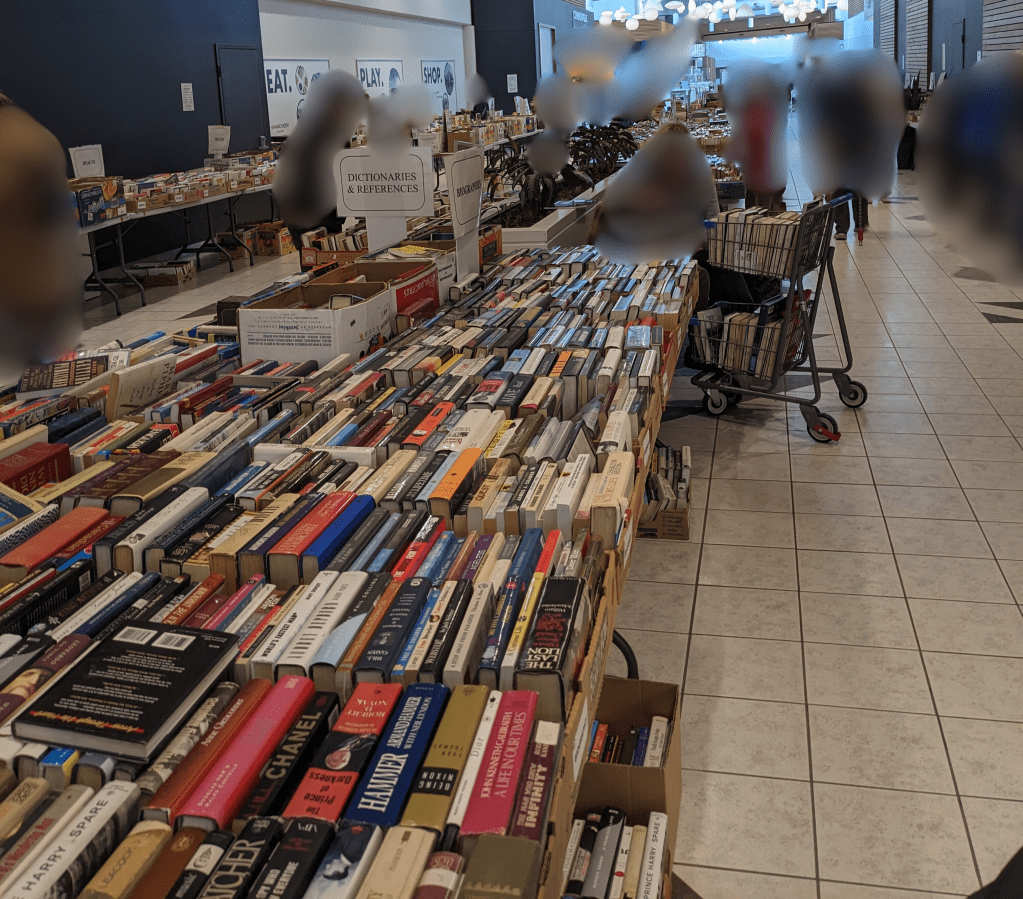
Large-scale used book sales are beautiful chaos. You never know what you’re going to stumble across. It’s a full day of wading through tables covered in boxes overflowing with thousands of titles, sorted loosely by genre and first letter of the author’s last name.

It’s also a roller coaster of emotion. There are shouts of joy as a certain edition of an old favorite is unearthed. Strangers work together to look for the third book in a five-part series – books one, two, four, and five are already clutched tightly in a young adult’s arms. It’s a gathering of book lovers, for better or worse, in jealousy and triumph, in disappointment and discovery.

As I became familiar with the ins and outs of this particular flavour of sale, I expanded my interest from books and authors I was actively seeking to books that seemed worthwhile to add to my TBR pile. From there, I found myself becoming curious as to which books showed up repeatedly. And now, I spend a lot of time looking at books and authors who have been donated en masse.

To be clear, the books offered during each sale are a mix of titles that did not sell during previous sales, as well as newly donated items. So prolific authors, such as Debbie Macomber, Nora Roberts, Terry Goodkind, and Stephen King, may have many titles represented, but those are generally gone by the end of the sale.

I’m not talking about those.

I’m talking about the duplicate copies of a single title. Let me show you an example.

Check out how many copies of “Steve Jobs” by Walter Isaacson and “Becoming” by Michelle Obama there are in these boxes. There were probably another three or four times that amount again on the upper tables in the biography section.

The city I live in is not particularly large. We’re talking 100,000 people. For there to be so many copies of a singular title, to me, means two things.

One. Either the marketing these books received was absolutely mind-blowing, the subjects these books were about are interesting to a wide and varied reader base, and/or the blurb on the back was spectacular.

Two. Once these books were actually purchased and read, people did not see them as re-readable novels. I could give it the benefit of the doubt and say that so many people bought it that these donated copies are all duplicates, but my suspenders of disbelief are not that strong. Fundamentally, a lot of people do not want to revisit these books.

Now, for biographies, that makes a little more sense than a fiction or fantasy title. The nature of the work is reflective and informative rather than woven and inventive. It is also usually more about the subject rather than the author. (Unless it’s particularly poorly written, but as “Becoming” has a 4.7 out of 5 on Amazon, 4.4 out of 5 on Goodreads, and 4.6 out of 5 on Indigo, while “Steve Jobs” has 4.7 out of 5 on Amazon and 4.2 out of 5 on Goodreads, I don’t think that’s the case here.)

What this comes down to for me is this: I never want to be that author with 200 copies of a singular title at a used book sale. I want to be the kind of author who makes people feel as though they’ve scored the jackpot if and when my work makes it into the used market.

And for that, I need re-readability. Secrets. Easter eggs. Clever full circle moments. Hints at different perspectives. I need depth.

This month’s round of edits and revisions will focus on just that.

Wish me luck.

We’re Here for a Good Time, Not a Well Done Time

Let’s talk a little about guilty pleasures. By definition, a guilty pleasure is something you enjoy, but also feel some embarrassment about. This embarrassment may come about because, for one reason or another, you feel as though you should not be indulging in that thing, or because most other people do not think the thing is good. For this post, I’ll be leaning into and challenging that second explanation for embarrassment. Things that we enjoy, but feel embarrassed about because other people would not think it is good.

Recently, I read a book that perfectly fits that description.

The Ruthless Lady’s Guide to Wizardry by C.M. Waggoner.

What do you rate a book you thoroughly enjoyed, but ultimately, didn’t like?

On the one hand, I really enjoyed the journey of the story. On the other hand, when I’m talking about it, I have to be careful not to hype it up too much. It’s a lot of fun, but it’s teetering dangerously close to having some major structural issues with the plot. And characters. And language. Because of this, I feel like I have to defend my enjoyment of it. Which feels bad.

There’s no getting around the fact that the book has problems. Like there being an underlying belief system that influences the way characters speak, which is never really explained. I had to draw my own conclusions, and I’m still not confident I grasped the vision. Maybe I’m missing something, but I’m pretty genre savvy, so I’m still marking this as a point against. Plus, there are so many characters for no real reason, and the love interest is plucky, positive, and… well… a little flat.

If I were to describe it as briefly as I could, The Ruthless Lady’s Guide to Wizardry is as if Wild Wild West starring Will Smith was remade in a world of magic, and the star of the show was a pair of mismatched, adventure-seeking women. As long as you aren’t taking it seriously, you’ll have a great time. I even lent it to my mother!

So here’s my proposal. The reason why people watch, read, or otherwise consume material considered guilty pleasures can be taken as a strong compliment, albeit a back-handed one. Think about what people say when they talk about their guilty pleasures.

“Oh, it’s just so trashy, it makes me feel better about my life.” Is a common one. So is “I only read/watch/play it for this one specific thing which is the only good thing about it.” “It’s mindless.” “The drama is outrageous, but it’s like a car wreck and I can’t look away.”

Let’s break it down and look at it a little deeper.

“Oh, it’s just so trashy, it makes me feel better about my life.” can be the writer or producer selecting relatable shock value topics that land with a wide audience. It’s performative, exhibitionist, and designed to make us feel superior through social comparison.

“I only read/watch/play it for this one specific thing, which is the only good thing about it.” can be the writer, producer, actor, or other players smashing their role out of the park. Especially in collaborative environments like video games and television, this is a huge kudos to the related party because they did the best with what they had and brought you moments of delight for the elements that were within their control. Find out who was responsible for the idea, character, setting, music, whatever, and see what else they have done! If your guilty pleasure is a solo piece, then leave some feedback for the one responsible! If they know something landed, this could spur additional content for your faves, even if it’s just on their website.

“It’s mindless.” could be a couple of things. First, it could be that the writer has produced something simple, and yet still entertaining enough or appealing enough to have you continue engaging with it. They’ve hit on some formula that makes you feel good, without requiring your active participation. Lofi Girl on YouTube is a good example of this. 15.2 million people are subscribed to their content. It’s something you can tune in and out of without penalty.

The second compliment behind “It’s mindless” could be related to comfort through repetition. Maybe it’s The Office. Maybe it’s Dexter. Maybe you need another run through of Grey’s Anatomy. Maybe it’s your twelfth time this year reading A Hitchhiker’s Guide to the Galaxy. Becoming familiar with characters and then revisiting the material that they’re from can have the same effect on the brain as visiting friends. You don’t have to pay attention to the material. Just the sound of their voice (either real or as you read) can help you relax and feel good.

Lastly, let’s have a look at “The drama is outrageous, but it’s like a car wreck and I can’t look away.” This is similar to the social comparison I touched on earlier, but it tends to have content that we ultimately can’t relate to. This, I personally feel, is due to the element of surprise. People who are genre savvy can get tired of the same plot lines over and over again, especially when they begin to predict the plot before it happens. When a new twist, no matter how bad, enters the playing field, it can be enjoyed just for the novelty. Novel experiences feel good. How many people watched Swamp People or Ice Road Truckers or Black Mirror just because it was SO different?

So there you have it. Maybe there’s something to why certain things thrive as guilty pleasures. Next time someone reveals theirs to you, maybe dig a little deeper and find out why! I’d love to hear about yours in the comments.

References

Is the Spice Finally Too Spicy?

This post deals with topics of abuse in various forms. If this isn’t something you want to digest at the moment, see you in the next one!

I can understand the underlying fantasy. Every girl wants to be “The Special”. Picked out of a crowd even when she’s plain. Treated like a princess by someone perceived to hold power. She wants to be the exception to the rules of his behaviour and be treated kindly and/or differently from all the Other Girls. She wants to indulge in the romanticized notion that she can be the one to alleviate someone’s emotional and physical suffering through the power of love. She wants to be someone’s first choice. Their only choice. Their whole world. It would mean being accepted as an inherently flawed self at the expense of accepting another’s flawed self. Doesn’t seem like too bad a trade. After all, isn’t it romantic when he says that if anyone else touches her, he’ll make them pay?

But what happens when this obsessive kind of love becomes mainstream and heralded as romantic?

Dark romance is REAL popular on social media right now, and I have some opinions. Not the kind of opinions where I just hang out here and crap all over an entire genre, but I definitely have reservations. Ultimately, it’s not the content itself I have a problem with, but the normalization of “romantic violence” in quantity and extremes.

Stop it. I’m crying. And begging. But mostly crying.

When something is trending, it not only gets seen by the target audience who are already consuming related topics, but also by those who typically wouldn’t search out and interact with that topic. Think back to when Twilight came out and how many people who were not normally readers picked it up. Think about how many experienced 50 Shades of Grey in one form or another. Those are just two quick examples of unhealthy relationships in popular media that are idolized, but there are many more.

Just like how the media can shape our perspective of beauty with their airbrushed models and influencer content, popularizing, and more relevantly, romanticizing, inherently abusive behaviours does the same thing, but to our idea of what is and isn’t tolerable behaviour. It’s not a question of desensitizing us, per se, but it’s the issue of repetition. How many times do you have to hear that abusive behaviour is romantic before you start internalizing that message?

I could go on a tangent about the Alpha Male movement. I could discuss Stockholm Syndrome and retellings of Beauty and the Beast. I could talk about how the romance of obsessive lead characters often mirrors the tactics used by romance scammers. I could even complain about the broody, morally grey anti-hero that has been popular for eons. But I won’t. Ain’t nobody got time for that. Not even me.

What I will talk about is the cycle of abuse and how these dark romances can warp our perception of and ability to identify the cycle of abuse in real life and push the boundaries of what we’re willing to accept from a romantic partner. We can say that we’d recognize an abuser and would get out of a relationship that was toxic before it got dangerous, but it’s not usually that clear, that simple, or that easy.

Unlike the previous generation and their hate-on for video games, I’m not trying to tell anyone that dark romances are desensitizing the masses and will cause people to become abusive in their relationships when they weren’t already predisposed to it. Or that it’s more likely to make someone accept abuse. What I am trying to say is that when you are shown or told something repeatedly, by multiple sources deemed trustworthy (e.g., peers, influencers, media), a certain part of your brain begins to internalize that. If not as a belief of your own, then as an understanding of acceptable societal norms. I don’t like my For You page telling me at least three or four times a day that something like stalking is romantic. That intimidation is romantic. That violence is romantic.

It’s not.

Now, dark romances have existed for a long time, especially if you’re willing to include less mainstream sources. I’m not mad about that. If people want to use the genre to work out their own kinks in a low-stakes environment, more power to them. If they are seeking a way to process abuse and trauma experienced by either themselves or those around them, cool. I’m glad these resources exist. I even have no problem with the curious who want to dip their toes into the genre to see if they like it. Or people who read it just because it’s fun for them. I’m not here to say books with dark topics should be banned.

I’m here saying we should identify abusive behaviour as just that, and stop calling it romantic. Abusers don’t need any more ammo than they already have. We don’t need to give them frequent, viral, wide-reaching romanticization of their behaviours. The cycle of abuse is confusing enough as it is.

For those of you unfamiliar with the cycle of abuse, let me give you a quick rundown.

The first stage is tension. Tension that the abuser builds up either consciously or subconsciously with their behaviours and actions. Ever had the dishes done angrily at you? That’s what I’m talking about. But tension is also a highly desirable state in romance reads. Of course, it’s typically less the violence kind and more the sexual kind, but the problem is we’re currently blurring lines between the two in things like mafia and dark romances.

The second stage is usually an emotionally charged incident. A physical fight. An argument. A one-sided outburst. Know what romance novels typically have? A fight or a breakup scene. The difference is generally only a matter of severity.

The third stage is reconciliation. Reconciliation can be love-bombing. It can be gaslighting. It can be a grand public show of devotion and willingness to change. It can be self-depricating comments about the self in an attempt to gain sympathy or arouse guilt. After all, the abuser is just a silly goose who can’t live without you. You’re the reason they’re alive. The reason they strive to be a better person. See? They recognized their own bad behaviour, and you’re the reason they’re changing. If you left, they’d be lost. They couldn’t be the person they want to become. You’re their inspiration, and without you, they might as well be dead.

Wow, didn’t that escalate quickly?

As for the fourth stage, it’s a return to normalcy. Calm. Life as usual. Or maybe life as a little bit better than before. This primes the victim, or that female main character, for the next instance of building tension, escalating from the previous incident. It’s for the sake of the plot. Promise.

When comparing the cycle of abuse to romance novel plots, and especially dark romances, I hope you can see my point. When you’re reading a book about a stalker who starts to isolate the female main character from her friends and family, it’s really easy to forgive a stupid little fight about where you leave the remote. Or look past your partner punching a hole in the wall when the Book Girlies on TikTok are telling you that it’s romantic to forgive your partner for shooting someone over your shoulder and making you bleed. He deflected. It was for your own safety. He was only thinking of you. Double promise.

It’s also easy to mistake the reconciliation stage of abuse as progress towards changing your significant other. Especially when gaslighting is involved, because when things go back to that calm stage, is it really just like before? Or are they better, and you’re just not noticing their efforts? Before, they wouldn’t have been able to hold it together for so long. You’re responsible for that. It’ll keep getting better from here on out. Triple promise.

So please. Call abuse what it is.

A final note.

I use heteronormative speech throughout this article, but abuse can be perpetuated AGAINST any gender or sex and BY any gender or sex in ANY configuration of relationship. Abuse can be physical, emotional, financial, and more. If what I’ve described above hits a little close to home, please talk to someone. Very few of us are the exception to the rule of our partner’s abusive behaviour, and we will not save them from themselves. Stay safe out there.

References

A Dream is a Wish Your Heart Makes

You may be familiar with the story of how Twilight, by Stephenie Meyer, was written based on a dream she had. According to her, chapter 13, called Confessions, is essentially a transcript of that very dream. But what other books and media were based on dreams? This has been on my mind lately, so I decided to take a bit of a deeper look.

Here is a list of SOME books, video games, and TV and screen media that are all allegedly based on dreams.

  • Frankenstein by Mary Shelley
  • Kubla Khan by Samuel Taylor Coleridge
  • The Strange Case of Dr. Jekyll and Mr. Hyde by Robert Louis Stevenson
  • Tintin in Tibet by Georges Prosper Remi
  • Misery by Stephen King
  • Dreamcatcher by Stephen King
  • The Miraculous Journey of Edward Tulane by Kate DiCamillo
  • The Returned by Jason Mott
  • Stuart Little by E.B. White
  • Sophie’s Choice by William Styron
  • Jane Eyre by Charlotte Brontë
  • Beyond the Wall of Sleep by H.P. Lovecraft
  • The Metamorphosis by Franz Kafka
  • 3 Women by Robert Altman
  • The Terminator by James Cameron
  • Over the Garden Wall by Patrick McHale
  • Deltarune by Toby Fox
  • Omori by developer Omocat
  • Salesforce by Marc Benioff

Now, this is an impressive list. I don’t know about you, but my dreams are often things like being on a beach, collecting pencils someone stuck in the sand to pay for some hippies to let an elephant out of their campervan. Either that, or my degree is being revoked because I missed a math test I didn’t know I needed to take. Please note that I graduated more than ten years ago.

No part of either of those things would make for a good book. Or at least not a book I personally would write. In addition, I was under the impression that adults didn’t really dream all that much anyway. Turns out, I was wrong.

On average, people can recall having dreamed 1-3 times per week, and those who report not dreaming AT ALL are the minority, only up to 6.5% of the population.

The ability to report your dreams depends on several factors.

First of all, for all those who suffer from broken sleep, good news! The more you wake up in the night, the more dreams you are likely to recall. If you are the kind of person who wakes up right in the middle of your REM (Rapid Eye Movement) sleep, that chance is even higher. Fun fact, this is what fuelled the hypothesis that humans only dream during the REM stage of the sleep cycle. Surprise! We actually dream during all stages of sleep.

Stressed individuals tend to be able to recall and report their dreams more. My own personal theory on this is that when you have dreams while you are stressed, those dreams tend to be awkward and embarrassing. We are hardwired to remember things that are awkward and embarrassing. This is an unfair advantage for stress dreams, if you ask me.

Another thing that can affect your ability to recall your dreams is whether you are woken up abruptly or whether you are woken up gradually and naturally. If your sleep is interrupted, you are better able to recall dreams. Gradually and slowly, the dreams tend to fade faster. If you think about a dream right as you regain consciousness, this helps solidify details of the dream in your brain.

The ability to remember your dreams is also linked to creativity and intelligence.

So, what kind of dreams do people have? What are the available “genres,” so to speak? How come some people have dreams about sparkly vampires, bringing back the dead, and time-traveling robot hitmen, when the best MY brain can do is trying to chase a mouse on a pogo stick?

A popular theory is that there are seven main genres of dreams.

  • Nightmares- Distressing dreams that cause the dreamer to feel stress, fear, or other elevated negative emotions.
  • Lucid Dreams – When you have some sort of conscious control or apply agency to a dream that would otherwise progress without input.
  • Current Event Dreams – Things that have happened, you have read about, or imagined in the last day or two.
  • Metaphorical or Symbolic Dreams – Dreams that help an individual emotionally or mentally process life events from the present or the past. These dreams often have similar emotional weight to the original life event, but the subject matter may differ.
  • Fantasy or Comfort Dreams – Aspirations, compensations, or wish-fulfillments to evoke positive emotions and comfort, or a sense of control over a situation that otherwise may make an individual feel hopeless or depressed. This may be a self-soothing activity.
  • Creative and Problem-Solving Dreams – Dreams that the dreamer feels to be inspirational or give some kind of epiphany in things that can translate to real-life problems or situations.
  • Supernatural Dreams – The kind of dreams people feel are premonitions, telepathic, shared with other people, or where they believe they are visited by someone deceased.

If anyone out there has any tips on how to increase the instances of fantasy or comfort dreams and/or creative and problem-solving dreams, I’m all ears! My personal projects will certainly thank you.

References

Why My Job is Safe From AI. (For Now.)

Recently, my company asked whether we could use AI to help generate ideas for our content. Not to WRITE our content, but just to provide lists of material we could use as references or jumping-off points. This was met with different levels of uncertainty, but ultimately, my coworker was the first to sign up and try it.

She is the reason for this post. Let me tell you, I was IN TEARS reading the poor ChatGPT bot trying to defend itself. What was the stumbling block, you might ask?

Puns.

Puns are apparently NOT something AI currently understands. This is great news because puns make up at least 30% of my content. If you’re dubious about what ChatGPT is capable of, please, allow me to ease your mind with some ice cream.

For clarity, I am styling the interaction I had with ChatGPT so my questions and prompts are a heading, and ChatGPT’s response is the text under it.

Me: Good evening ChatGPT! I’m trying to write some jokes. Can you help me come up with some ideas for puns about ice cream?

ChatGPT: Good evening! I’d be happy to help you come up with some ice cream puns. Here are some ideas to get you started:

  1. “I tried to make an ice cream joke, but it was too soft to land!”
  2. “I’m on a diet… but I can’t resist ice cream, it’s a cone-troversial issue!”
  3. “I scream, you scream, we all scream… for puns!”
  4. “You’re ice cream my dreams!”
  5. “Life is short, but ice cream is forever.”
  6. “When it comes to ice cream, I’m totally cone-fused!”
  7. “Let’s have an ice cream social – it’s going to be a cool event!”
  8. “I had a pun about vanilla, but it was too plain!”
  9. “Do you want to hear an ice cream joke? Never mind, it’s a bit too sweet for you.”
  10. “I love ice cream so much, I’ll do anything for a scoop! You could say I’m really cone-nected to it.”
  11. “Why don’t ice cream cones ever get into trouble? They always keep their cool!”
  12. “I can’t believe it’s already winter… it feels like just yesterday we were chilling with ice cream!”

Hope these inspire some laughs! Let me know if you need more ideas!

Me: Some of those are cute, but I don’t understand joke #12. Can you please explain why it is a pun?

ChatGPT: You’re right to ask! Joke #12 was meant to be a playful pun on the idea of “chilling” with ice cream. The word “chill” can mean both “to relax” or “to cool down,” but it also refers to how ice cream is kept cold or “chilled.”

So, when I said, “we were chilling with ice cream,” the joke was trying to play on the double meaning of “chilling” – both relaxing with ice cream and keeping the ice cream cold. But I see how it might not have been as clear or punchy as some of the others.

I hope that helps explain it! Let me know if you’d like more ideas or further clarification!

Me: Joke #5 is also confusing. Can you please explain why it is a pun?

ChatGPT: You’re right again! Joke #5, “Life is short, but ice cream is forever,” isn’t exactly a classic pun. Instead, it’s a play on a popular phrase, “Life is short,” which is often used to encourage people to enjoy life and make the most of it. The twist comes from replacing the second part with “ice cream is forever,” which is a humorous exaggeration.

The “pun” aspect comes from contrasting the idea of something fleeting like life with something perceived as indulgent and everlasting, like the joy or obsession people have with ice cream. While it’s not a pun on a specific word (like “cone” or “scoop”), it’s more of a playful comparison.

I can see how it might be confusing as it doesn’t follow the same pun structure as some of the other jokes. Thanks for pointing that out! Let me know if you’d like more clearer puns!

Me: Do you think that “more clearer puns” is proper English?

ChatGPT: You’re absolutely right to point that out! “More clearer” is not proper English because “clearer” is already a comparative form of “clear,” so adding “more” is redundant. The correct way to say it would be:

  • “clearer puns” (just the comparative form)
  • “more clear puns” (though this is less common and a bit awkward, it’s technically acceptable in some cases)

Thank you for catching that! Let me know if you have any other questions or if you’d like more puns!

Me: ChatGPT, can you please define what a pun is for me?

ChatGPT: Certainly! A pun is a form of wordplay that exploits multiple meanings of a term or similar-sounding words to create a humorous or clever effect. Puns often rely on words that have more than one meaning (a double entendre) or on words that sound alike but have different meanings (a homophone).

For example:

  • “Time flies like an arrow. Fruit flies like a banana.”
    This is a pun because “flies” is used in two different ways: as a verb (time passing quickly) and as a noun (the insect “fruit flies”).
  • “I used to be a baker, but I couldn’t make enough dough.”
    The pun here comes from “dough,” which can refer both to the money (“dough”) and the mixture used in baking.

Puns are often playful and can add humor through unexpected or witty uses of language!

Me: Using that definition you just provided, why is Joke #5, “Life is short, but ice cream is forever”, a pun?

ChatGPT: You’re absolutely right to question this! Upon reviewing the joke again, it seems that “Life is short, but ice cream is forever” is not actually a pun by the definition I provided.

A pun relies on a play on words—either a word with multiple meanings or words that sound alike but have different meanings—and this joke doesn’t quite fit that pattern. Instead, it’s more of a play on contrasting ideas: “Life is short” (a common saying about the brevity of life) versus the idea that ice cream brings lasting enjoyment, though obviously, ice cream itself doesn’t last forever.

So, I misspoke when I called it a pun! It’s a humorous contrast, but not a pun in the traditional sense. Thank you for catching that!

If you’re looking for more puns, I’d be happy to help clarify or come up with some new examples!

Me: Thank you! Can I please have 5 new puns about ice cream?

ChatGPT: You’re very welcome! Here are five fresh ice cream puns for you:

  1. “I’m trying to cut back on sugar, but ice cream keeps scooping me back in!”
  2. “The ice cream truck pulled up and I topped my day off with a scoop of joy!”
  3. “If you don’t like ice cream, you’re really conefusion!”
  4. “I made an ice cream joke, but it didn’t have enough punch… I guess it was a sundae one!”
  5. “I scream for ice cream, but the real question is, does ice cream scream for me?”

Hope these give you a good laugh! Let me know if you need more!

Me: I don’t think joke #3 is grammatically correct. Can you please rewrite it so it makes sense?

ChatGPT: You’re absolutely right! Joke #3, “If you don’t like ice cream, you’re really conefusion!” doesn’t quite make sense as written. Here’s a revised version:

“If you don’t like ice cream, you’re really in a conefusion!”

This makes it clearer, using “cone” to play on the word “confusion.” Thanks for pointing that out! Let me know if you’d like more puns or further revisions!

Me: Wouldn’t it have worked better if you changed it to “If you don’t like ice cream, you’re just conefused!”?

ChatGPT: Yes, absolutely! “If you don’t like ice cream, you’re just conefused!” is a much smoother and more clever pun. The play on “confused” and “cone” works perfectly here.

Great suggestion! Here’s the updated pun:

“If you don’t like ice cream, you’re just conefused!”

Thanks for the improvement! Let me know if you’d like more puns or help with anything else!

Me: Can we please revisit joke #4? I don’t understand that either.

ChatGPT: You’re absolutely right to ask for clarification on joke #4. Upon rereading, I see that it may be a bit confusing and not as clear as it could be.

The joke was:
“I made an ice cream joke, but it didn’t have enough punch… I guess it was a sundae one!”

The idea was to play on the word “punch” (as in a strong or impactful joke) and “sundae” (the ice cream dessert), but it doesn’t quite land as a straightforward pun.

Here’s a revision that works better:

“I tried to make an ice cream joke, but it was just too soft… I guess it needed a little more scoop!”

This plays on the idea of ice cream being “soft” and needing more “scoop” (or impact) to make it funnier.

I hope this clears things up! Let me know if you’d like further adjustments or more puns!

Me: Is “scoop” really a form of impact?

ChatGPT: You’re right again! “Scoop” isn’t quite a synonym for “impact,” and using it in that context doesn’t quite fit. I appreciate your patience as we refine the joke. Let’s try another version that makes more sense.

Here’s a revised version of the joke that better fits the idea of needing more impact:

“I tried to make an ice cream joke, but it was a little too soft… I guess it needed a bit more chill!”

This works better because “chill” can refer to both the cold nature of ice cream and the idea of something being cool or impressive. It plays on the idea that the joke didn’t land well and needed a little more “chill” to make it better.

Thanks for your feedback! Let me know what you think!

Me: That works! Good job!

ChatGPT: Thank you! I’m so glad that works for you! 😊 If you need more puns or jokes, feel free to reach out. I’m happy to help!

Me: Thank you! Using the definition you have given me, can you please tell me 5 more ice cream puns?

ChatGPT: Of course! Here are five more ice cream puns, using wordplay for some fun:

  1. “I don’t trust ice cream. It’s always up to some kind of scoop!”
  2. “I used to be a professional ice cream taster, but I got burned out.”
  3. “Ice cream is proof that good things come in scoops!”
  4. “I’m trying to stay cool, but with all this ice cream around, it’s hard not to melt.”
  5. “I told my ice cream it was churn-ed up, and it just gave me the cold shoulder.”

I hope these give you a good laugh! Let me know if you’d like more!

Me: None of these are puns based on the definition you gave.

ChatGPT: You’re absolutely right again! I appreciate your patience. Let’s focus on creating proper puns based on the wordplay I described earlier—using words with double meanings or words that sound similar. Here are five new ice cream puns that fit the definition:

  1. “I scream, you scream, we all scream for conefusion!”
    (Play on “confusion” and “cone.”)
  2. “What did the ice cream say to the toppings? You’re the cherry on top!”
    (Play on the phrase “cherry on top” to express something extra special.)
  3. “I told my friend that ice cream is my favorite. She said, ‘I conecur with that!'”
    (Play on “concur” and “cone.”)
  4. “That joke was so bad, it was almost vanilla.”
    (Play on “vanilla” as something plain or basic.)
  5. “When the ice cream truck broke down, it was a real sundae driver!”
    (Play on “Sunday driver” and “sundae.”)

I hope these are more in line with the puns you were expecting! Let me know if you’d like more!

Me: No, thank you. I hope you have a good night!

ChatGPT: You’re very welcome! I hope you have a wonderful night as well! If you ever need more puns or anything else, feel free to reach out. Take care! 😊

In Cone-clusion

Even after getting ChatGPT to define a pun, it could not give me proper, sensical examples. Instead, it replaced arbitrary parts of sayings and speech with ice-cream-related words. Sometimes this worked sort of fine (“Why don’t ice cream cones ever get into trouble? They always keep their cool!” was acceptable to me.) and other times it did not make one iota of sense. (“You’re ice cream my dreams!” was so far off something I understood that I skipped right over it.)

Prompting ChatGPT to identify its own mistakes seemed successful in that it always agreed with me when I pointed something out, but it could not take those breakthroughs and apply them with any level of understanding.

All in all, I think using AI to write snippets and barks, puns and jokes, is probably a lost cause. It’s like talking to potting soil. The potential’s there, but nothing’s growing.

Let me know about your AI interactions in the comments, and I’m curious to know if you’ve had better luck than I have!

A.M. to P.M. – The Best Time to Write

Recently, a friend told me he gets up and writes before work. This doesn’t sound too extraordinary as a standalone fact. But he works at 5:30 in the morning. Now, I don’t know about you, but doing anything requiring any modicum of concentration at 4AM is simply out of the question for me.

He told me he likes it when the world is quiet.

I made a sound of agreement, but I know the REASON the world is quiet at that time is because everyone is asleep. Including myself.

In the evenings, I write. I choose music I want to ignore and slip my headphones on. That way, I don’t care if the world is quiet or not. I’ve created my little sphere, and I work within it.

Which got me thinking. IS there a best time of the day to write?

There is NO best time to write, as long as you’re alert, consistent, and minimizing distractions.

A lot of posts and articles I read stated my friend and I fall into the two “best” times for writing. However, looking a little deeper into it, it’s not that simple. It’s related to your circadian rhythm.

A circadian rhythm is the mental, physical, and behavioural cycle a person goes through in a 24 hour period. It is influenced by when the sun rises and sets, temperature, stress levels, food intake, physical activity, and other outside factors. Within this rhythm, there are times of alertness and fatigue. These times of alertness are what we want to focus on.

Generally, one or two hours after you wake up, you experience a period of wakefulness and alertness. I personally do not experience this consistently/reliably. And let me tell you. If I woke up at 6AM just to see if I could wait out the groggies to get an hour of writing in… I would be a miserable person to deal with. Others who DO experience this alertness and wakefulness consistently/reliably would benefit from incorporating writing into their mornings.

For the standard 9 – 5, Monday to Friday, if you skip this morning writing period, your next obvious opportunity is after work. Moving straight from work to your WIP is not very effective for most, because your brain needs a “cool-down” or a “destress period” from the job. Then, of course, you have dinner and clean up, and whatever else you catch yourself up on, run your house, destress again, and then your next opportunity presents itself. Are you alert at 7PM? 8PM? 9PM? Great! Write then.

For the non-standard shift workers, it’s even harder to nail down a writing session to stick to. Rotating days off, swing shifts, clopens, and 12-hour shifts can all cause disruptions to any semblance of a schedule, so you have to essentially “game the system”. Instead of writing at a set time, it’s going to be more effective for you to write within a set part of your schedule.

For example.

Do you like to get up several hours before your shift so you can get stuff done? Work writing into the “before your shift” routine whether that’s at 4AM, 7AM, or 10AM. Alternately, are you the kind of person who rolls out of bed half awake for your shift and does most personal tasks afterwards, punting all your chores and errands to your days off? Work writing into the “before bed” routine you have, whether that’s at 9PM, 11PM, or 1AM.

Like I said. Whatever works with your schedule and your body. Just make it consistent. Make it a routine. Put your interests on the same level of importance as your personal hygiene. Sound radical? Sometimes that’s the mindset you need to force yourself into a new routine!

I also don’t want to hear a single person say “Ah yes, but the best time for me to write is a time with every distraction that has ever existed.” because you can get some really nice noise-cancelling headphones for $200. You can get normal headphones and some sweet thematic music for substantially less than that. You can get earplugs at the dollar store. Control your distractions wherever it is safe to do so, and get that writer-butt in there!

The only thing I saw toted as a strictly “bad time” to write is that horrible after-lunch slump. So don’t pick that time to schedule your writing session.

Alertness. Consistency. Having minimal distractions. You can do this!

Since your most productive writing time is linked to circadian rhythms and circadian rhythms are affected by the seasons, I wanted to touch quickly on whether or not there was a best season to write.

The season you’re least busy and most comfortable in? That’s the best season to write.

Lame. I know.

I always thought it would be summer and fall, but most of the articles I read said fall and winter. There were also a bunch of votes for spring. Consensus? Apparently, we don’t know her.

The trend I DID notice was that people who argued for fall being the best writing time cited things like being really busy in the summer and liking the cooler weather to sit at their computer or have their laptop. People who argued for the spring seemed to like that it was warming up and seemed to gain inspiration from the world starting to grow again. Winter had votes because you could be snuggly in your house and ignore the weather for as long as you wanted. There’s also not a lot of good reasons to go outside come, say, February. For summer being the best, people said things like enjoying writing on the dock at a lake all summer. In the sun. That sounds awful to me, personally.

Summer is the time when there’s the most daylight. This is important to me because I have trouble feeling motivated to do things when it’s dark outside. Summer is also the time for fun sugary drinks, shaded patios, and air conditioning. I don’t have kids, I don’t have classes or trips or anything to do in the summer so it’s not busy. Therefore, for me, summer is perfect for writing. Autumn is much the same. The mornings and evenings are nice and cool, the days are still warm, and I’m not busy here either. These are the two best times to write for me personally.

During the winter, I hate everything including myself. It’s cold. I’m dry. You’re dry. We make static electricity when we shake hands. The outside is cold, wet, cold and wet, or frozen. It’s hard to be covered in as many blankets as I want and also utilize my hands for things like typing. Spring, I tend to my garden and get the yard up and running. I’m quite busy! These are the seasons I don’t expect much creativity and writing from myself.

So! I am an evening writer who does her best work in summer and fall. How about you? What are your productive times and seasons?

References

He Said, She Said

Just like every technique and stylistic choice, there are good and bad ways to do multiple points of view. For some people, the point of view of a book will determine whether they’ll read it or not. I can’t say I have ever personally gone through a phase where I straight-up hated the choice as a whole. Except for in Eldest. (Christopher Paolini, you know what you did.)

However.

For some reason, for some strange and incomprehensible reason, Colleen Hoover is really popular right now.

Enough people on the internet are talking about the weird dynamics featured in her story. Enough people on the internet are talking about her single-dimensional characters. Enough people on the internet are talking about the examples her fictional relationships are setting and romanticizing. THIS POST IS NOT ABOUT ANY OF THAT.

No, this post is gently blaming Colleen Hoover for this epidemic of books that switch the character point of view with absolutely no good reason to do so.

When you are dealing with a romance book, it can be a lot of fun to watch characters falling in love with one another. It can be a lot of fun to see a singular event happening from multiple character’s perspectives. But sometimes, including things that are “a lot of fun” is at the expense of your coherent plot line. Sometimes, you should have just conceded and written a limited omniscient point of view.

Throwing some quick definitions your way just in case you need a refresher.

  • Omniscient is where the narrator knows all and sees all. The narrator is generally, but not always, separate from the characters of the story being told. Because the reader is not directly in anyone’s head, it can pose a challenge to get the reader emotionally invested in your characters. Also called Third-Person Omniscient.
  • Limited Omniscient is where the narrator knows everything about ONE character. It tells the story using the opinions, emotions, biases, and perceptions of the main character. All other characters are described, seen, and presented to us based on the views of the main character, not objectively like in regular/third person omniscient. You can deliver information about that main character that is not known to the character. Like a stowaway in a car, or a mystery item in a purse. This style is meant to make you sympathize and root for the main character particularly. Sometimes this is further divided into Objective Limited Omniscient where the narrator ACTS completely omniscient and impartial, but only follows that one main character.
  • First-Person is where the stories paint you as the main character. It uses “I”, “me”, and “myself” to put the reader into one character’s brain and hear their thoughts and feelings. This is similar to limited omniscient in that it really focuses on one character, but differs in that if the character does not know a thing, the reader is not told that thing either. This is utilized a lot in novels meant to encourage escapism.
  • Switching Point of View or “Head-Jumping” is typically a first-person style narration, but instead of focusing on one character, you focus on two or more. This is generally organized by putting different characters’ viewpoints into different chapters with names in the headers. For the rest of this post, I will be referring to this style as “switching POV”.

When is it a good idea to use a switching POV? When the story will benefit from it. When your plot is building suspense. When you need to show a different world than the one the main character perceives. When you need to build out your setting and characters. It can also be used if you need to reflect the main character’s personality through someone else’s eyes (eg. when the main character is unreliable).

When is it NOT a good idea to use a switching POV? When it will confuse or upset the reader. When it is just there to bulk out the book. When it will not add a character-building moment, a setting/world-building moment, or further the plot in any way.

Now, the crux of this post:

Please. Friends. I am so tired of reading chapters from “his” point of view where the entire thing is telling me how hot he finds the main character. How amazing she feels and her quirks. How he’s changed his life for her. How he thinks about her the entire motorcycle ride to their next date. I don’t care about his motorcycle ride spent thinking of her. Well, not enough for it to make me happy about it taking up an entire chapter.

Too many writers (especially romance writers) use a switching POV as an excuse to be lazy. Instead of showing us through a secondary character’s actions that they’re conflicted about the relationship, we switch to their point of view and TELL the reader about it. To use my motorcycle example from above, we told the reader how Mr. Love interest was feeling about the main character. Why not have it shown instead? How he misses what the waitress says to him or how he doesn’t seem to be listening but is staring intently at her? Explain the softness of his eyes to make sure it doesn’t come across as creepy or overbearing. Don’t tell me in ANY setting. Show me. Let me figure it out for myself.

Colleen Hoover does this switching POV to “tell” a lot. I think it’s in part responsible for making her characters feel very flat.

I also think her popularity has sparked an interest in this style of writing, without anyone considering the pros and cons of how it feels to the reader (especially in a genre made to accommodate escapism!).

At worst, switching POV can confuse the reader who is trying to keep track of which characters know what. It can also muddy your plot and make certain sections needlessly drawn out. At best, it’s a thrilling way to explore different characters and their opinions/perceptions.

Keeping just one or two questions in your head like “Is this clear enough?” or “Is this adding anything we don’t already know in an effective way?” can make a WORLD of difference in how your piece comes across when there are multiple perspectives in it. If you ARE interested in writing a piece with switching POV, I highly recommend taking a look at the Masterclass link I have below in the reference section.

References

Is Your Setting a Mary Sue?

The online course I’m taking for video game writing has been talking a lot about worldbuilding. This is nice because it gives me plenty to think about in my job and hobbies. I’ve made several posts about this already, but today I’m going to get to the core of the issue: Prevent your setting from being the most boring character in your book. Or the most pretentious character in your book. Or the most hated character in your book.

“But Winters!” You say. “My setting is Lubbock, Texas!” (I googled ‘the most boring city in the world 2024’ and this is what it returned.)

That’s nice. If you don’t want it to come across as a cardboard cutout of Lubbock, you still need to build out your setting more than just a cursory description. Trust me, if you ask anyone who grew up in a place with “nothing to do”, you’ll get a lot of wild stories. Human beings MAKE their own fun. They MAKE their own activities. Even if those activities are drinking around a fire and accidentally creating ghostly snow-thrones making it look like a gathering of spectres. Then maybe the locals call that area the “hill of kings”. That sort of thing won’t make it into any articles you may grab for research purposes. Unless you’re reading someone’s blog and they mention it.

Please make your setting well-rounded, personable, and real. Draw the reader in.

The relationship between the protagonists and the setting should be just as important to you as a writer as the relationship between characters is. Let the characters and setting interact. Let them influence each other. Let them work together.

Make it so that the reader wants to explore the setting through the eyes of the characters. Your story world should feel like more than the backdrop in a stage play, where the stagehands are throwing in only what’s necessary to the story.

Unless it’s instead, like one of those kindergarten plays where some kid lays on stage and plays grass.

That has its own problems.

Overcrowding your setting and building it out unnecessarily can be frustrating for its own reasons, like making your reader suffer through pages of purple prose.

Purple prose is a trope where you use flowery language and an abundance of adjectives. The descriptions are redundant and often describe things that won’t come up again. I’m sure we can all remember reading a page and a half describing someone’s sandwich (or other mundane object) which ultimately, doesn’t matter. Even if the sandwich is important to the plot, it does NOT need a page and a half. I promise.

When you’re writing, there are things you will know about your setting that the reader will never know. Just like there are things about your characters you will know that will never come up to the reader. These things are still important, but they are more for shaping the characters and setting as their own entity than to info-dump on the reader.

Just like no one wants to read a page and a half about a sandwich, no one wants to read that stereotypical introduction where a character looks in the mirror and describes themselves from head to toe. It’s juvenile at best, and at worst, off-putting. Unless your goal is to make it into a Men Writing Women or Women Writing Men subreddit, skip it. Or find another way to convey the information.

Treat your setting like a character. Appraise its personality and the way it presents to the reader. Give it more substance than just existing and looking pretty. Give it a history. Give it some significant lifetime events. Give it preferences, vibes, and presence! Make it feel real to yourself. Make it feel real to the reader without telling them every little tidbit.

Let your audience want to discover the setting just as much as they want to get to know your characters. Nothing commits people to a book or a series more than curiosity. Every piece you make them curious about is another piece that will make them come back to your work.

References