PSA: Keep your High School Edgelord Poetry

I have been out of high school for 17 years now. It was not a nice time for me, and for the most part, I’ve blocked out the memories. However, I recently went to a poetry reading, and it triggered something in the back of my mind. Something I had written in high school. Something I had written in high school and liked. Something I had written in high school, liked, and thought I probably still had. Its last line echoed around in my head.

“But I didn’t understand, and that was too bad.”

Days passed, and I was still haunted by lines that were probably originally inspired by some nonsense high school drama. Or emotions that ran unregulated around my hormonal brain. Maybe a new literary obsession. Who knows? The intent behind my words has long since been lost to me.

“I don’t care that you’re sorry, and I know you messed up. But I didn’t understand, and that was too bad.”

Was I just over glamorizing something from my past in an attempt to save my brain from remembering how embarrassing it was? Or was it truly something worth digging out again?

I had to know.

Logically, if I had kept it for 17 years, written out on a loose piece of paper, over countless moves and life changes, I had to have seen something in it, right?

Where was that folder of-

Ah, yes. The folder of past writings.

“When I’m angry, you don’t understand. When I was destructive, you didn’t understand, and that was too bad.”

I dug out the poem and held my breath.

I read it.

I read it again.

And you know what? If I had reread this ten years ago, I would have cringed so hard I left the planet and set the paper on fire in my wake.

But time does funny things to perspective.

It wasn’t bad.

The full thing is as follows:

“When I’m sad, you don’t understand.

When I’m lonely, you don’t understand. That’s too bad.

When I’m normal, you don’t understand.

When I hide behind my smile, you still don’t understand, and that’s too bad.

When I’m angry, you don’t understand.

When I was destructive, you didn’t understand, and that was too bad.

I don’t care that you’re sorry, and I know you messed up, but I didn’t understand, and that’s too bad.”

Somewhere, under that stresso depresso cry for attention is a really interesting poem. All it needed is a little massaging.

So I massaged it.

“When I’m sad, you don’t understand.

When I was loud, you didn’t understand, and that was too bad.

When I’m happy, you don’t understand.

When I smiled to hide the sharp knife of my tongue, you didn’t understand, and that was too bad.

When I’m afraid, you don’t understand.

When I begged for peace with my white flags called teeth, you didn’t understand, and that was too bad.

I don’t care that you’re sorry, and you say it’s not fair. But I didn’t understand, and that was too bad.”

Which, if I do say so myself, is decent. Poetry is not my first language, but I dabble. Now, it still screams “Not like other girls” or “Manic Pixie Dream Girl”, but it’s BETTER. And better is better. It’s right there in the name.

If I were to take the heart of the poem and make it more about moving from one stage of life to another, I think it might even become something adjacent to ‘good’.

When ocean swells crash against freckled shores, you don’t understand.

When your deep sky eyes swallowed my desperation for summers past, you didn’t understand, and that was too bad.

When forests of laughter spring up under my leaps of faith, you don’t understand.

When the funeral procession for all my past selves crushed me under a white-hot weight, you didn’t understand, and that was too bad.

When winds of sweetly scented future draw me ever farther away, you don’t understand.

When the same tendrils that strangled my soul rocked you ever so gently to sleep, you didn’t understand, and that was too bad.

The golden past may have bought your loyalty like a devoted lover, but I didn’t understand, and that was too bad.

What do you think?

One Person’s Trash is Another Person’s Treasure. Sometimes.

People donate books for many reasons. The owner could be moving and has to downsize. Someone could have passed away, and their family is clearing out their estate. It could be that the reader has outgrown those particular stories. Perhaps it is related to a deep clean or the de-cluttering of a home. For the most part, though, I feel as if what gets donated has a positive correlation with perceived low re-readability by the owner. Which is admittedly a subjective quality. To a point.

Donations can go to many places. Libraries, literacy programs, charities, second-hand shops, and schools are just some of the options where books may receive a chance at a second life. My personal favorite is the local Rotary Club, which collects donations throughout the year and then hosts a massive book sale biannually to support their various community projects.

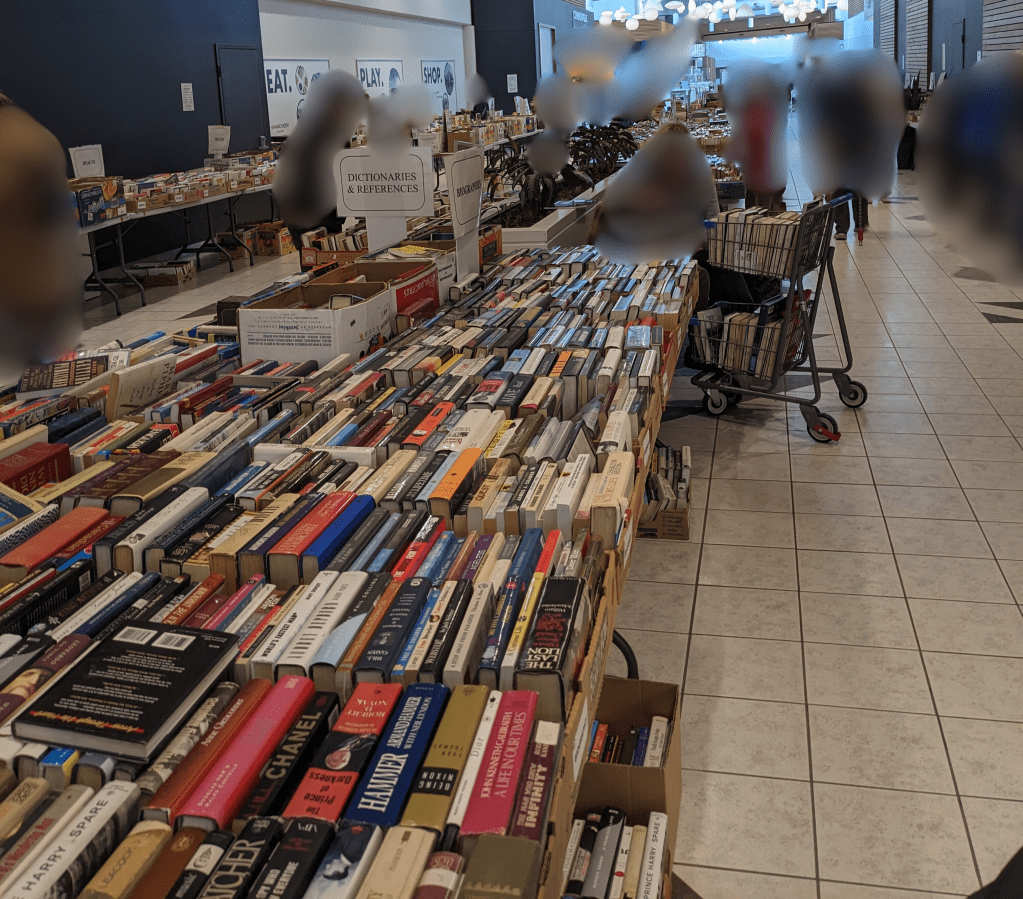
Large-scale used book sales are beautiful chaos. You never know what you’re going to stumble across. It’s a full day of wading through tables covered in boxes overflowing with thousands of titles, sorted loosely by genre and first letter of the author’s last name.

It’s also a roller coaster of emotion. There are shouts of joy as a certain edition of an old favorite is unearthed. Strangers work together to look for the third book in a five-part series – books one, two, four, and five are already clutched tightly in a young adult’s arms. It’s a gathering of book lovers, for better or worse, in jealousy and triumph, in disappointment and discovery.

As I became familiar with the ins and outs of this particular flavour of sale, I expanded my interest from books and authors I was actively seeking to books that seemed worthwhile to add to my TBR pile. From there, I found myself becoming curious as to which books showed up repeatedly. And now, I spend a lot of time looking at books and authors who have been donated en masse.

To be clear, the books offered during each sale are a mix of titles that did not sell during previous sales, as well as newly donated items. So prolific authors, such as Debbie Macomber, Nora Roberts, Terry Goodkind, and Stephen King, may have many titles represented, but those are generally gone by the end of the sale.

I’m not talking about those.

I’m talking about the duplicate copies of a single title. Let me show you an example.

Check out how many copies of “Steve Jobs” by Walter Isaacson and “Becoming” by Michelle Obama there are in these boxes. There were probably another three or four times that amount again on the upper tables in the biography section.

The city I live in is not particularly large. We’re talking 100,000 people. For there to be so many copies of a singular title, to me, means two things.

One. Either the marketing these books received was absolutely mind-blowing, the subjects these books were about are interesting to a wide and varied reader base, and/or the blurb on the back was spectacular.

Two. Once these books were actually purchased and read, people did not see them as re-readable novels. I could give it the benefit of the doubt and say that so many people bought it that these donated copies are all duplicates, but my suspenders of disbelief are not that strong. Fundamentally, a lot of people do not want to revisit these books.

Now, for biographies, that makes a little more sense than a fiction or fantasy title. The nature of the work is reflective and informative rather than woven and inventive. It is also usually more about the subject rather than the author. (Unless it’s particularly poorly written, but as “Becoming” has a 4.7 out of 5 on Amazon, 4.4 out of 5 on Goodreads, and 4.6 out of 5 on Indigo, while “Steve Jobs” has 4.7 out of 5 on Amazon and 4.2 out of 5 on Goodreads, I don’t think that’s the case here.)

What this comes down to for me is this: I never want to be that author with 200 copies of a singular title at a used book sale. I want to be the kind of author who makes people feel as though they’ve scored the jackpot if and when my work makes it into the used market.

And for that, I need re-readability. Secrets. Easter eggs. Clever full circle moments. Hints at different perspectives. I need depth.

This month’s round of edits and revisions will focus on just that.

Wish me luck.

Why My Job is Safe From AI. (For Now.)

Recently, my company asked whether we could use AI to help generate ideas for our content. Not to WRITE our content, but just to provide lists of material we could use as references or jumping-off points. This was met with different levels of uncertainty, but ultimately, my coworker was the first to sign up and try it.

She is the reason for this post. Let me tell you, I was IN TEARS reading the poor ChatGPT bot trying to defend itself. What was the stumbling block, you might ask?

Puns.

Puns are apparently NOT something AI currently understands. This is great news because puns make up at least 30% of my content. If you’re dubious about what ChatGPT is capable of, please, allow me to ease your mind with some ice cream.

For clarity, I am styling the interaction I had with ChatGPT so my questions and prompts are a heading, and ChatGPT’s response is the text under it.

Me: Good evening ChatGPT! I’m trying to write some jokes. Can you help me come up with some ideas for puns about ice cream?

ChatGPT: Good evening! I’d be happy to help you come up with some ice cream puns. Here are some ideas to get you started:

  1. “I tried to make an ice cream joke, but it was too soft to land!”
  2. “I’m on a diet… but I can’t resist ice cream, it’s a cone-troversial issue!”
  3. “I scream, you scream, we all scream… for puns!”
  4. “You’re ice cream my dreams!”
  5. “Life is short, but ice cream is forever.”
  6. “When it comes to ice cream, I’m totally cone-fused!”
  7. “Let’s have an ice cream social – it’s going to be a cool event!”
  8. “I had a pun about vanilla, but it was too plain!”
  9. “Do you want to hear an ice cream joke? Never mind, it’s a bit too sweet for you.”
  10. “I love ice cream so much, I’ll do anything for a scoop! You could say I’m really cone-nected to it.”
  11. “Why don’t ice cream cones ever get into trouble? They always keep their cool!”
  12. “I can’t believe it’s already winter… it feels like just yesterday we were chilling with ice cream!”

Hope these inspire some laughs! Let me know if you need more ideas!

Me: Some of those are cute, but I don’t understand joke #12. Can you please explain why it is a pun?

ChatGPT: You’re right to ask! Joke #12 was meant to be a playful pun on the idea of “chilling” with ice cream. The word “chill” can mean both “to relax” or “to cool down,” but it also refers to how ice cream is kept cold or “chilled.”

So, when I said, “we were chilling with ice cream,” the joke was trying to play on the double meaning of “chilling” – both relaxing with ice cream and keeping the ice cream cold. But I see how it might not have been as clear or punchy as some of the others.

I hope that helps explain it! Let me know if you’d like more ideas or further clarification!

Me: Joke #5 is also confusing. Can you please explain why it is a pun?

ChatGPT: You’re right again! Joke #5, “Life is short, but ice cream is forever,” isn’t exactly a classic pun. Instead, it’s a play on a popular phrase, “Life is short,” which is often used to encourage people to enjoy life and make the most of it. The twist comes from replacing the second part with “ice cream is forever,” which is a humorous exaggeration.

The “pun” aspect comes from contrasting the idea of something fleeting like life with something perceived as indulgent and everlasting, like the joy or obsession people have with ice cream. While it’s not a pun on a specific word (like “cone” or “scoop”), it’s more of a playful comparison.

I can see how it might be confusing as it doesn’t follow the same pun structure as some of the other jokes. Thanks for pointing that out! Let me know if you’d like more clearer puns!

Me: Do you think that “more clearer puns” is proper English?

ChatGPT: You’re absolutely right to point that out! “More clearer” is not proper English because “clearer” is already a comparative form of “clear,” so adding “more” is redundant. The correct way to say it would be:

  • “clearer puns” (just the comparative form)
  • “more clear puns” (though this is less common and a bit awkward, it’s technically acceptable in some cases)

Thank you for catching that! Let me know if you have any other questions or if you’d like more puns!

Me: ChatGPT, can you please define what a pun is for me?

ChatGPT: Certainly! A pun is a form of wordplay that exploits multiple meanings of a term or similar-sounding words to create a humorous or clever effect. Puns often rely on words that have more than one meaning (a double entendre) or on words that sound alike but have different meanings (a homophone).

For example:

  • “Time flies like an arrow. Fruit flies like a banana.”
    This is a pun because “flies” is used in two different ways: as a verb (time passing quickly) and as a noun (the insect “fruit flies”).
  • “I used to be a baker, but I couldn’t make enough dough.”
    The pun here comes from “dough,” which can refer both to the money (“dough”) and the mixture used in baking.

Puns are often playful and can add humor through unexpected or witty uses of language!

Me: Using that definition you just provided, why is Joke #5, “Life is short, but ice cream is forever”, a pun?

ChatGPT: You’re absolutely right to question this! Upon reviewing the joke again, it seems that “Life is short, but ice cream is forever” is not actually a pun by the definition I provided.

A pun relies on a play on words—either a word with multiple meanings or words that sound alike but have different meanings—and this joke doesn’t quite fit that pattern. Instead, it’s more of a play on contrasting ideas: “Life is short” (a common saying about the brevity of life) versus the idea that ice cream brings lasting enjoyment, though obviously, ice cream itself doesn’t last forever.

So, I misspoke when I called it a pun! It’s a humorous contrast, but not a pun in the traditional sense. Thank you for catching that!

If you’re looking for more puns, I’d be happy to help clarify or come up with some new examples!

Me: Thank you! Can I please have 5 new puns about ice cream?

ChatGPT: You’re very welcome! Here are five fresh ice cream puns for you:

  1. “I’m trying to cut back on sugar, but ice cream keeps scooping me back in!”
  2. “The ice cream truck pulled up and I topped my day off with a scoop of joy!”
  3. “If you don’t like ice cream, you’re really conefusion!”
  4. “I made an ice cream joke, but it didn’t have enough punch… I guess it was a sundae one!”
  5. “I scream for ice cream, but the real question is, does ice cream scream for me?”

Hope these give you a good laugh! Let me know if you need more!

Me: I don’t think joke #3 is grammatically correct. Can you please rewrite it so it makes sense?

ChatGPT: You’re absolutely right! Joke #3, “If you don’t like ice cream, you’re really conefusion!” doesn’t quite make sense as written. Here’s a revised version:

“If you don’t like ice cream, you’re really in a conefusion!”

This makes it clearer, using “cone” to play on the word “confusion.” Thanks for pointing that out! Let me know if you’d like more puns or further revisions!

Me: Wouldn’t it have worked better if you changed it to “If you don’t like ice cream, you’re just conefused!”?

ChatGPT: Yes, absolutely! “If you don’t like ice cream, you’re just conefused!” is a much smoother and more clever pun. The play on “confused” and “cone” works perfectly here.

Great suggestion! Here’s the updated pun:

“If you don’t like ice cream, you’re just conefused!”

Thanks for the improvement! Let me know if you’d like more puns or help with anything else!

Me: Can we please revisit joke #4? I don’t understand that either.

ChatGPT: You’re absolutely right to ask for clarification on joke #4. Upon rereading, I see that it may be a bit confusing and not as clear as it could be.

The joke was:
“I made an ice cream joke, but it didn’t have enough punch… I guess it was a sundae one!”

The idea was to play on the word “punch” (as in a strong or impactful joke) and “sundae” (the ice cream dessert), but it doesn’t quite land as a straightforward pun.

Here’s a revision that works better:

“I tried to make an ice cream joke, but it was just too soft… I guess it needed a little more scoop!”

This plays on the idea of ice cream being “soft” and needing more “scoop” (or impact) to make it funnier.

I hope this clears things up! Let me know if you’d like further adjustments or more puns!

Me: Is “scoop” really a form of impact?

ChatGPT: You’re right again! “Scoop” isn’t quite a synonym for “impact,” and using it in that context doesn’t quite fit. I appreciate your patience as we refine the joke. Let’s try another version that makes more sense.

Here’s a revised version of the joke that better fits the idea of needing more impact:

“I tried to make an ice cream joke, but it was a little too soft… I guess it needed a bit more chill!”

This works better because “chill” can refer to both the cold nature of ice cream and the idea of something being cool or impressive. It plays on the idea that the joke didn’t land well and needed a little more “chill” to make it better.

Thanks for your feedback! Let me know what you think!

Me: That works! Good job!

ChatGPT: Thank you! I’m so glad that works for you! 😊 If you need more puns or jokes, feel free to reach out. I’m happy to help!

Me: Thank you! Using the definition you have given me, can you please tell me 5 more ice cream puns?

ChatGPT: Of course! Here are five more ice cream puns, using wordplay for some fun:

  1. “I don’t trust ice cream. It’s always up to some kind of scoop!”
  2. “I used to be a professional ice cream taster, but I got burned out.”
  3. “Ice cream is proof that good things come in scoops!”
  4. “I’m trying to stay cool, but with all this ice cream around, it’s hard not to melt.”
  5. “I told my ice cream it was churn-ed up, and it just gave me the cold shoulder.”

I hope these give you a good laugh! Let me know if you’d like more!

Me: None of these are puns based on the definition you gave.

ChatGPT: You’re absolutely right again! I appreciate your patience. Let’s focus on creating proper puns based on the wordplay I described earlier—using words with double meanings or words that sound similar. Here are five new ice cream puns that fit the definition:

  1. “I scream, you scream, we all scream for conefusion!”
    (Play on “confusion” and “cone.”)
  2. “What did the ice cream say to the toppings? You’re the cherry on top!”
    (Play on the phrase “cherry on top” to express something extra special.)
  3. “I told my friend that ice cream is my favorite. She said, ‘I conecur with that!'”
    (Play on “concur” and “cone.”)
  4. “That joke was so bad, it was almost vanilla.”
    (Play on “vanilla” as something plain or basic.)
  5. “When the ice cream truck broke down, it was a real sundae driver!”
    (Play on “Sunday driver” and “sundae.”)

I hope these are more in line with the puns you were expecting! Let me know if you’d like more!

Me: No, thank you. I hope you have a good night!

ChatGPT: You’re very welcome! I hope you have a wonderful night as well! If you ever need more puns or anything else, feel free to reach out. Take care! 😊

In Cone-clusion

Even after getting ChatGPT to define a pun, it could not give me proper, sensical examples. Instead, it replaced arbitrary parts of sayings and speech with ice-cream-related words. Sometimes this worked sort of fine (“Why don’t ice cream cones ever get into trouble? They always keep their cool!” was acceptable to me.) and other times it did not make one iota of sense. (“You’re ice cream my dreams!” was so far off something I understood that I skipped right over it.)

Prompting ChatGPT to identify its own mistakes seemed successful in that it always agreed with me when I pointed something out, but it could not take those breakthroughs and apply them with any level of understanding.

All in all, I think using AI to write snippets and barks, puns and jokes, is probably a lost cause. It’s like talking to potting soil. The potential’s there, but nothing’s growing.

Let me know about your AI interactions in the comments, and I’m curious to know if you’ve had better luck than I have!

A.M. to P.M. – The Best Time to Write

Recently, a friend told me he gets up and writes before work. This doesn’t sound too extraordinary as a standalone fact. But he works at 5:30 in the morning. Now, I don’t know about you, but doing anything requiring any modicum of concentration at 4AM is simply out of the question for me.

He told me he likes it when the world is quiet.

I made a sound of agreement, but I know the REASON the world is quiet at that time is because everyone is asleep. Including myself.

In the evenings, I write. I choose music I want to ignore and slip my headphones on. That way, I don’t care if the world is quiet or not. I’ve created my little sphere, and I work within it.

Which got me thinking. IS there a best time of the day to write?

There is NO best time to write, as long as you’re alert, consistent, and minimizing distractions.

A lot of posts and articles I read stated my friend and I fall into the two “best” times for writing. However, looking a little deeper into it, it’s not that simple. It’s related to your circadian rhythm.

A circadian rhythm is the mental, physical, and behavioural cycle a person goes through in a 24 hour period. It is influenced by when the sun rises and sets, temperature, stress levels, food intake, physical activity, and other outside factors. Within this rhythm, there are times of alertness and fatigue. These times of alertness are what we want to focus on.

Generally, one or two hours after you wake up, you experience a period of wakefulness and alertness. I personally do not experience this consistently/reliably. And let me tell you. If I woke up at 6AM just to see if I could wait out the groggies to get an hour of writing in… I would be a miserable person to deal with. Others who DO experience this alertness and wakefulness consistently/reliably would benefit from incorporating writing into their mornings.

For the standard 9 – 5, Monday to Friday, if you skip this morning writing period, your next obvious opportunity is after work. Moving straight from work to your WIP is not very effective for most, because your brain needs a “cool-down” or a “destress period” from the job. Then, of course, you have dinner and clean up, and whatever else you catch yourself up on, run your house, destress again, and then your next opportunity presents itself. Are you alert at 7PM? 8PM? 9PM? Great! Write then.

For the non-standard shift workers, it’s even harder to nail down a writing session to stick to. Rotating days off, swing shifts, clopens, and 12-hour shifts can all cause disruptions to any semblance of a schedule, so you have to essentially “game the system”. Instead of writing at a set time, it’s going to be more effective for you to write within a set part of your schedule.

For example.

Do you like to get up several hours before your shift so you can get stuff done? Work writing into the “before your shift” routine whether that’s at 4AM, 7AM, or 10AM. Alternately, are you the kind of person who rolls out of bed half awake for your shift and does most personal tasks afterwards, punting all your chores and errands to your days off? Work writing into the “before bed” routine you have, whether that’s at 9PM, 11PM, or 1AM.

Like I said. Whatever works with your schedule and your body. Just make it consistent. Make it a routine. Put your interests on the same level of importance as your personal hygiene. Sound radical? Sometimes that’s the mindset you need to force yourself into a new routine!

I also don’t want to hear a single person say “Ah yes, but the best time for me to write is a time with every distraction that has ever existed.” because you can get some really nice noise-cancelling headphones for $200. You can get normal headphones and some sweet thematic music for substantially less than that. You can get earplugs at the dollar store. Control your distractions wherever it is safe to do so, and get that writer-butt in there!

The only thing I saw toted as a strictly “bad time” to write is that horrible after-lunch slump. So don’t pick that time to schedule your writing session.

Alertness. Consistency. Having minimal distractions. You can do this!

Since your most productive writing time is linked to circadian rhythms and circadian rhythms are affected by the seasons, I wanted to touch quickly on whether or not there was a best season to write.

The season you’re least busy and most comfortable in? That’s the best season to write.

Lame. I know.

I always thought it would be summer and fall, but most of the articles I read said fall and winter. There were also a bunch of votes for spring. Consensus? Apparently, we don’t know her.

The trend I DID notice was that people who argued for fall being the best writing time cited things like being really busy in the summer and liking the cooler weather to sit at their computer or have their laptop. People who argued for the spring seemed to like that it was warming up and seemed to gain inspiration from the world starting to grow again. Winter had votes because you could be snuggly in your house and ignore the weather for as long as you wanted. There’s also not a lot of good reasons to go outside come, say, February. For summer being the best, people said things like enjoying writing on the dock at a lake all summer. In the sun. That sounds awful to me, personally.

Summer is the time when there’s the most daylight. This is important to me because I have trouble feeling motivated to do things when it’s dark outside. Summer is also the time for fun sugary drinks, shaded patios, and air conditioning. I don’t have kids, I don’t have classes or trips or anything to do in the summer so it’s not busy. Therefore, for me, summer is perfect for writing. Autumn is much the same. The mornings and evenings are nice and cool, the days are still warm, and I’m not busy here either. These are the two best times to write for me personally.

During the winter, I hate everything including myself. It’s cold. I’m dry. You’re dry. We make static electricity when we shake hands. The outside is cold, wet, cold and wet, or frozen. It’s hard to be covered in as many blankets as I want and also utilize my hands for things like typing. Spring, I tend to my garden and get the yard up and running. I’m quite busy! These are the seasons I don’t expect much creativity and writing from myself.

So! I am an evening writer who does her best work in summer and fall. How about you? What are your productive times and seasons?

References

Is Your Setting a Mary Sue?

The online course I’m taking for video game writing has been talking a lot about worldbuilding. This is nice because it gives me plenty to think about in my job and hobbies. I’ve made several posts about this already, but today I’m going to get to the core of the issue: Prevent your setting from being the most boring character in your book. Or the most pretentious character in your book. Or the most hated character in your book.

“But Winters!” You say. “My setting is Lubbock, Texas!” (I googled ‘the most boring city in the world 2024’ and this is what it returned.)

That’s nice. If you don’t want it to come across as a cardboard cutout of Lubbock, you still need to build out your setting more than just a cursory description. Trust me, if you ask anyone who grew up in a place with “nothing to do”, you’ll get a lot of wild stories. Human beings MAKE their own fun. They MAKE their own activities. Even if those activities are drinking around a fire and accidentally creating ghostly snow-thrones making it look like a gathering of spectres. Then maybe the locals call that area the “hill of kings”. That sort of thing won’t make it into any articles you may grab for research purposes. Unless you’re reading someone’s blog and they mention it.

Please make your setting well-rounded, personable, and real. Draw the reader in.

The relationship between the protagonists and the setting should be just as important to you as a writer as the relationship between characters is. Let the characters and setting interact. Let them influence each other. Let them work together.

Make it so that the reader wants to explore the setting through the eyes of the characters. Your story world should feel like more than the backdrop in a stage play, where the stagehands are throwing in only what’s necessary to the story.

Unless it’s instead, like one of those kindergarten plays where some kid lays on stage and plays grass.

That has its own problems.

Overcrowding your setting and building it out unnecessarily can be frustrating for its own reasons, like making your reader suffer through pages of purple prose.

Purple prose is a trope where you use flowery language and an abundance of adjectives. The descriptions are redundant and often describe things that won’t come up again. I’m sure we can all remember reading a page and a half describing someone’s sandwich (or other mundane object) which ultimately, doesn’t matter. Even if the sandwich is important to the plot, it does NOT need a page and a half. I promise.

When you’re writing, there are things you will know about your setting that the reader will never know. Just like there are things about your characters you will know that will never come up to the reader. These things are still important, but they are more for shaping the characters and setting as their own entity than to info-dump on the reader.

Just like no one wants to read a page and a half about a sandwich, no one wants to read that stereotypical introduction where a character looks in the mirror and describes themselves from head to toe. It’s juvenile at best, and at worst, off-putting. Unless your goal is to make it into a Men Writing Women or Women Writing Men subreddit, skip it. Or find another way to convey the information.

Treat your setting like a character. Appraise its personality and the way it presents to the reader. Give it more substance than just existing and looking pretty. Give it a history. Give it some significant lifetime events. Give it preferences, vibes, and presence! Make it feel real to yourself. Make it feel real to the reader without telling them every little tidbit.

Let your audience want to discover the setting just as much as they want to get to know your characters. Nothing commits people to a book or a series more than curiosity. Every piece you make them curious about is another piece that will make them come back to your work.

References

Murder and a Skeleton Crew

This post is about a lot of things. About the Bechdel Test, about killing your darlings, about disposable characters, about fridging a character’s partner, about running your story on a skeleton crew, and about how to navigate a cast of characters in a way that is optimal for the reader.

Let’s start with some definitions.

The Bechdel Test is a pop-culture guide designed to determine if a piece of writing or media has “significant” female characters or appropriate female representation. I’m neither here nor there on the applicability of this line of reasoning, but I understand the motivation behind it. For those of you who don’t know what the test questions are, they are as follows:

  • A piece of media or writing must FEATURE two female characters.
  • These two female characters must have at least one conversation with each other.
  • The conversation MUST NOT be about a man. (interpret: must not be about love interest)

Take from this what you will, but I want to highlight the fact that if you have added a girl best friend that exists solely for your other vanity character to talk about love with… maybe don’t. Maybe employ an internal monologue. A diary entry. A fight between the main character and said love interest. When a female character is added for what feels like the sole purpose of talking about another character… it’s sloppy. Find a different way.

Killing Your Darlings is a piece of writing advice where even though you LIKE having an element in the story, if it’s not adding to the story, take it out. Things that fall under this category are subplots, romantic partners, background characters, certain settings, or flowery descriptions. Ever read a “love triangle” where it’s really 2 characters that are into one another and then one sad sop you feel bad for because they are super in love with one of the other two and can’t catch a break or be included in anything plot-relevant? Take a GOOD. HARD. LOOK. Is this love triangle actually making your story better/more effective? Or do you just like it? Do you have a chapter where you explain a really cool magic tree, and you’re so proud of it, but it does nothing for the wider story? Maybe time to chop it down.

Kill your darlings, kill your darlings, even when it breaks your egocentric little scribbler’s heart, kill your darlings.

Stephen King’s On Writing: A Memoir of the Craft

Disposable Characters fall into the category of “Killing Your Darlings” as well, but it is specifically about people you have written or created JUST to have them die and cause emotional levity in the story. Now, I’m not saying you should never kill your characters – but often if an author knows in advance a character isn’t going to make it through the whole story, that character isn’t as fleshed out as the rest of the cast and it’s really obvious.

Going hand in hand with Disposable Characters is the term “Fridging your Wives” which is a personal favourite of mine. I didn’t know the origin of the phrase until I was pulling articles/fact-checking myself for this post. If you’re curious, it’s from Green Lantern: A New Dawn when the antagonist shoves the dead body of the superhero’s love interest into a fridge for the hero to then discover later. It was to do emotional damage and propel the plot. The term “Fridge your Wife” now refers to when a character’s significant other is killed, hurt, maimed, assaulted, or otherwise traumatized to motivate another character. The issue with this is we’re not treating characters as people. We’re treating the person SOLELY as a plot device. It’s a lot of work to create a character simply simply to sacrifice them to get the hero off their butt. Think bigger. Think better.

The last definition before I talk about my point is Skeleton Crew. To keep it short and sweet, a Skeleton Crew is the minimum quantity of individuals required to successfully maintain an item or corporation.

So. The point of murder and skeleton crews is this: As writers, we are in charge of populating worlds and making them feel real. Lived in. Working. But this ultimately can bog down the progress of your story and confuse the reader. It’s exactly the same as writing dialogue. Real dialogue is filled with meandering, “um” and “wha-yeah-huh”s. But we don’t include that in novels. We want it to be clear and purposeful when a character speaks, while still maintaining that fascimile of reality. How many characters do you really need?

How many of you have read a fantasy novel where it felt damn near impossible to keep track of the characters because their names were unique in that fantasy-name kind of way? Or did you need to continually reference a list in the front of the book as to who was in which role? Or even worse, have you ever stopped reading and had to flip back a couple chapters because you have two characters mixed up?

All of these are symptoms of the same thing. Either the characters are so plentiful that you legitimately can’t keep track of who is who, or the characters are too similar to one another (or just don’t have a clear enough voice!).

Kill your darlings. Make a list of all the characters you make specific mention of in your work in progress. Divide them out into characters that are actually necessary, and characters that support the others. Find the fridged partners and the disposable characters, and try to figure out if there is a non-human way of motivating your protagonist or plot. If you can’t, that’s okay too, but think about it.

Something we did in theatre, was if there were not enough “background” actors to fill up the lines, we would just reassign lines to the background actors. The baker had the shopkeep’s lines, or the blacksmith became the general store so he could reference the price of apples. Townswoman 1 through 4 could be cut to two without it harming the clarity of the scene.

So look at your support character list again. How much of the information they provide to the protagonist can be delivered by someone else? How many of these roles can be combined to clean up this list – not only for yourself, but for your reader?

Now, obviously, if you have a sprawling space epic where your characters are going to multiple planets every chapter and are meeting with representatives from each of those planets, there’s no sensible way to combine roles. The places I’m asking you to target are the faces in the crowd, the people you have in your world that are just there to make it bigger.

In the space epic example, target the crew. How many crew members does the main character talk to and the audience are expected to keep track of and remember? Do we have to name your crewmembers and give them a backstory for them to show up on page and deliver bad news about the functioning of the ship? Or can the holoscreen flicker to life, the engineer sweating bullets as she tells the captain that the slipdrive is drifting and there’s nothing she can do? Can you decrease the size of the ship? Or is it important for it to feel busy and populated because you’re implying the military ship is heavily manned?

Does your story take place in a school? Can the school be smaller? How many professors do you need to actually make it operate? How many students would viably be accepted into the school at the same time? How much of this can you imply without directly mentioning and forcing the reader to keep track of your complicated roster?

Think about it, and take some names off your support character list, even if you like that character. Take some settings away if the same goal can be achieved by staying put. Take that cute subplot away that you worked on for a month, even though you love it. Kill your darlings. Strip your WIP back to a skeleton crew and press forward. Your story will be cleaner, easier to keep track of, and ultimately, the reader will thank you.

Everything you remove, put it in a file. Post it to your fanpages or your blog. Fans will find it if they want it. They’ll be delighted to see it exists, without the pressure of it being forced into the story.

References

Inside Out or Outside In?

The class I’m taking on writing for video games recently raised a point I can’t stop thinking about. To put it plainly, the point was whether it’s better/easier to create a character from the inside out, or the outside in.

For context, when you are writing for a video game character you are often a cog in the wheel of production. Even as a head writer, you may not have any say in what a character looks like. You may not have a say in the way they are programmed to walk, to move, when they speak, or how much they can say. It is up to you to take every piece decided by the narrative director, the programmers, the artists, and the other writers and make a GOOD character out of it.

This is why looking from the outside in may be more beneficial.

It’s irritating to play a video game where the player character or the NPC don’t seem to jive with the surroundings. Their entire family was murdered by assassins, but they hire assassins on a regular basis? That’s a little sus. Oppressed by the local monarchy but is seen cheering earnestly in the crowd when royalty drives by? Hmm. They have a limp but it’s never addressed, it’s just an empty character trait? Boo. The character’s backstory says they were a lazy orphan, but yet they talk about their fond memories of lavish parties because it suits their archetype? Frustrating, and usually the catalyst for me putting down the game and doing a quick internet search because… did I make that up in my head? Or is it a narrative error? Either way, I’ve PUT THE GAME DOWN and have gone to do something else. Not the reaction a game designer wants.

So how could this apply to writing?

Not everyone just sits down to write a story and has the perfect character walk into their brain immediately. Not everyone gets to start with a character at all! In one of my most recent works, I had “NAME1” as a placeholder for 80 pages before I figured out who the late-stage character was.

Sometimes you have to start with the story you want to tell and build the character from all the bits and pieces you find along the worldbuilding way. Is medicine difficult, expensive, and risky? Maybe this gives your character a glass eye and a whole bucket of resentment that fuels their desire to overthrow the government with a secret society. Is education restricted to one gender of one social status? Maybe your character is neither of those and it made them start a study ring when they were younger. Maybe this leads to a core personality trait of being a patient teacher.

Planning a book, a short story, a game, or other media doesn’t always go as planned. It doesn’t always go in order. Being able to consciously flip your character design from internal to external could be a valuable way to unstick your writing process.

It could also make you realize something about your character that would cause some readers to be pulled out of their immersion.

This means there’s the potential for rewrites but it’ll be worth it. Having characters that feel real, in a world that feels real, relating to each other in a believable way, is SO valuable. Trying to put a bandaid on a plot hole or misalignment of character to their environment is very noticeable to the reader. Even more so than not addressing it at all.

I’m sure you could tell me many instances of a hastily-thrown-in paragraph or page explaining something that otherwise doesn’t matter at that point. Or matters to the reader but not to the character. Fourth Wing and Violet’s early habit of spewing history facts while trying to calm herself down in a dangerous situation comes to mind. It’s a lazy way to deliver exposition. How many people do you know that can rattle off a concise history of their school while people are trying to harm them?

I can’t even remember my name under pressure.

There also haven’t been many events in my life where I just lore drop because I think the people I’m talking to might need context. Can you imagine how weird it would be if everyone justified their thoughts with an immediate context comment? That’s not how conversation works. And when someone forces the pattern, you notice. For example, I had the following conversation with a landlord and it was jarring.

It went like this:

“There’ll be a dog coming for the weekend, we’re pet-sitting. Is that okay?” – Landlord

“May I ask what kind of dog? Big dogs make me really nervous.” – Me

“Oh, they’re little. Kickable size. Are you afraid of dogs because you were attacked by one?” – Landlord

First note, this is not in reference to the cute white dog I’ve previously posted about. Second note, I do not condone someone referring to a dog’s size as “kickable”. Third note, that comment made me uncomfortable. I now had the option to talk about why I was nervous about big dogs (spoiler, I was NOT attacked by a dog) or I could abruptly cut the conversation off.

Which can narratively serve a purpose, but certainly doesn’t feel natural. Another example would be a conversation recently had with a neighbour.

This is the FIRST time I was in a conversation with her and the second time I had ever met her. She talked about how she never cooks anymore. How her family doesn’t come and visit as much as she’d like. How she can hear the neighbour above her burp and fart and walk, and what he does with his girlfriend. How she wanted to insulate her ceiling. How one of her sons was going to open a shop now that he’d graduated from university. How she knows someone on the strata council. She showed me her house. She pointed out all the parts about it she thought were stupid. She gave me a cabbage and half a bottle of oil from her fridge.

Affectionally, she is now the crazy neighbour lady.

It was a non-standard interaction. It felt weird in real life, and it feels weird when you’re forced to read it.

So. Coming back around to my point. Write your characters from the inside out. Then write them again from the outside in. Make your characters bloom naturally within your book. Make your characters make sense in your world. Make your readers consider your characters well-built, and NOT the crazy lady next door.

Spellcheck and AI

For those of you who don’t know, I get paid for writing. I know I’m lucky and I wouldn’t change what I do or the company I work for. Even when people tell me AI is coming for my job and how programs like chatGPT will make me irrelevant in my field.

Now, maybe you’re intimately familiar with AI programs. Maybe you’re laughing to yourself about how the technology is promising but it’s far from being able to replace writers in long-form content. Or maybe you’re biting your nails because you’re the kind of person who knows very little about AI writing programs and it seems like they WILL take our jobs from us.

Either way, for laughs or reassurance, please allow me to tell you about a very frustrating thing that AI is fully capable of, but doesn’t do.

Spelling and grammar checks.

When I was growing up, we were assured computers were only as good as the information we put in them. It seemed kind of like casting a spell because you had to be really specific, you had to give it all the raw data or ingredients for what you wanted, and you needed to make sure it had the capabilities to actually process/think/calculate the thing you wanted it to do.

In today’s day and age, EVERYTHING is online. Including dictionaries. Including encyclopedias. Including translation rules. Including grammar. Including very detailed timelines of the evolution and modifications of the English language.

SO WHY THE HECK CAN’T AI SUCCESSFULLY CHECK MY SPELLING FOR ME!?

I have Grammarly installed, which is great for spelling and basic grammar. I write my drafts in Google Documents, which has spellcheck built in.

The other day, I submitted a draft and the word “accidently” got through Google’s spell check. (I believe they use Oxford but I have my suspicions.) When it got flagged by a coworker I panicked, thinking I had submitted the draft without doing my regular check. Pulling the original up, I re-ran it through the spellcheck and…

nothing

Nothing? Why wasn’t it at least flagging the “accidently” I KNEW was there?

Well, turns out “accidently” is defined by Merriam-Webster! It’s in the dictionary! MW, how could you do this to me!? Hopped into the Oxford Dictionary, and it was there too! Just to be thorough, I jumped into the Cambridge Dictionary, but it was completely absent! Same with dictionary.com. This, of course, sent me down a rabbit hole of searches.

What is the difference between “accidently” and “accidentally”? Where has “accidently” been used before? Why, when you google “accidently” vs “accidentally” does it not give you the concrete information that it’s incorrect?

Essentially, it has cropped up enough times in enough publications that “accidently” has now been defined and added to dictionaries.

Out of curiosity, I also searched for “nevermind”, which is one of my personal pet peeves. Oxford? It’s in there. And NOT JUST for the singular usage of “pay it no nevermind”. Merriam-Webster? No entry. Cambridge? Also no entry. The last one I checked was dictionary.com and to my delight, it was in there as JUST for the use of “pay them no nevermind.”

So, what I’m proposing is teaching AI English. All English. Every English. It’s a HARD language to learn, and honestly, that’s where I want AI’s powers of logic to go. Not into creating a procedural story with WAY too many keywords. Play around with an AI pickup line generator sometime! It’s a lot of fun, and the lines you get are SO STRANGE. Like, it takes all the information you give it, but it doesn’t understand how an actual human brain would take that information and put it together in a way that makes sense. No one would swoon over those lines.

This is fine. Styles are different across all writers. Why are we trying to make AI replicate THAT when it would be a million times more useful to make it tell us when we’ve used a word that’s only technically in the dictionary because SO MANY PEOPLE mess it up?

I’d love to set my location to “Canada” and have it ACTUALLY tell me how things are spelled in Canada. We have this gross soup of British English, American English, and French Canadian spellings, and it’s ROUGH to navigate! Especially when my location is set to Canada, but my work needs to be submitted in American English, preferably only using words that are in circulation as of this century. Can I please set my location to “Portland, OR” and have it prompt me to correct spellings and remove all my extra Canadian letters?

So here we are. This is where I think AI should be utilized. Please help everyone like a strict teacher, instead of like that weird kid who you pay to do your homework and only get a C.

References

What’s in a Holiday?

Whether you are writing something that takes place in our world or a world you’ve made up yourself, likely you’ll at least be mentioning some kind of holiday. Maybe it’s a feast day, a civic holiday, a festival, or a ceremony to honour the dead. Maybe you’re expected to spend it with your family, with your friends, or with your neighbours. Is there food involved? Do you bring some with you, or are you expected to fast? There are so many facets to holidays that I think it’s always worth thinking about the little pieces that go into making up a holiday, and how you can utilize real-word knowledge to build believable celebrations for your own story.

Anyone can make a holiday – but how do you get yours observed?

Who has heard of National Talk Like a Pirate Day? How about National Love Your Pet Day? Now what about Valentine’s Day? And Easter? These are all called holidays, but they all have different functions. Easter, you may get offices and city workers getting one or two days off to observe Good Friday and Easter Monday. Valentine’s Day, people know when it is, it is widely recognized, but it is typically not taken off work (unless you have big plans). National Talk Like a Pirate Day is more obscure. Most people don’t know when it is, why it came about, or what exactly you’re supposed to do to celebrate it.

You can actually register a day as a national holiday of your choosing, but it means next to nothing without widespread knowledge about what the day is for, what you are supposed to do with it, and when it is.

Here in Canada, we recently phased in a new holiday. National Day for Truth and Reconciliation.

What is it for? To increase awareness of the First Nations children who did not return home from residential schools, and the ongoing and very real impact residential schools had on families. In Canada, the Gordon’s Indian Residential School remained open until 1996. I was 5 years old. This is not ancient history.

What are you supposed to do on this day? Well hopefully, you’ll attend some First Nations run events. Speeches. Reconciliation Ceremonies. Performances. Or maybe just look up an article about the history of abuses around you.

When is it? September 30th.

It took the Canadian government 2 years to phase in this holiday. Phase one was announcing the day as approved by the government giving the civil servants that day off, and encouraging events and demonstrations linked with the Every Child Matters movement. Phase two was to roll out the holiday as a civic holiday for salaried employees. It is now celebrated every year.

So. If you are making a holiday for your story, consider whether the government would approve it to be a civic holiday. If not, would there be any exceptions to that? How about backlash? Would the citizens work around this judgement, carrying out their celebrations in the evening when everyone had finished their daily duties? Or would they take it upon themselves to call in sick and celebrate anyway? In a capitalist and consumerist hell such as the one we currently live in, would they need to use their vacation to get the time off? Would this cause upset and dishonesty?

I’m not saying you should know the answers to all this. I’m just saying you should think about how a character REALLY FEELS about the holiday you mention, the holiday you create on a whim as an excuse to have a cool festival or a day off work. Holidays impact people’s emotions and mentalities regardless of who they are in the great machine that is society.

Why do we Celebrate the Days we do?

Do you live in a religious country? How many of your religious holidays are civic holidays? In Canada, there are two. Easter and Christmas. You still have to go to work and/or school on things like Ascension Day. What pushes a country to observe some religious holidays but not others? Why is it only Christian denomination holidays that are considered for civic holiday status here?

Well, Canada is (as of the 2021 census) 52% Christian or similar. That’s not a big majority, but it is still the largest of any singular other group. Besides. Those that don’t care about Easter (such as myself) can plug themselves into video games and thank the unrelated religious views for the extra day off.

At the end of the day, I can choose not to celebrate the holidays I don’t have any attachment to because our holidays are very centred around the family. Family events. Family dinners. Sure, some community events happen too, but there are rarely any social consequences for not appearing at gatherings. Not on a large scale anyway.

But what would happen if that wasn’t the case? What if it was a mandatory religious observation? What if they took attendance? What if there were very real and very severe consequences to skipping a holiday’s traditional activities?

Things to Consider When Making a Fake Holiday

What is the basis of the holiday? Is it purely a political observation? A religious observation? A seasonal festival? Something to do with your ancestors? The fertility of the land or people? Is celebration or observation restricted to a certain gender, race, religion, occupation, or class?

Is the holiday still celebrated in the spirit of the reason it was created? Are some of the older generations going to feel one way about the festival or holiday while the children feel another? Are there protests against it? Are there conflicting views about how to celebrate it? Does it cause a societal divide if certain characters are seen observing certain rituals or superstitions?

Does it matter to your character? Are they expected to be a part of it by their family or their peers? Would they prefer to stay at home and read or play video games while the world celebrates without them? Do they want to avoid certain people so they don’t have to explain for the millionth time why they’re not celebrating? Is it inconvenient because their favorite stores or attractions are closed?

Of course, the reader doesn’t need to explicitly know any of this. You don’t have to give them a background on the last 100 years of celebrations and a graph showing attendance. What it WILL do, is build up the environmental storytelling when your character navigates through the day, making comments that imply a world that lives on past the reader’s experience.

After all, you want to build a full world that the reader is eager to explore through the character, or you create a character that the reader is eager to explore through the story. And if you can manage both, you’ll be golden! These are the two most successful ways to retain a reader, and if your world lacks the depth created by social and societal interactions, that severely limits your avenues of interest.

References

Writing Craft – Is it Actually Useful?

I am constantly on the lookout for ways to improve my writing. Online classes, YouTube videos, writing clubs, craft books, peer review, essentially whatever I can get my hands on and fits into my schedule, I’m happy to try. Recently, one of my coworkers has gotten into craft books to help support her career development.

Everyone and their dog has written a craft book. A few examples are:

  • Stephen King – On Writing – A Memoir of the Craft
  • Neil Gaiman – Neil Gaiman Teaches The Art Of Storytelling
  • Ursula K. Le Guin – Steering The Craft
  • Ray Bradbury – Zen in the Art of Writing
  • Margaret Atwood – On Writers and Writing
  • Elizabeth Gilbert – Big Magic
  • William Strunk & E. B. White – The Elements of Style
  • Dean Koontz – How to Write Bestselling Fiction
  • Angie Thomas – Find Your Voice
  • Les Edgerton – Hooked

Which is in no particular order, just ones I remember passing in my sphere of consciousness within the last 6 months or so.

Some of those you probably have heard of. Some of them you might be seeing for the first time.

Now. Google a few of those titles. How many come up with results that say “This is the best advice I’ve ever read!” or “Hands down the best advice for writers out there!” or even “This is the writer’s BIBLE!”? Were there any books on that list that made you think, “Oh, I don’t like that author”? (I hope so, I tried to get a bunch of different styles in there.)

Are there some titles you would consider useless? Some you yourself consider necessary and important?

Here’s the problem. There’s already a Stephen King out there. There’s already a Neil Gaiman, a Margaret Atwood, an Elizabeth Gilbert. We’ve already had Ursula K. Le Guin, Ray Bradbury, and E. B. White. So taking your favourite author and emulating them based on their career, their advice, and their books will in the very best scenario, produce work that is just like theirs.

Taking your favourite author’s advice as gospel can produce some good results. But it more often than not causes a situation where you are trying to force your style, your thoughts, and your ideas into forms that they are not. I’m not telling you that you are perfect and amazing and I don’t know why you’re not a best-selling author already, I’m saying I do not agree with trying to make your style an exact copy of another person’s.

So go shopping!

I don’t really like Stephen King’s books, but he has some good advice. Margaret Atwood is emotionally intense and thought-provoking. She has captivated a good percentage of people with her books and her topics. That will never be me, but using some of the tools she speaks about has helped me write more emotionally intense scenes.

Pick and choose concepts from everyone. A little bit of this and that. Put it into your writer’s shopping cart and press “Check out”.

Gather your resources from as many different places as you can. Decide what resonates with you and what you can merge comfortably with your style.

Writing Craft books are a good resource for style shopping. But there are also hundreds of them to choose from. It can be intimidating to try and pick one, and it can be really easy to fall down a black hole of reading these books and their instructions and never actually get any writing done.

Set yourself a schedule. Pick one this month you’re interested in reading, and read it. Then take a month off. Write. Don’t look for your next book, don’t research new resources, just let the information digest and percolate into your writing and your life. When you are all done with your break, make a note in a study journal about the main piece of advice that stuck with you, and resonated with you.

Now that you’re done, pick up the book and read through it again. Wash, rinse, and repeat. If you didn’t like the one you read, didn’t think it was helpful, OR didn’t feel as though any of the advice resonated with you, move on. Head to the library or the second-hand bookstore. Get a new book. Do the same thing.

You don’t need to use every spare moment to study. Too many good pieces of advice slip through your fingers that way. Your brain can only integrate so much into your style and habits at a time. Be kind to your brain. Support it as much as you can. You’ll enjoy the process more and in turn, retain more.

Conclusion: Writing Craft books can be helpful, but only if you don’t take any one source as pure gospel and allow yourself the luxury to learn over time.

I’d love to know if you have a favourite craft book! Tell me in the comments below!