Recently, I was invited to a poetry reading. An amateur poetry reading. Visions of a room full of beret-wearing college kids filled my mind, all snapping after one word is spoken into a microphone on a sparse, poorly-lit stage. It could be any word, but it’s spoken artistically. If you don’t see the way ‘balustrade’ perfectly reflects the social situation of racial tensions in some faraway country, then you’re not artsy enough to be here.
Of course, that’s nothing close to what it was like.
A historical building converted into a coffee shop. Mismatched tables and chairs are crammed into any space available. A great, old, carved bar serves as the order counter. The smell of coffee and pot pies hangs in the air, and soft acoustic music allows for hushed conversation and the sound of scratching pencils against notebooks. Yeah, okay, the building itself passed the vibe check.
But the people? They were all sorts.
A traditional Goth sat in one corner with her drink. A couple on a date shared desserts off of fine china. My own soda bubbled, and my sister’s tea steamed. A raggedy man, a middle-aged businesswoman, and an artsy type share a table and some sort of card game. Peppered throughout the building are young adults dressed in black. Someone knits. Another crochets. A third is drawing with confident strokes in a sketchbook. A couple of people are reading.
This is the scene I joined, waiting to find out what kind of experience the event would offer.
The first poet stood with trembling hands and a downcast gaze. She read her words as she had rehearsed. Her voice was even, but it seemed as though a tremble waited for only the smallest opportunity to creep in. Her poetry was good, but at the end of her segment, I was left uninspired. Unmoved. But not uninterested. Hers were words to devour with your eyes, not the sort that called to your imagination as a siren calls to a sailor.
The second poet took the stage. Feet rooted as those of mountains are, she began with a bang. Or rather, a swear.
Now, I don’t typically enjoy things that use vulgarity for shock value, but somehow, this time, it was perfect.
Galaxies and bones stirred my mind. Heartbreak and betrayal, alien to me, haunted my fabricated memories. It was raw. It was uncomfortable. It was captivating. Yet if I had just read it, with the emotions it sought to evoke confined to a page, I doubt I would have liked it.
The third poet took the stage and compared life to peanut butter. He had stage presence and a nice voice. The pomp and absurdity of his words should have endeared me to him. It didn’t.
I’m currently in a period of my life that requires me to read aloud nearly daily. I had already noticed that things which were pleasant to read weren’t always pleasant to speak. I was trying to get my thoughts together for a post about it when I was invited to the poetry reading.
And I saw my point in three parts.
What is it about a good storyteller that enchants us? What is it about the voice that can draw us into something we may not relate to? How can a good orator transform mediocre words into ambrosia?
I hopped on Google. I searched for what makes a good storyteller. It provided me with some tips on how to connect with an audience and how to enhance my writing. I switched to Google Scholar. I searched for articles about the parts of the brain that activate when being told a story. That yielded articles on lying, body language, learning, and culture. I tried to reword it. I came away with some, honestly, really very good tips on presenting. What I didn’t find was a consensus on what a good speaker does to us in the context I was looking for. An interesting link between listening to stories and listening to music, though.
So, until science (or the internet) comes to prove me wrong, I’ll go with this:
People donate books for many reasons. The owner could be moving and has to downsize. Someone could have passed away, and their family is clearing out their estate. It could be that the reader has outgrown those particular stories. Perhaps it is related to a deep clean or the de-cluttering of a home. For the most part, though, I feel as if what gets donated has a positive correlation with perceived low re-readability by the owner. Which is admittedly a subjective quality. To a point.
Donations can go to many places. Libraries, literacy programs, charities, second-hand shops, and schools are just some of the options where books may receive a chance at a second life. My personal favorite is the local Rotary Club, which collects donations throughout the year and then hosts a massive book sale biannually to support their various community projects.
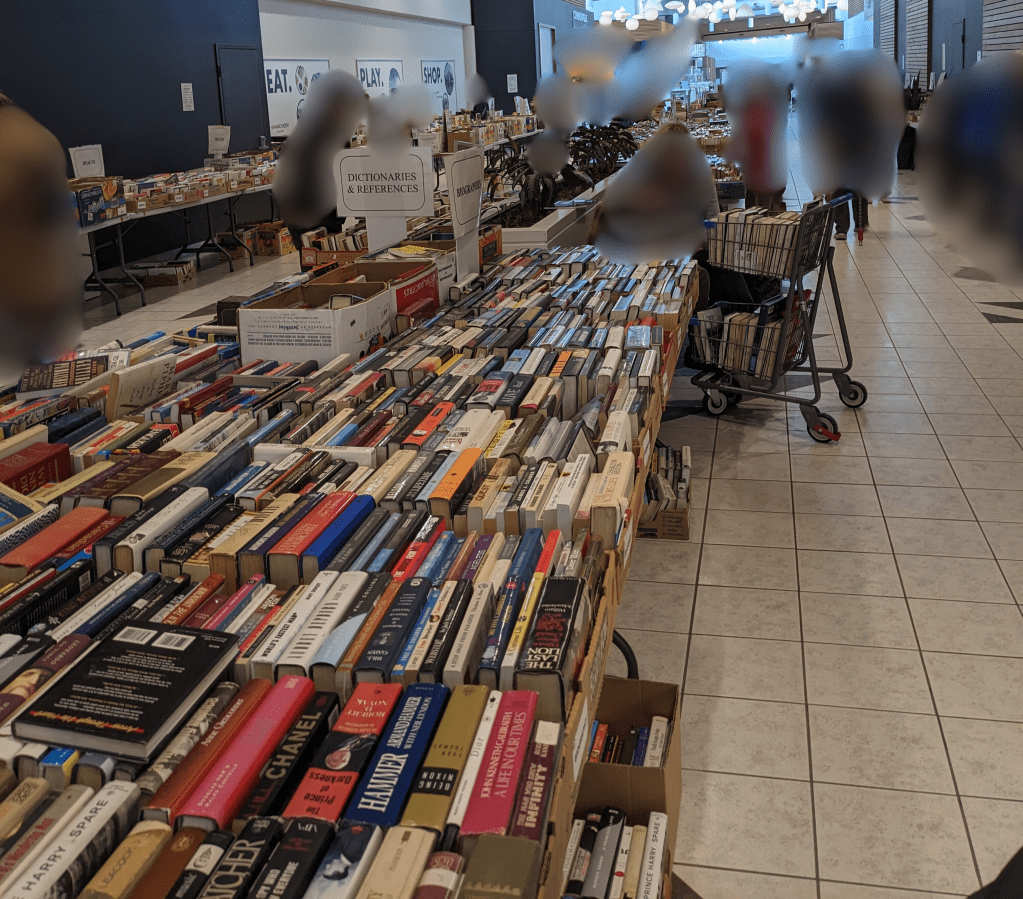
Large-scale used book sales are beautiful chaos. You never know what you’re going to stumble across. It’s a full day of wading through tables covered in boxes overflowing with thousands of titles, sorted loosely by genre and first letter of the author’s last name.
It’s also a roller coaster of emotion. There are shouts of joy as a certain edition of an old favorite is unearthed. Strangers work together to look for the third book in a five-part series – books one, two, four, and five are already clutched tightly in a young adult’s arms. It’s a gathering of book lovers, for better or worse, in jealousy and triumph, in disappointment and discovery.
As I became familiar with the ins and outs of this particular flavour of sale, I expanded my interest from books and authors I was actively seeking to books that seemed worthwhile to add to my TBR pile. From there, I found myself becoming curious as to which books showed up repeatedly. And now, I spend a lot of time looking at books and authors who have been donated en masse.
To be clear, the books offered during each sale are a mix of titles that did not sell during previous sales, as well as newly donated items. So prolific authors, such as Debbie Macomber, Nora Roberts, Terry Goodkind, and Stephen King, may have many titles represented, but those are generally gone by the end of the sale.
I’m not talking about those.
I’m talking about the duplicate copies of a single title. Let me show you an example.
Check out how many copies of “Steve Jobs” by Walter Isaacson and “Becoming” by Michelle Obama there are in these boxes. There were probably another three or four times that amount again on the upper tables in the biography section.
The city I live in is not particularly large. We’re talking 100,000 people. For there to be so many copies of a singular title, to me, means two things.
One. Either the marketing these books received was absolutely mind-blowing, the subjects these books were about are interesting to a wide and varied reader base, and/or the blurb on the back was spectacular.
Two. Once these books were actually purchased and read, people did not see them as re-readable novels. I could give it the benefit of the doubt and say that so many people bought it that these donated copies are all duplicates, but my suspenders of disbelief are not that strong. Fundamentally, a lot of people do not want to revisit these books.
Now, for biographies, that makes a little more sense than a fiction or fantasy title. The nature of the work is reflective and informative rather than woven and inventive. It is also usually more about the subject rather than the author. (Unless it’s particularly poorly written, but as “Becoming” has a 4.7 out of 5 on Amazon, 4.4 out of 5 on Goodreads, and 4.6 out of 5 on Indigo, while “Steve Jobs” has 4.7 out of 5 on Amazon and 4.2 out of 5 on Goodreads, I don’t think that’s the case here.)
What this comes down to for me is this: I never want to be that author with 200 copies of a singular title at a used book sale. I want to be the kind of author who makes people feel as though they’ve scored the jackpot if and when my work makes it into the used market.
And for that, I need re-readability. Secrets. Easter eggs. Clever full circle moments. Hints at different perspectives. I need depth.
This month’s round of edits and revisions will focus on just that.
Let’s talk a little about guilty pleasures. By definition, a guilty pleasure is something you enjoy, but also feel some embarrassment about. This embarrassment may come about because, for one reason or another, you feel as though you should not be indulging in that thing, or because most other people do not think the thing is good. For this post, I’ll be leaning into and challenging that second explanation for embarrassment. Things that we enjoy, but feel embarrassed about because other people would not think it is good.
Recently, I read a book that perfectly fits that description.
The Ruthless Lady’s Guide to Wizardry by C.M. Waggoner.
What do you rate a book you thoroughly enjoyed, but ultimately, didn’t like?
On the one hand, I really enjoyed the journey of the story. On the other hand, when I’m talking about it, I have to be careful not to hype it up too much. It’s a lot of fun, but it’s teetering dangerously close to having some major structural issues with the plot. And characters. And language. Because of this, I feel like I have to defend my enjoyment of it. Which feels bad.
There’s no getting around the fact that the book has problems. Like there being an underlying belief system that influences the way characters speak, which is never really explained. I had to draw my own conclusions, and I’m still not confident I grasped the vision. Maybe I’m missing something, but I’m pretty genre savvy, so I’m still marking this as a point against. Plus, there are so many characters for no real reason, and the love interest is plucky, positive, and… well… a little flat.
If I were to describe it as briefly as I could, The Ruthless Lady’s Guide to Wizardry is as if Wild Wild West starring Will Smith was remade in a world of magic, and the star of the show was a pair of mismatched, adventure-seeking women. As long as you aren’t taking it seriously, you’ll have a great time. I even lent it to my mother!
So here’s my proposal. The reason why people watch, read, or otherwise consume material considered guilty pleasures can be taken as a strong compliment, albeit a back-handed one. Think about what people say when they talk about their guilty pleasures.
“Oh, it’s just so trashy, it makes me feel better about my life.” Is a common one. So is “I only read/watch/play it for this one specific thing which is the only good thing about it.” “It’s mindless.” “The drama is outrageous, but it’s like a car wreck and I can’t look away.”
Let’s break it down and look at it a little deeper.
“Oh, it’s just so trashy, it makes me feel better about my life.” can be the writer or producer selecting relatable shock value topics that land with a wide audience. It’s performative, exhibitionist, and designed to make us feel superior through social comparison.
“I only read/watch/play it for this one specific thing, which is the only good thing about it.” can be the writer, producer, actor, or other players smashing their role out of the park. Especially in collaborative environments like video games and television, this is a huge kudos to the related party because they did the best with what they had and brought you moments of delight for the elements that were within their control. Find out who was responsible for the idea, character, setting, music, whatever, and see what else they have done! If your guilty pleasure is a solo piece, then leave some feedback for the one responsible! If they know something landed, this could spur additional content for your faves, even if it’s just on their website.
“It’s mindless.” could be a couple of things. First, it could be that the writer has produced something simple, and yet still entertaining enough or appealing enough to have you continue engaging with it. They’ve hit on some formula that makes you feel good, without requiring your active participation. Lofi Girl on YouTube is a good example of this. 15.2 million people are subscribed to their content. It’s something you can tune in and out of without penalty.
The second compliment behind “It’s mindless” could be related to comfort through repetition. Maybe it’s The Office. Maybe it’s Dexter. Maybe you need another run through of Grey’s Anatomy. Maybe it’s your twelfth time this year reading A Hitchhiker’s Guide to the Galaxy. Becoming familiar with characters and then revisiting the material that they’re from can have the same effect on the brain as visiting friends. You don’t have to pay attention to the material. Just the sound of their voice (either real or as you read) can help you relax and feel good.
Lastly, let’s have a look at “The drama is outrageous, but it’s like a car wreck and I can’t look away.” This is similar to the social comparison I touched on earlier, but it tends to have content that we ultimately can’t relate to. This, I personally feel, is due to the element of surprise. People who are genre savvy can get tired of the same plot lines over and over again, especially when they begin to predict the plot before it happens. When a new twist, no matter how bad, enters the playing field, it can be enjoyed just for the novelty. Novel experiences feel good. How many people watched Swamp People or Ice Road Truckers or Black Mirror just because it was SO different?
So there you have it. Maybe there’s something to why certain things thrive as guilty pleasures. Next time someone reveals theirs to you, maybe dig a little deeper and find out why! I’d love to hear about yours in the comments.
This post deals with topics of abuse in various forms. If this isn’t something you want to digest at the moment, see you in the next one!
I can understand the underlying fantasy. Every girl wants to be “The Special”. Picked out of a crowd even when she’s plain. Treated like a princess by someone perceived to hold power. She wants to be the exception to the rules of his behaviour and be treated kindly and/or differently from all the Other Girls. She wants to indulge in the romanticized notion that she can be the one to alleviate someone’s emotional and physical suffering through the power of love. She wants to be someone’s first choice. Their only choice. Their whole world. It would mean being accepted as an inherently flawed self at the expense of accepting another’s flawed self. Doesn’t seem like too bad a trade. After all, isn’t it romantic when he says that if anyone else touches her, he’ll make them pay?
But what happens when this obsessive kind of love becomes mainstream and heralded as romantic?
Dark romance is REAL popular on social media right now, and I have some opinions. Not the kind of opinions where I just hang out here and crap all over an entire genre, but I definitely have reservations. Ultimately, it’s not the content itself I have a problem with, but the normalization of “romantic violence” in quantity and extremes.
Stop it. I’m crying. And begging. But mostly crying.
When something is trending, it not only gets seen by the target audience who are already consuming related topics, but also by those who typically wouldn’t search out and interact with that topic. Think back to when Twilight came out and how many people who were not normally readers picked it up. Think about how many experienced 50 Shades of Grey in one form or another. Those are just two quick examples of unhealthy relationships in popular media that are idolized, but there are many more.
Just like how the media can shape our perspective of beauty with their airbrushed models and influencer content, popularizing, and more relevantly, romanticizing, inherently abusive behaviours does the same thing, but to our idea of what is and isn’t tolerable behaviour. It’s not a question of desensitizing us, per se, but it’s the issue of repetition. How many times do you have to hear that abusive behaviour is romantic before you start internalizing that message?
I could go on a tangent about the Alpha Male movement. I could discuss Stockholm Syndrome and retellings of Beauty and the Beast. I could talk about how the romance of obsessive lead characters often mirrors the tactics used by romance scammers. I could even complain about the broody, morally grey anti-hero that has been popular for eons. But I won’t. Ain’t nobody got time for that. Not even me.
What I will talk about is the cycle of abuse and how these dark romances can warp our perception of and ability to identify the cycle of abuse in real life and push the boundaries of what we’re willing to accept from a romantic partner. We can say that we’d recognize an abuser and would get out of a relationship that was toxic before it got dangerous, but it’s not usually that clear, that simple, or that easy.
Unlike the previous generation and their hate-on for video games, I’m not trying to tell anyone that dark romances are desensitizing the masses and will cause people to become abusive in their relationships when they weren’t already predisposed to it. Or that it’s more likely to make someone accept abuse. What I am trying to say is that when you are shown or told something repeatedly, by multiple sources deemed trustworthy (e.g., peers, influencers, media), a certain part of your brain begins to internalize that. If not as a belief of your own, then as an understanding of acceptable societal norms. I don’t like my For You page telling me at least three or four times a day that something like stalking is romantic. That intimidation is romantic. That violence is romantic.
It’s not.
Now, dark romances have existed for a long time, especially if you’re willing to include less mainstream sources. I’m not mad about that. If people want to use the genre to work out their own kinks in a low-stakes environment, more power to them. If they are seeking a way to process abuse and trauma experienced by either themselves or those around them, cool. I’m glad these resources exist. I even have no problem with the curious who want to dip their toes into the genre to see if they like it. Or people who read it just because it’s fun for them. I’m not here to say books with dark topics should be banned.
I’m here saying we should identify abusive behaviour as just that, and stop calling it romantic. Abusers don’t need any more ammo than they already have. We don’t need to give them frequent, viral, wide-reaching romanticization of their behaviours. The cycle of abuse is confusing enough as it is.
For those of you unfamiliar with the cycle of abuse, let me give you a quick rundown.
The first stage is tension. Tension that the abuser builds up either consciously or subconsciously with their behaviours and actions. Ever had the dishes done angrily at you? That’s what I’m talking about. But tension is also a highly desirable state in romance reads. Of course, it’s typically less the violence kind and more the sexual kind, but the problem is we’re currently blurring lines between the two in things like mafia and dark romances.
The second stage is usually an emotionally charged incident. A physical fight. An argument. A one-sided outburst. Know what romance novels typically have? A fight or a breakup scene. The difference is generally only a matter of severity.
The third stage is reconciliation. Reconciliation can be love-bombing. It can be gaslighting. It can be a grand public show of devotion and willingness to change. It can be self-depricating comments about the self in an attempt to gain sympathy or arouse guilt. After all, the abuser is just a silly goose who can’t live without you. You’re the reason they’re alive. The reason they strive to be a better person. See? They recognized their own bad behaviour, and you’re the reason they’re changing. If you left, they’d be lost. They couldn’t be the person they want to become. You’re their inspiration, and without you, they might as well be dead.
Wow, didn’t that escalate quickly?
As for the fourth stage, it’s a return to normalcy. Calm. Life as usual. Or maybe life as a little bit better than before. This primes the victim, or that female main character, for the next instance of building tension, escalating from the previous incident. It’s for the sake of the plot. Promise.
When comparing the cycle of abuse to romance novel plots, and especially dark romances, I hope you can see my point. When you’re reading a book about a stalker who starts to isolate the female main character from her friends and family, it’s really easy to forgive a stupid little fight about where you leave the remote. Or look past your partner punching a hole in the wall when the Book Girlies on TikTok are telling you that it’s romantic to forgive your partner for shooting someone over your shoulder and making you bleed. He deflected. It was for your own safety. He was only thinking of you. Double promise.
It’s also easy to mistake the reconciliation stage of abuse as progress towards changing your significant other. Especially when gaslighting is involved, because when things go back to that calm stage, is it really just like before? Or are they better, and you’re just not noticing their efforts? Before, they wouldn’t have been able to hold it together for so long. You’re responsible for that. It’ll keep getting better from here on out. Triple promise.
So please. Call abuse what it is.
A final note.
I use heteronormative speech throughout this article, but abuse can be perpetuated AGAINST any gender or sex and BY any gender or sex in ANY configuration of relationship. Abuse can be physical, emotional, financial, and more. If what I’ve described above hits a little close to home, please talk to someone. Very few of us are the exception to the rule of our partner’s abusive behaviour, and we will not save them from themselves. Stay safe out there.
The online course I’m taking for video game writing has been talking a lot about worldbuilding. This is nice because it gives me plenty to think about in my job and hobbies. I’ve made several posts about this already, but today I’m going to get to the core of the issue: Prevent your setting from being the most boring character in your book. Or the most pretentious character in your book. Or the most hated character in your book.
“But Winters!” You say. “My setting is Lubbock, Texas!” (I googled ‘the most boring city in the world 2024’ and this is what it returned.)
That’s nice. If you don’t want it to come across as a cardboard cutout of Lubbock, you still need to build out your setting more than just a cursory description. Trust me, if you ask anyone who grew up in a place with “nothing to do”, you’ll get a lot of wild stories. Human beings MAKE their own fun. They MAKE their own activities. Even if those activities are drinking around a fire and accidentally creating ghostly snow-thrones making it look like a gathering of spectres. Then maybe the locals call that area the “hill of kings”. That sort of thing won’t make it into any articles you may grab for research purposes. Unless you’re reading someone’s blog and they mention it.
Please make your setting well-rounded, personable, and real. Draw the reader in.
The relationship between the protagonists and the setting should be just as important to you as a writer as the relationship between characters is. Let the characters and setting interact. Let them influence each other. Let them work together.
Make it so that the reader wants to explore the setting through the eyes of the characters. Your story world should feel like more than the backdrop in a stage play, where the stagehands are throwing in only what’s necessary to the story.
Unless it’s instead, like one of those kindergarten plays where some kid lays on stage and plays grass.
That has its own problems.
Overcrowding your setting and building it out unnecessarily can be frustrating for its own reasons, like making your reader suffer through pages of purple prose.
Purple prose is a trope where you use flowery language and an abundance of adjectives. The descriptions are redundant and often describe things that won’t come up again. I’m sure we can all remember reading a page and a half describing someone’s sandwich (or other mundane object) which ultimately, doesn’t matter. Even if the sandwich is important to the plot, it does NOT need a page and a half. I promise.
When you’re writing, there are things you will know about your setting that the reader will never know. Just like there are things about your characters you will know that will never come up to the reader. These things are still important, but they are more for shaping the characters and setting as their own entity than to info-dump on the reader.
Just like no one wants to read a page and a half about a sandwich, no one wants to read that stereotypical introduction where a character looks in the mirror and describes themselves from head to toe. It’s juvenile at best, and at worst, off-putting. Unless your goal is to make it into a Men Writing Women or Women Writing Men subreddit, skip it. Or find another way to convey the information.
Treat your setting like a character. Appraise its personality and the way it presents to the reader. Give it more substance than just existing and looking pretty. Give it a history. Give it some significant lifetime events. Give it preferences, vibes, and presence! Make it feel real to yourself. Make it feel real to the reader without telling them every little tidbit.
Let your audience want to discover the setting just as much as they want to get to know your characters. Nothing commits people to a book or a series more than curiosity. Every piece you make them curious about is another piece that will make them come back to your work.
Okay maybe the title of this is a little dramatic, but I’m sure you’ve heard the joke that if you date a writer, you’re gonna end up in a book. Or that if you’re a Game Master for a tabletop RPG, you steal everything that isn’t nailed down. When I first heard this, I was in grade school and thought to myself: “The author isn’t doing a very good job if the person can recognize themselves as a character in someone’s book…”
Ah, young self. You missed the point completely.
If I had been an artist, I would have been one of those horrible people who thought copying/tracing as an exercise or as practice is against the law or something.
So let’s talk a little bit about people watching and stealing things. Ideas. Concepts. Characters.
Are you looking at your screen in disgust? Hear me out. How many of the most popular books right now are retellings of fairytales? How many websites out there host fanfiction from well-known series such as Harry Potter, Hunger Games, Twilight, etc? How many times are there “waves” of books of one central trope that become really popular? How many authors see these tropes and it inspires them to write their own take on something?
Hopefully you’re still reading after that explanation.
Characters and stories are MEANT to be inspiring. They’re meant to stick in your imagination, make you think about their wider world, long to know them, long to explore different scenarios with the same base framework.
So where does watching people strategically fit into this?
As part of creating a character, you should know their likes and dislikes. As part of that, you should know where they like to hang out. If that is a real place, and a safe place, go there! Don’t just assume you know what kind of atmosphere a place has or what kind of people hang out there from TV and other books.
Is your character a gym buff? Join a gym. Hang out on the bikes or walk on a treadmill. Put in your headphones but don’t turn on any music. What do you see? What do you feel? What do you hear? What do you notice?
Is your character a regular at a bar? Find one that’s similar to the one you’d see your character at (if it’s safe to do so) and order yourself a drink and sit at a booth with a notepad! Copy down snippets of conversations. Sketch the lighting. Review the menu. Freak the staff out! But not in a creepy way, in a you-might-be-a-food/bar/beer-critic kind of way.
Does your character go to the park to think things out? Go to the park (if it’s safe to do so) and find a place you can imagine them sitting. Are there a bunch of bugs there? Does it smell like pine? Are there dogs barking? Would that annoy your character?
These little observations make the reader feel. Feel like these are places they have been to or could go to. Like your characters and story exist within a realm of near-possibility.
So strategically people watch. Steal everything that isn’t nailed down.
It’s an age-old tactic! How many legends and stories do you know that are similar to one another, with one or two details changed? Things such as names, local landmarks, or the result of such a story?
I mean, Joseph Campbell didn’t make all that money explaining a Monomyth for nothing!
So, I’d love to know… what are some of your favourite retellings of fairytales or other legends?
Always curious to me is why people choose to not finish a book. I know people who give a book three chapters, and if they’re not hooked by then, they put it down and walk away. I know others that if they get bored at any point in reading it, then they put it down and walk away. Yet more that can only handle so much poor sentence structure before putting their book down. Some people can’t handle bad or unrealistic dialogue. I am proud to say that there’s only one book that I ever flat out did not finish.
But recently, I was SO CLOSE to adding a second title to that list.
The Ghost Woods by C. J. Cooke has a lot of things I really like. A beautiful cover, sapphic elements, a gothic setting, the suggestion of creatures not of this world, and quirky and unsettling characters. I was hooked early on its concept and how it presented the unsettling conflict, building it in slow spirals that had me trying to guess the twist.
And then I got to the middle third of this book.
The story’s premise is deeply intertwined with pregnancy and childbirth, but I guess I wasn’t expecting such a pocket of uncomfortably emotional motherhood. The creepy elements of the ghost woods, the mysteries of the house, and the crumbling sanity of the characters were all put to such an absolute halt that the dreaded words floated into my head…
“Wow. This book really isn’t for me.”
Emphasis on that is on “FOR” and not “ISN’T”.
It wasn’t like the writing suddenly took a nosedive, the whole thing was very well written. It’s just that I’ve never been a mother, I’ve never given birth, and I’ve never experienced any kind of “if you love them then let them go” morality crisis. The emotional hellscape the characters were fighting through had very little impact on me.
As I was talking myself into adding it to my donation box, I decided to give it a few more chapters. There was still a third of the book left, and we couldn’t possibly have set up all these weird and twisted, gothic and supernatural elements to just leave them there. Right?
RIGHT.
I am SO GLAD I kept on reading! After that middle lull, all the elements that had piqued my interest in the first place came back in full force and spiralled around the characters to tear them down in gruesome and wonderful ways.
Did you like the mini-series “Haunting of Hill House”? Then you’ll like this. Promise. Just push through that middle bit (or be crushed on an additional emotional level if you are a mother and/or can relate to the set-it-free morality problem stated above) and you won’t be sorry!
Now that you’ve read my review, are you curious about the only book I have closed and intentionally put away forever?
The Time Traveller’s Wife.
Fuck you Audrey Niffenegger.
I resent being set up with a beautiful story and an incredibly interesting plot device, only to be promised heartache. I DNF’d it like 10 years ago and I’m still salty about it.
“What about Nicholas Sparks?” you may ask me. I’ll allow it. I’ll even answer you. His books get you invested in the people only for real life to happen all over them and you. I live in real life. I’m familiar with the bullshit it can dish out to people who are otherwise just minding their own business and staying in their lane.
But a soft and cute fantasy where the premise is interesting and begging to be explored? Just to have some bullshit happen all over them because of my least favourite plot device: the misunderstanding? No. Go home.
Which leads me to wonder, what are some books other people have viciously DNF’d and why?
Maybe I’m old and getting grumpier, or maybe the world I live in is truly getting sneakier and less whimsical. I remember times when I would go to the bookstore and be drawn in by things like “#1 New York Times Bestseller!” written on the cover. However, it wasn’t until recently that I learned exactly how one gets on the New York Times Bestseller list. If you’re like me and were living in the land of assumptions, let me lay it out for you.
The New York Times takes in information from certain vendors both brick-and-mortar and digital. Each week, it’s essentially a popularity contest of sales – Who in which genres sold the most copies that week, as reported by the vendors who report to the New York Times (which will be abbreviated to NYT moving forward in this opinion piece). There are different parameters for digital media and ebooks, but the general idea is the same.
When I found out that not all bulk sales were immediately discounted for this contest, I became a little disillusioned. Now, MOST bulk sales are discounted, but not ALL OF THEM.
The next thing I found out was that there is no criteria for the content of the book, just the parameters of genre. The NYT Best Reviewed list is something else entirely.
Think about that for a minute. If someone wrote a book, marketed it as fiction, wrote 300 pages of paragraphs filled with sentences like “And then I saw”, “And then I went”, and “And then I thought” over and over and over, and 10,000 people bought it because they thought it was funny… that would make it on the list. The book could be written as though dictated by a child in their rambling story phase, with many grammar and spelling errors, but as long as it is reported as selling well, then it makes it on the list.
What started me on this whole rabbit hole was listening to an opinion piece about Lani Sarem’s Handbook for Mortals. Now, the events that sparked the YouTube video I was listening to happened back in 2017, so it is by no means new news. However, if you live under a rock like I do, you may have missed it. If that’s the case, allow me to paraphrase it for you.
Handbook for Mortals upstaged The Hate U Give by Angie Thomas on the NYT Bestseller list. Position #1. It was widely unknown by the online reading community prior to this. The displacement sparked controversy because it was thought Lani Sarem bought her way to the top of the list for her debut novel.
Before I looked into this more, I thought that had to be an obnoxious and very well-coordinated effort on the part of the author and the author’s friends to go and buy at least 5,000 individual copies of this book over the period of one week.
Silly me, there are companies to do that for you!
Companies like Result Source Inc. If you go to their website, which it blew my mind to find out was still active, you can submit your contact information. The entire thing has been stripped down to a simple “contact us” link. Probably because of the unwanted attention scamming a bestseller list got them.
Now, this is not the first time a book has been flat out removed from the NTY Bestseller list, but in my opinion, it is certainly the most interesting.
I wish I could say that there was a source of reviews I trusted. Goodreads was a promising effort, but the amount of 1-star review bombing that’s happening there based on the author’s behaviour or opinions. Can we please implement a 2-tiered system? This author gets 1-star because of reasons X,Y, and Z. Their book, A Tale of Mischief, 5 stars. Amazing. This tells me that I might have a good time if I find this book at a used bookstore, but not to order from the author themselves, or from a standard bookstore.
What’s your opinion on good books written by questionable people? I’d love to know in the comments!


 Winters Writer