We’re Here for a Good Time, Not a Well Done Time

Let’s talk a little about guilty pleasures. By definition, a guilty pleasure is something you enjoy, but also feel some embarrassment about. This embarrassment may come about because, for one reason or another, you feel as though you should not be indulging in that thing, or because most other people do not think the thing is good. For this post, I’ll be leaning into and challenging that second explanation for embarrassment. Things that we enjoy, but feel embarrassed about because other people would not think it is good.

Recently, I read a book that perfectly fits that description.

The Ruthless Lady’s Guide to Wizardry by C.M. Waggoner.

What do you rate a book you thoroughly enjoyed, but ultimately, didn’t like?

On the one hand, I really enjoyed the journey of the story. On the other hand, when I’m talking about it, I have to be careful not to hype it up too much. It’s a lot of fun, but it’s teetering dangerously close to having some major structural issues with the plot. And characters. And language. Because of this, I feel like I have to defend my enjoyment of it. Which feels bad.

There’s no getting around the fact that the book has problems. Like there being an underlying belief system that influences the way characters speak, which is never really explained. I had to draw my own conclusions, and I’m still not confident I grasped the vision. Maybe I’m missing something, but I’m pretty genre savvy, so I’m still marking this as a point against. Plus, there are so many characters for no real reason, and the love interest is plucky, positive, and… well… a little flat.

If I were to describe it as briefly as I could, The Ruthless Lady’s Guide to Wizardry is as if Wild Wild West starring Will Smith was remade in a world of magic, and the star of the show was a pair of mismatched, adventure-seeking women. As long as you aren’t taking it seriously, you’ll have a great time. I even lent it to my mother!

So here’s my proposal. The reason why people watch, read, or otherwise consume material considered guilty pleasures can be taken as a strong compliment, albeit a back-handed one. Think about what people say when they talk about their guilty pleasures.

“Oh, it’s just so trashy, it makes me feel better about my life.” Is a common one. So is “I only read/watch/play it for this one specific thing which is the only good thing about it.” “It’s mindless.” “The drama is outrageous, but it’s like a car wreck and I can’t look away.”

Let’s break it down and look at it a little deeper.

“Oh, it’s just so trashy, it makes me feel better about my life.” can be the writer or producer selecting relatable shock value topics that land with a wide audience. It’s performative, exhibitionist, and designed to make us feel superior through social comparison.

“I only read/watch/play it for this one specific thing, which is the only good thing about it.” can be the writer, producer, actor, or other players smashing their role out of the park. Especially in collaborative environments like video games and television, this is a huge kudos to the related party because they did the best with what they had and brought you moments of delight for the elements that were within their control. Find out who was responsible for the idea, character, setting, music, whatever, and see what else they have done! If your guilty pleasure is a solo piece, then leave some feedback for the one responsible! If they know something landed, this could spur additional content for your faves, even if it’s just on their website.

“It’s mindless.” could be a couple of things. First, it could be that the writer has produced something simple, and yet still entertaining enough or appealing enough to have you continue engaging with it. They’ve hit on some formula that makes you feel good, without requiring your active participation. Lofi Girl on YouTube is a good example of this. 15.2 million people are subscribed to their content. It’s something you can tune in and out of without penalty.

The second compliment behind “It’s mindless” could be related to comfort through repetition. Maybe it’s The Office. Maybe it’s Dexter. Maybe you need another run through of Grey’s Anatomy. Maybe it’s your twelfth time this year reading A Hitchhiker’s Guide to the Galaxy. Becoming familiar with characters and then revisiting the material that they’re from can have the same effect on the brain as visiting friends. You don’t have to pay attention to the material. Just the sound of their voice (either real or as you read) can help you relax and feel good.

Lastly, let’s have a look at “The drama is outrageous, but it’s like a car wreck and I can’t look away.” This is similar to the social comparison I touched on earlier, but it tends to have content that we ultimately can’t relate to. This, I personally feel, is due to the element of surprise. People who are genre savvy can get tired of the same plot lines over and over again, especially when they begin to predict the plot before it happens. When a new twist, no matter how bad, enters the playing field, it can be enjoyed just for the novelty. Novel experiences feel good. How many people watched Swamp People or Ice Road Truckers or Black Mirror just because it was SO different?

So there you have it. Maybe there’s something to why certain things thrive as guilty pleasures. Next time someone reveals theirs to you, maybe dig a little deeper and find out why! I’d love to hear about yours in the comments.

References

The Only Book I Ever DNF’d

Always curious to me is why people choose to not finish a book. I know people who give a book three chapters, and if they’re not hooked by then, they put it down and walk away. I know others that if they get bored at any point in reading it, then they put it down and walk away. Yet more that can only handle so much poor sentence structure before putting their book down. Some people can’t handle bad or unrealistic dialogue. I am proud to say that there’s only one book that I ever flat out did not finish.

But recently, I was SO CLOSE to adding a second title to that list.

The Ghost Woods by C. J. Cooke has a lot of things I really like. A beautiful cover, sapphic elements, a gothic setting, the suggestion of creatures not of this world, and quirky and unsettling characters. I was hooked early on its concept and how it presented the unsettling conflict, building it in slow spirals that had me trying to guess the twist.

And then I got to the middle third of this book.

The story’s premise is deeply intertwined with pregnancy and childbirth, but I guess I wasn’t expecting such a pocket of uncomfortably emotional motherhood. The creepy elements of the ghost woods, the mysteries of the house, and the crumbling sanity of the characters were all put to such an absolute halt that the dreaded words floated into my head…

“Wow. This book really isn’t for me.”

Emphasis on that is on “FOR” and not “ISN’T”.

It wasn’t like the writing suddenly took a nosedive, the whole thing was very well written. It’s just that I’ve never been a mother, I’ve never given birth, and I’ve never experienced any kind of “if you love them then let them go” morality crisis. The emotional hellscape the characters were fighting through had very little impact on me.

As I was talking myself into adding it to my donation box, I decided to give it a few more chapters. There was still a third of the book left, and we couldn’t possibly have set up all these weird and twisted, gothic and supernatural elements to just leave them there. Right?

RIGHT.

I am SO GLAD I kept on reading! After that middle lull, all the elements that had piqued my interest in the first place came back in full force and spiralled around the characters to tear them down in gruesome and wonderful ways.

Did you like the mini-series “Haunting of Hill House”? Then you’ll like this. Promise. Just push through that middle bit (or be crushed on an additional emotional level if you are a mother and/or can relate to the set-it-free morality problem stated above) and you won’t be sorry!

Now that you’ve read my review, are you curious about the only book I have closed and intentionally put away forever?

The Time Traveller’s Wife.

Fuck you Audrey Niffenegger.

I resent being set up with a beautiful story and an incredibly interesting plot device, only to be promised heartache. I DNF’d it like 10 years ago and I’m still salty about it.

“What about Nicholas Sparks?” you may ask me. I’ll allow it. I’ll even answer you. His books get you invested in the people only for real life to happen all over them and you. I live in real life. I’m familiar with the bullshit it can dish out to people who are otherwise just minding their own business and staying in their lane.

But a soft and cute fantasy where the premise is interesting and begging to be explored? Just to have some bullshit happen all over them because of my least favourite plot device: the misunderstanding? No. Go home.

Which leads me to wonder, what are some books other people have viciously DNF’d and why?

Opinion: New York Times Bestseller Achievement Does Not Promise a Good Read

Maybe I’m old and getting grumpier, or maybe the world I live in is truly getting sneakier and less whimsical. I remember times when I would go to the bookstore and be drawn in by things like “#1 New York Times Bestseller!” written on the cover. However, it wasn’t until recently that I learned exactly how one gets on the New York Times Bestseller list. If you’re like me and were living in the land of assumptions, let me lay it out for you.

The New York Times takes in information from certain vendors both brick-and-mortar and digital. Each week, it’s essentially a popularity contest of sales – Who in which genres sold the most copies that week, as reported by the vendors who report to the New York Times (which will be abbreviated to NYT moving forward in this opinion piece). There are different parameters for digital media and ebooks, but the general idea is the same.

When I found out that not all bulk sales were immediately discounted for this contest, I became a little disillusioned. Now, MOST bulk sales are discounted, but not ALL OF THEM.

The next thing I found out was that there is no criteria for the content of the book, just the parameters of genre. The NYT Best Reviewed list is something else entirely.

Think about that for a minute. If someone wrote a book, marketed it as fiction, wrote 300 pages of paragraphs filled with sentences like “And then I saw”, “And then I went”, and “And then I thought” over and over and over, and 10,000 people bought it because they thought it was funny… that would make it on the list. The book could be written as though dictated by a child in their rambling story phase, with many grammar and spelling errors, but as long as it is reported as selling well, then it makes it on the list.

What started me on this whole rabbit hole was listening to an opinion piece about Lani Sarem’s Handbook for Mortals. Now, the events that sparked the YouTube video I was listening to happened back in 2017, so it is by no means new news. However, if you live under a rock like I do, you may have missed it. If that’s the case, allow me to paraphrase it for you.

Handbook for Mortals upstaged The Hate U Give by Angie Thomas on the NYT Bestseller list. Position #1. It was widely unknown by the online reading community prior to this. The displacement sparked controversy because it was thought Lani Sarem bought her way to the top of the list for her debut novel.

Before I looked into this more, I thought that had to be an obnoxious and very well-coordinated effort on the part of the author and the author’s friends to go and buy at least 5,000 individual copies of this book over the period of one week.

Silly me, there are companies to do that for you!

Companies like Result Source Inc. If you go to their website, which it blew my mind to find out was still active, you can submit your contact information. The entire thing has been stripped down to a simple “contact us” link. Probably because of the unwanted attention scamming a bestseller list got them.

Now, this is not the first time a book has been flat out removed from the NTY Bestseller list, but in my opinion, it is certainly the most interesting.

I wish I could say that there was a source of reviews I trusted. Goodreads was a promising effort, but the amount of 1-star review bombing that’s happening there based on the author’s behaviour or opinions. Can we please implement a 2-tiered system? This author gets 1-star because of reasons X,Y, and Z. Their book, A Tale of Mischief, 5 stars. Amazing. This tells me that I might have a good time if I find this book at a used bookstore, but not to order from the author themselves, or from a standard bookstore.

What’s your opinion on good books written by questionable people? I’d love to know in the comments!

References

Book Review – March 23rd

Memoirs of a Geisha – Arthur Golden

Rating: 2 out of 5.

Hello friends! We have a theme! I also took a long time to decide if I was going to review THIS book! Now, let me back up. For those that have read my blog post about the books I would like to read this year (which can be found here), you may be looking at this post and your calendar. You are right, Memoirs of a Geisha was scheduled for May, not for March. The Master and Margarita was scheduled for March.

Yeah. About that.

Apparently, everyone and their dog wants to read that right now. When I searched for it, there were already TEN holds on it. My library system is pretty good, but they only have 2 copies of the damned thing. As of writing this, I am hold five of eleven, so there is some hope that I can have it by the end of May. In similar news, since I am skeptical that I will like many of the books on my list, I am not purchasing them.

This book kind of underlines why.

First, I want to address the lawsuits that surrounded the author, Arthur Golden, after the publication of this book. For those of you that don’t know, Geisha culture is a fairly tight-lipped affair, so speaking out about practices, norms, expectations, and events hasn’t been very widely approved of. Golden’s Memoirs certainly spurred a flurry of information and fact-finding, but I honestly can’t say it was for the right reasons.

One of the women that Golden interviewed for background had requested that her identity remain a secret. That was not respected as he thanked her in the acknowledgements, and although I’m sure the author meant well, caused a lot of problems for this woman. She received death threats and it caused a strain on her interpersonal relationships. Golden was sued for breach of contract and ended up settling out of court for an undisclosed sum.

Now that I’ve mentioned that, please buckle in for a not-very-friendly review.

Do you remember the book “A Million Little Pieces”? Do you remember how it was marketed as a memoir, but then a little while after, it came out that the author James Frey was making his story more dramatic so it had to be remarketed as general fiction and/or misery literature?

Memoirs felt a lot like that, but more… amateur. Like you know those fanfictions you wrote in high school, where you shamelessly self-inserted yourself into a story and your love interest of choice notices you for your *whatever trait you choose*? Your voice, your hair, your eyes, your singing, your height? Well, that’s sort of how this started. Everyone notices Sayuri’s eyes. They’re pale and unusual.

Now, I don’t typically mind this, because people are unusual! People have a lot of cool traits! There’s usually something of someone to look at and appreciate! I’d be lying if I said I wasn’t sucked into the story in the first few chapters. However, the moment Sayuri gets to Gion, everything goes downhill and the entire rest of the story made me increasingly more uncomfortable.

When I ranted to my partner about the plot, he summed it up really nicely by offering me “Sounds like it’s a whole book of terrible people making terrible choices.” It’s not ALL really that bad, but… I found myself unable to get much evidence to the contrary.

I typically try my best to read a book objectively. Just because I don’t like the plot, doesn’t mean that I think the book is bad. So why then, did this super popular book get such a low rating from me? I alluded to it in the paragraph talking about fanfiction. Arthur Golden has a degree in art history, in Japanese history, and one in English. He interviewed Mineko Iwasaka for her deep knowledge and involvement with the Geisha lifestyle.

AND YET. Some of the language and connections that he used and made felt like he had learned about certain aspects of life in an okiya and as a Geisha, and then just ran away with them. Some may argue “yes. That is what fiction is. You learn about something, or you speculate on something, and you write about it.” Which yes. Yes, that’s how that works. I’m not arguing that. What point I hope to slide in here is that when you are writing something on a topic that’s so tight-lipped, you have to be careful which face you decide to show in your writing. The book was written for an English audience, and how do you think people received it when he compares Geisha to escorts and prostitutes? He allegedly rewrote Memoirs three times, each from a different perspective, until he settled on Sayuri’s.

To Golden’s credit, Sayuri is believable as a narrator. Her personality is consistent throughout the book (almost to a fault) and you go through the book (mostly) being able to get behind her motivations. Not all authors can say that, especially when the author is writing a gender that he does not identify as, from a culture that he does not identify with.

What all this blather is trying to say is: Arthur Golden writes his book very well, on a topic that was done not very well.

It’s sort of like the uncanny valley. The book falls too much into ‘realism’ to be completely dismissed, but aspects of it are so squidgy and uncomfortable that it’s hard to completely settle into it.

All in all, take it as it is – fiction, and maybe watch the equally problematic cinematic release featuring Chinese actresses and save yourself some time.

References:

Book Review – February 18th

Fahrenheit 451 – Ray Bradbury – Introduction by Neil gaiman

Rating: 4 out of 5.

“Fire is bright and fire is clean”

Captain Beatty

Hello all. I want you to know that I took a long time to decide if I would review this book. Not because I didn’t know how I felt about it, but because I would have to tread carefully if I yelled my opinion out there for everyone to read. Even with my currently small audience. But hey. This is my blog. If there’s a place where I should be able to say what I think, it’s here.

It’s not controversial, it’s not hating on anything, it’s just a really relevant topic in today’s polarizing media.

For those who have NOT read Fahrenheit 451 or have not seen the movie, it is set in a dystopian future where it is illegal to read books. Instead of putting fires out, firemen are a squad of people who, when books are discovered in someone’s otherwise fireproof house, SET fires to get rid of the illegal material. As the story progresses, our protagonist expresses his solidifying dissent with the order of things. He makes a choice and receives consequences for this action. How’s that for talking about the book without giving any spoilers?

First, I want to comment that during the climax of the story, there is a very blatant social commentary about feeding people a conclusion that feels nice, and that they would expect to see rather than the truth of the situation.

** LOOKS AT SOCIETY ** DOES that sound familiar!?

Second, I want to comment on the REASON why books became illegal. This is the part where I know I need to be careful. So, in that vein, I am stating the reasons, according to Captain Beatty.

“Don’t step on the toes of the dog-lovers, the cat-lovers, doctors, lawyers, merchants, chiefs, Mormons, Baptists, Unitarians, second-generation Chinese, Swedes, Italians, Germans, Texans, Brooklynites, Irishmen, people from Oregon or Mexico. The people in this book, this play, this TV serial are not meant to represent any actual painters, cartographers, mechanics anywhere. The bigger your market, Montag, the less you handle controversy, remember that! All the minor minor minorities with their navels to be kept clean. Authors, full of evil thoughts, lock up your typewriters.”

Ray Bradbury, Fahrenheit 451, Page 55, Captain Beatty

“Coloured people don’t like Little Black Sambo. Burn it. White people don’t feel good about Uncle Tom’s Cabin. Burn it. Someone’s written a book on tobacco and cancer of the lungs? The cigarette people are weeping? Burn the book.”

Ray Bradbury, Fahrenheit 451, Page 57, Captain Beatty

** LOOKs at society harder** how about now!?

We are supposed to be able to identify when something is bad. Bad things exist. Do we WANT them to exist? No. Bad things, by definition, are bad. But like I said in my post previously, if you only ever get one sociopolitical, socioracial, or socioeconomic viewpoint, how is reading supposed to broaden your horizons? If all of our books are neat, and perfect, and comfortable, how will we know how to deal with things that are uncomfortable when they inevitably happen in real life?

If you have some suggestions on the above, I’m all ears. Except for “Ignore all bad things forever and strive for societal perfection by destroying everything in our past that was bad and uncomfortable.” This advice will be yeeted so far out the window you may not even see it.

You have no power here. I’m from Canada. Know what Canadians did to the indigenous population? Do you know anything about residential schools? If not, please know that Canada has TRIED the ‘lets pretend it never happened and we are good people’ angle. Know what it caused? Broken homes. Trauma. Abuse. Neglect.

Spoiler?

Pretending that everything is fine and nice and we’ve never done anything wrong in our life? Doesn’t work.

We need to understand our societal development and be comfortable enough in our own progression to read something from the past, or something that might be controversial, and say ‘Hey. Here is a viewpoint. Let’s discuss it.’

So why then, did this book only get four stars if I identified so strongly with the message? Even though it was published in the 1950’s and I’m saying it applies to us even SEVENTY YEARS LATER?

I felt the ending had a bit of a ‘rocks fall and everyone dies’ ending.

Yes, shh, it’s symbolic of the progression of society and Montag’s journey forward and transitions into new worldviews and perspectives. We still dropped a bomb on the town and killed everyone. Rocks fall. Everyone died. I didn’t like it. I thought it was abrupt. 4 stars.

If you’ve read this book, I’d love to know what you thought about it, and if you identified with it as strongly as I did. Alternately, I have NOT seen the movie, so I would be interested in learning what the tone was!

If someone tells you what a story is about, they are probably right. If they tell you that is all a story is about, they are very definitely wrong.

Neil Gaiman

12 Books You HAVE to Read Before You Die!

Okay, okay. The title is clickbait. No one cares if you have read these twelve books, and nothing in your life will be harmed if you’ve never heard of these books. Except maybe April’s read – it depends on how many nerds you know and interact with.

So I don’t know about you, but I hated the time in high school when they would demand we read certain books. They said it was important. That the ideas in them were integral to our manifestation of self to think about. Be made aware about. Animal Farm, One Flew Over the Cucoo’s nest, the Catcher in the Rye, Life of Pi, and the Giver are the titles that stick out in my mind. And I’m going to add my thoughts as a grain of sand in an entire opinion beach full of other people’s grains of sand.

The Giver? I couldn’t tell you what that was about. I think it made me sad and frustrated at the end so I put it out of my head. “But Emma,” you might say. “The book was supposed to evoke feelings!” Okay, cool, but my child-self did NOT like sad books and as such I said “Thank u next” to whatever that lesson was.

Life of Pi? A child deals with the trauma a series of unfortunate events evokes by referring to everyone as animals and takes a really depressing sea voyage. Obviously that’s been paraphrased within an inch of its life, but you get the idea. A bunch of people thought it was an important enough story to make it into a movie, so that’s cool. I don’t know, I’m not sure what they were trying to teach us with this one. Maybe just deal with your trauma as much as you are able?

The Catcher in the Rye? I have no idea. Some kid skips school and wanders around and thinks about things. It’s supposed to be a ‘coming of age’ story. I can’t decide if the coming of age is just an outdated concept within the narrative, or if I didn’t get it because I’m a girl.

One Flew Over the Cucoo’s nest. This doesn’t even get a question mark at the end. Did it make me think? Yes. It made me think about how terribly we treat other people, how terribly we have treated other people, and how shitty it was to have any kind of “mental illness” in the past.

Animal Farm? This one I got. I thought that it should have been taught in social studies/humanities/history; whatever it’s called where you’re from. Where should it have gone in the curriculum? Right before you learned about the holocaust and all the terrible things that were done there. Or right before you learned about residential schools and all the terrible things that were done there. Or right before you learned about any other genocide! Cultural, racial, religious, I give 0 fucks which. Too many people have the “Well it wouldn’t happen here and now” mentality, but surprise! It’s happening right now! Giving a plain example of the small changes and slimy pitch tactics required from politics to completely change a country’s mentality will never stop being important.

Where was I going with this? Oh right. Sorry, I got on a little tangent there. Let me just get down off of my soapbox.

Books. You might be looking at the above and thinking to yourself “Well this girl hates reading if she has such a low opinion of those books.”

BUT JUST WAIT, THERE’S MORE!

I stumble upon lists with dramatic titles such as “100 books to read before you die” and “10 most popular books of 2023, how many have YOU read?” and “You can’t count yourself a lover of classics if you haven’t read these 50 titles!”.

Normally, I don’t really pay attention to these outrageous claims. I don’t really care what I ‘should’ and ‘should not have’ read and what I should have taken away from each experience. Do you want to make someone hate reading? Give them a huge list of titles that were written between 1800 and 1920. Tell them that if they don’t make it through the list, they can’t say they’re a reader. Boom. Resentment.

This year, I decided to take a look at the books that were currently being harped on as ‘must reads’ and you know what? I was pleasantly surprised. I think the last time I looked at similar lists was in 2008. Spoiler, back then 95% of all the titles were written by old white male Europeans. The other 5% was a white Englishwoman and like… 3 people of colour from Europe. This year? I saw a lot more diversity. It’s a good trend people, keep it up.

One more thing I should probably go over is that I’m white. I’m SO white. I have a Ukrainian background, but I was born and raised in Canada. My parents were born and raised in Canada. Half of my Grandparents were born and raised in Canada. My Great Grandparents were from Ukraine and surrounding areas. But I’m still white enough to make mayonnaise jealous and I’m not connected enough with my heritage to claim to be anything aside from Canadian. That DOES NOT MEAN I want to read a whole bunch of old white guy literature. It may be really good stylistically or thematically, but if you only ever get one sociopolitical, socioracial, or socioeconomic viewpoint, how is reading supposed to broaden your horizons?

Thank you for coming to my Ted Talk, hosted out here remotely on the hill I will die on.

So you’ve stuck with me to this point, I’ll deliver the goods. I picked 12 books that showed up repeatedly on ‘should read’ lists from multiple sources, and I assigned them all to a month of 2023.

MONTHTITLEAUTHORYEAR PUBLISHEDPAGE COUNT
JANUARYThe Count of Monte CristoAlexandre Dumas18461250
FEBRUARYFahrenheit 451Ray Bradbury1953250
MARCHThe Master and MargaritaMikhail Bulgakov1967430
APRILThe HobbitJ. R. R. Tolkien1937310
MAYMemoirs of a GeishaArthur Golden1997450
JUNEDon QuixoteMiguel de Cervantes16201100
JULYThe Time MachineH. G. Wells1895100
AUGUSTOne Hundred Years of SolitudeGabriel García Márquez1967410
SEPTEMBERMoby DickHerman Melville1851430
OCTOBERCirceMadeline Miller2018400
NOVEMBERJane EyreCharlotte Brontë1847540
DECEMBERPride and PrejudiceJane Austen1813430
2023 book a month reading list

Yes, there are still a lot of white men on this list. Yes, there are some titles on there that I personally feel I should have read by now. Take, for example, Pride and Prejudice. I’ve only had a copy sitting on my bookshelf for 10 years. Have not read it yet.

At the time of writing this, I somehow managed to make it through the Count of Monte Cristo in January. Fahrenheit 451 is in my hot little hands and things are looking good to be done in February. The Master and Margarita has a huge waitlist in my local library, so we’ll have to see if I manage to get it for March.

I’m simply not going to write a review about the Count of Monte Cristo in this blog. It’s not going to happen. The rest of them I’m hoping to cover in an alternating fashion with grammar advice and other writing tidbits.

Why does the Count of Monte Cristo get the boot? Honestly, I started to write one up, but it went all over the damn place. There’s so much that happens. To talk about any one particular part that’s not strictly structure, thematic timing, and/or literary style, you have to set up the whole damned plot. At the end of the day, you can go read a review for this book that covers the structure, timing, style, etc from someone much smarter than me, or who has a fancy degree from a nice university. Spark Notes or Wikipedia will provide you with the plot. Myself? If I know people who like Sherlock Holmes, I’ll tell them to read it. Otherwise, I probably will just wear my badge of honour for getting through 1250 pages in 3 weeks while working a full time job and also not becoming a hermit.

I’d love to hear other people’s reading lists for this year, or suggestions of things I should check out!

If you have the time or the brainpower, leave me a comment about it!

Book Review – March 11th

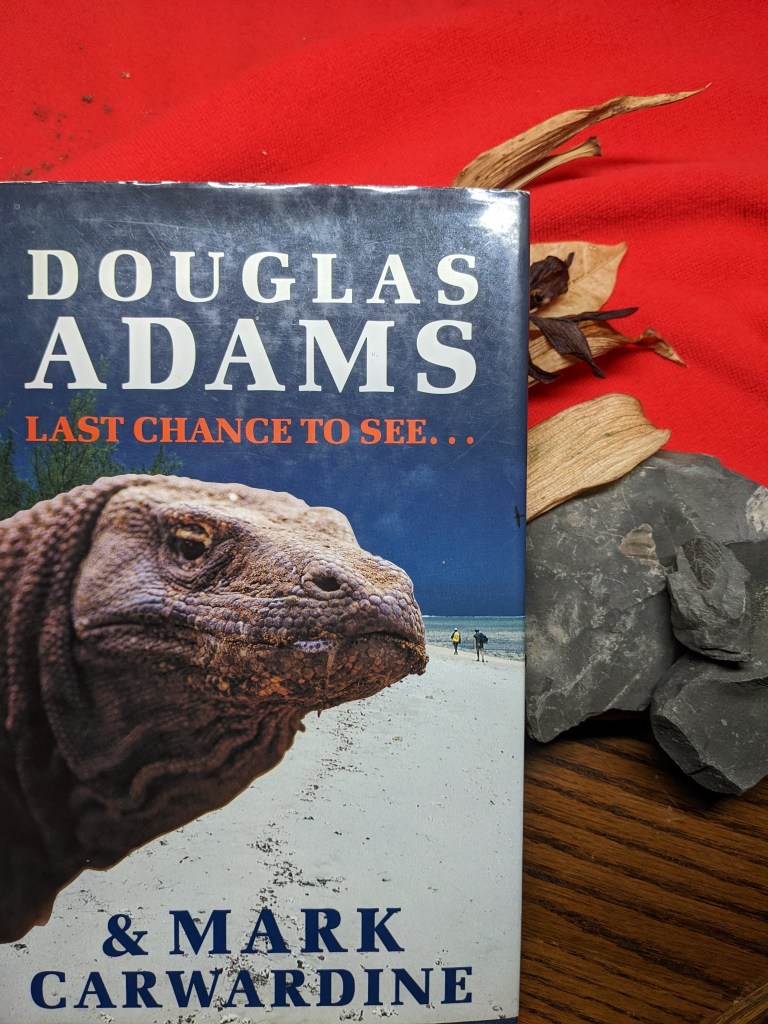
Last Chance to See – Douglas Adams & Mark Carwardine

Rating: 3.5 out of 5.

I am a sucker for Douglas Adams. Every time I read one of his books I feel as though it is similar to having a visit from that one friend who has you in stitches on and off for hours. It would have to be on and off otherwise the constant laughter would stop your ability to get enough oxygen. It doesn’t matter if you’ve heard a version of the story eight times at this point, it’s the way that it’s told to you, the quirky eyebrows (I never met Mr. Adams but I am SURE that he had quirky eyebrows) and the tonality of the delivery. All in all I don’t have the time nor can I be bothered to judge his writing from a stiff and awful analytical standpoint. Pieces like this you have to enjoy with your heart.

For those of you that have never heard of Last Chance – it was this wonderfully strange idea by a wonderfully confused Observer Colour Magazine to send Douglas Adams, shortly after writing about hitchhiking around the galaxy and the importance of 42, to Madagascar to look for aye-ayes with a group of people whom it actually made sense to send. Aye-ayes are hard to find. Google them. If I looked like that I would be hard to find too. This leaves us with the knowledge of the population of aye-ayes in a very ¯\_(ツ)_/¯ state. There could be 1,000 left. There could be 10,000 left. We don’t know. Madagascar is hard.

Last Chance to See… By Douglas Adams and Mark Carwardine

When the project picked up again, they went looking for Komodo Dragons. Komodo Dragons are scary. There are still between 4,000 and 5,000 left in the wild. This is more or less the same quantity as there were when Douglas Adams and Mark Carwardine were looking. This is largely due to their natural habitat being turned into amusement parks where people can pay to see them eat a goat. There are times where I am rudely reminded that my idea of a good time and other peoples’ are vastly different. With some quick digging, I found that you can actually still visit this park in 2022. They seem to have overhauled the bit with the goat in favour of a more ‘natural’ and terrifying discovery of dragons.

Next on this very rare bingo card is the Northern White Rhino. At the time the book was written, there were 22. The text makes it sound like there were high hopes for the programs and the conservation efforts. I have bad news on that. Only 2 remain at the time of me writing this. And they’re both girls. And unable to carry calves to term even if we pulled some sweet science cloning magic. In this particular species, we have failed.

The bit about the Mountain Gorillas, within the chapter filled with amusing English politeness kerfuffles, was very nice to read. They remark that there are 208 ish individuals at that point. Now, there are approximately 1000. We are doing much better with the gorillas than we are with the rhinos.

Kakapos. Weird little fat flightless parrots. Have you ever heard about them? I personally love quirky evolutionary adaptations. Kakapos have a wonderful one. They make a hole and scream at the ground for a mate. “Love me!” The hole cannot love them back, but as a quiet introvert I can relate to the tactics. There’s 202 left at the time of me writing this. There WERE 40.

Yangtze River Dolphin. Stupid looking. Totally gone. Haven’t seen one despite expeditions. The last known one died in captivity in 2002. They didn’t know how many there were to start. At this point, they have become the fisherman’s tale of the Yangtze, along with their friends (or… former friends?) the Yangtze Porpoise. I’m quite sure that old men sit around and dazzle the younger generations with “I saw one of them once… It was THIIIIIIIIIIIIIIIIS big!”

The last chapter was about Mauritius. Honestly? It made me a little bit sad for the state of the world and how people view conservation. There were four species that were looked at, Pink Pigeons in which 350 have escaped the fate of their ancestors of being made into pie, Echo Parakeets which have managed to increase to 700 from a mere 15 individuals, and the Mauritius Kestrel. The Kestrel was a victim of DDT. The pesticide made its way up through the food chain and softened the eggs of this small bird of prey. Without intervention and hands on breeding programs it is unclear whether they would have come back. Instead they are sitting at a population of around 800.

You may be looking at the above paragraph and wondering ‘where’s the fourth?’ Well, following the SPIT rule, (see previous post) I am changing paragraphs when I am introducing a new idea. The fourth species, unlike the other beings that I have spoken about here, is a tree. A coffee tree, to be exact.

I wanted to end on this because it was the passage that resonated with me the loudest.

In 1981, a teacher on Mauritius was speaking about an extinct kind of coffee bean tree. One of the students piped up and said to the teacher “Please, that’s not extinct, I have one in my backyard!”

Needless to say this caused quite the flap amongst the educated-about-trees crowd who immediately sent a sample off for testing. The testing did nothing but prove that this was indeed a specimen of the previously thought to be extinct coffee tree. Well, word gets around, doesn’t it? The tree was in danger of being cut down for firewood, or hit by a car that was on a nearby road, so they put a fence around it.

The problem with this is that the fence flagged it as special so people started acting, taking bits and pieces of it for luck, or medicine, or charms. What action did this prompt? The tree got a bigger fence. One with barbed wire. This made people more determined. So they put up more fence. They hired a guard.

ALL I CAN THINK ABOUT when I read this is this little tree, doing its best, then all of a sudden it gets a bunch of fences and its OWN GUARD! Because people heard that it was rare and wonderful so they determined to destroy it, handful by handful!

Ask why you can’t go up and touch Stonehenge anymore. There’s a rope around. Ask why you can’t climb the stairs or go into the ruins proper at Chichen Itza. There’s ropes, and this time guards – which are scarier than the deterrents in England. Please, read this book if you are like me. If you like to have a good giggle with your friends, if mild and silly politeness kerfuffles at someone else’s expense make you smile, and if you too want to scream at the general population “STOP WRECKING EVERYTHING!”

I promise you you won’t have a bad time.

References

Book Review – January 23rd

The Starless Sea – Erin Morgenstern

Rating: 5 out of 5.

So I feel tricked by this book. It was a gift from a good friend of mine.

“Here” she said. “I think you’ll like this book.” she said.

I began to read. It was beautiful. It was like meeting an incredibly attractive stranger at a fancy party you snuck into. Here is a whiff of their perfume/cologne. There you hear them laugh softly somewhere in a crowd of people. You can feel a brush of their fabric against your skin as again you just miss them. Their name, you must have their name!

Instead you find a scrap of paper. On it, there are three numbers. Could it possibly be a phone number? Or maybe a time. You know it’s important, but right now you don’t know just how.

You keep following the story, desperately drinking the magnificent word choices and the startlingly consistent tenses of the passages. Deeper it draws you in. You feel cradled.

The exploration of character was not a forward theme of this novel and yet by the end you feel as though you know each intimately. Like you share something private with them. Each piece of the split plot falls into place and the feeling of pride when you stand back and look at the whole thing is true. This is one of the most beautiful journeys that I have been on in a long time and my hat is off to the author for bringing this art into a readable format.

Heads up I did get to about here and started screaming – “IT HAS 30 PAGES TO REDEEM ITSELF!”
It did but please know in advance that it’s coming.