Did Not Many People Apply For This Or…?

A small window into anxiety and imposter syndrome

Well hi.

It’s been a hot minute.

Why might that be?

I got a job.

Well, another job.

That turned into my main job somehow.

And this, after five months of freelance and another three and a half months of full-time salary – STILL feels like I’m being punk’d. Okay, okay, bring out the cameras. I’m ready to face the fact that I have to go back and get a real-person grown-up job that crushes my soul. Anyone? Hello? Ground control to Major Tom? No? We’re still doing this? Perfect.

A quick look into how I got here and why the title.

Everything that I’ve read says that to get published in today’s market you need an agent, especially for the fantasy genre. To get an agent, you need to have prior published works. To get published works, you need to have a writing resume. To get a writing resume, you need to get things ~out there~ in the social sphere. Thus the Linked In connection, thus the Instagram connection, thus the blog, thus the whole bit.

So there’s me, trolling around with Linked In, trying to figure out how I can connect with pages and people that I can use to start exploring freelancing opportunities. What comes across my page instead? An advertisement for a job opportunity writing in the video game industry.

I looked at it and shrugged. You miss 100% of the shots you don’t take, right? Someone in pop culture said that right? Or maybe it was hockey? I’m Canadian so lets be real, it was probably hockey.

With what felt like a crayon in my hand (it was a keyboard) and a piece of construction paper (it was my computer) I scribbled (typed) my bid for why I, a gaming industry noob, should be considered to write speaking lines for video game characters. Chuckling under my breath at the sheer audacity I had found tucked in the deepest reaches of my soul, I clicked ‘send’.

I assumed that the HR department doing the hiring would likely have a bit of a laugh at my expense. I wondered if I could put the fact that I applied for it on my writing resume?

Then they called me.

An interview.

Another interview.

A job offer.

Continuing to write things with my crayon (keyboard), I submitted a script. They liked it. I submitted another one. They liked that too. At this point, they were paying me too much for it to be a joke, right? And if it was a trial, why would they have offered me full-time employment? I did more work. More submissions. They are saying they like my stuff and to provide evidence, it’s actually going into the game. It’s not sitting on some shelf for them to consider at a later time. (Well some of it is but that’s not the point I’m making.)

Let’s circle back to the subheading of this post.

First, for those of you who may be reading this and don’t know, Imposter Syndrome, as defined by the good ol’ Merriam-Webster dictionary, is the psychological condition where you have persistent doubts concerning your abilities or accomplishments accompanied by the fear of being exposed as a fraud, despite evidence of your ongoing success.

One thing that I would like to interject is that – I’m not afraid of being exposed, I feel like I’m already exposed and I’m just currently ‘the best they can do’.

So, like, did I get this job because no one else in the universe applied? Or I’m one of seven that applied with a fundamental grammar ability? Knows how to use spell check? Has pursued one or two extracurricular writing classes? Remembered to actually attach a writing sample?

Imposter Syndrome is bad enough as it is, but it often comes to people who are already suffering from some sort of anxiety problem. I’m not here to tell you you can or can’t have one, both, or multiple. What I am here to do is let you know the current mathematical and completely scientifical equation that is guiding my life right now is as follows:

SOCIAL ANXIETY + IMPOSTER SYNDROME = REPLACEABLE AT THE DROP OF A HAT

I really quite like this job, and I am already grieving for it. I haven’t even lost it yet! I’m waiting for them to receive an application from an actual writer and they’ll celebrate, throw a little party with some cake, and boot me.

Now, the logical thing to do here, would be to touch base with some of my coworkers and ask if there are any concerns that I can address, any areas that I can improve on, any work that I can do so my work better aligns with the vision of the company. I have already done this.

Poll to the room:

How many times can you ask someone if they still like you before the fact you’re asking them makes them not like you, whereas they would have continued to like you before you started to compulsively ask them if they liked you?

Asking for a friend.
References

Book Review – March 11th

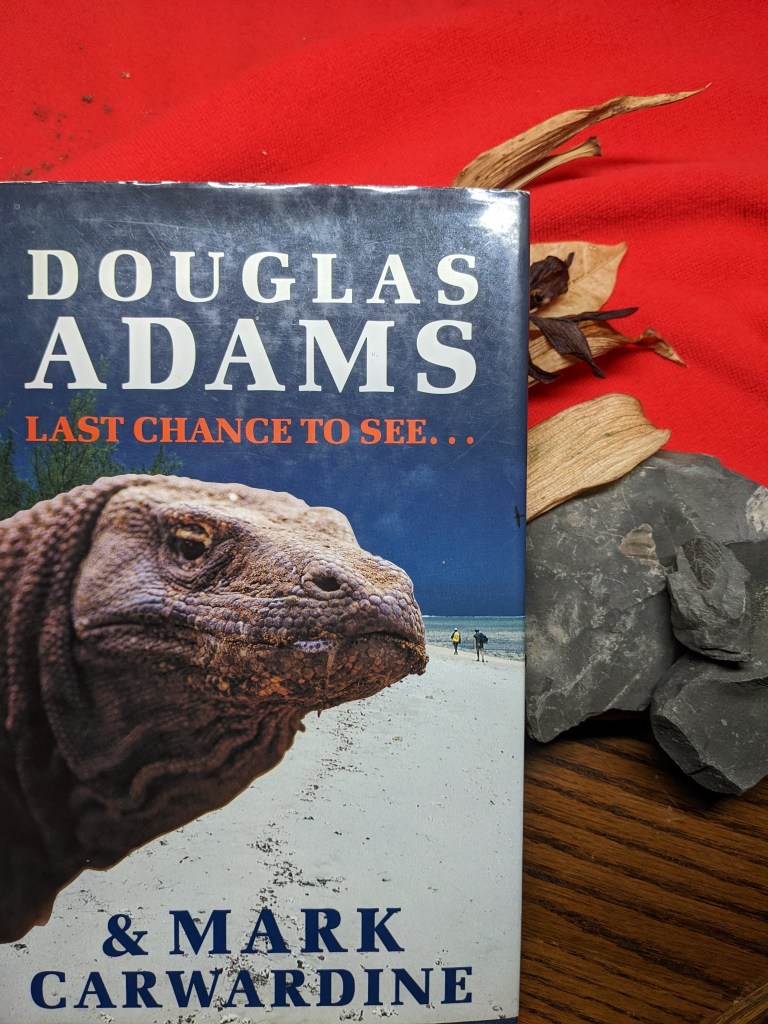
Last Chance to See – Douglas Adams & Mark Carwardine

Rating: 3.5 out of 5.

I am a sucker for Douglas Adams. Every time I read one of his books I feel as though it is similar to having a visit from that one friend who has you in stitches on and off for hours. It would have to be on and off otherwise the constant laughter would stop your ability to get enough oxygen. It doesn’t matter if you’ve heard a version of the story eight times at this point, it’s the way that it’s told to you, the quirky eyebrows (I never met Mr. Adams but I am SURE that he had quirky eyebrows) and the tonality of the delivery. All in all I don’t have the time nor can I be bothered to judge his writing from a stiff and awful analytical standpoint. Pieces like this you have to enjoy with your heart.

For those of you that have never heard of Last Chance – it was this wonderfully strange idea by a wonderfully confused Observer Colour Magazine to send Douglas Adams, shortly after writing about hitchhiking around the galaxy and the importance of 42, to Madagascar to look for aye-ayes with a group of people whom it actually made sense to send. Aye-ayes are hard to find. Google them. If I looked like that I would be hard to find too. This leaves us with the knowledge of the population of aye-ayes in a very ¯\_(ツ)_/¯ state. There could be 1,000 left. There could be 10,000 left. We don’t know. Madagascar is hard.

Last Chance to See… By Douglas Adams and Mark Carwardine

When the project picked up again, they went looking for Komodo Dragons. Komodo Dragons are scary. There are still between 4,000 and 5,000 left in the wild. This is more or less the same quantity as there were when Douglas Adams and Mark Carwardine were looking. This is largely due to their natural habitat being turned into amusement parks where people can pay to see them eat a goat. There are times where I am rudely reminded that my idea of a good time and other peoples’ are vastly different. With some quick digging, I found that you can actually still visit this park in 2022. They seem to have overhauled the bit with the goat in favour of a more ‘natural’ and terrifying discovery of dragons.

Next on this very rare bingo card is the Northern White Rhino. At the time the book was written, there were 22. The text makes it sound like there were high hopes for the programs and the conservation efforts. I have bad news on that. Only 2 remain at the time of me writing this. And they’re both girls. And unable to carry calves to term even if we pulled some sweet science cloning magic. In this particular species, we have failed.

The bit about the Mountain Gorillas, within the chapter filled with amusing English politeness kerfuffles, was very nice to read. They remark that there are 208 ish individuals at that point. Now, there are approximately 1000. We are doing much better with the gorillas than we are with the rhinos.

Kakapos. Weird little fat flightless parrots. Have you ever heard about them? I personally love quirky evolutionary adaptations. Kakapos have a wonderful one. They make a hole and scream at the ground for a mate. “Love me!” The hole cannot love them back, but as a quiet introvert I can relate to the tactics. There’s 202 left at the time of me writing this. There WERE 40.

Yangtze River Dolphin. Stupid looking. Totally gone. Haven’t seen one despite expeditions. The last known one died in captivity in 2002. They didn’t know how many there were to start. At this point, they have become the fisherman’s tale of the Yangtze, along with their friends (or… former friends?) the Yangtze Porpoise. I’m quite sure that old men sit around and dazzle the younger generations with “I saw one of them once… It was THIIIIIIIIIIIIIIIIS big!”

The last chapter was about Mauritius. Honestly? It made me a little bit sad for the state of the world and how people view conservation. There were four species that were looked at, Pink Pigeons in which 350 have escaped the fate of their ancestors of being made into pie, Echo Parakeets which have managed to increase to 700 from a mere 15 individuals, and the Mauritius Kestrel. The Kestrel was a victim of DDT. The pesticide made its way up through the food chain and softened the eggs of this small bird of prey. Without intervention and hands on breeding programs it is unclear whether they would have come back. Instead they are sitting at a population of around 800.

You may be looking at the above paragraph and wondering ‘where’s the fourth?’ Well, following the SPIT rule, (see previous post) I am changing paragraphs when I am introducing a new idea. The fourth species, unlike the other beings that I have spoken about here, is a tree. A coffee tree, to be exact.

I wanted to end on this because it was the passage that resonated with me the loudest.

In 1981, a teacher on Mauritius was speaking about an extinct kind of coffee bean tree. One of the students piped up and said to the teacher “Please, that’s not extinct, I have one in my backyard!”

Needless to say this caused quite the flap amongst the educated-about-trees crowd who immediately sent a sample off for testing. The testing did nothing but prove that this was indeed a specimen of the previously thought to be extinct coffee tree. Well, word gets around, doesn’t it? The tree was in danger of being cut down for firewood, or hit by a car that was on a nearby road, so they put a fence around it.

The problem with this is that the fence flagged it as special so people started acting, taking bits and pieces of it for luck, or medicine, or charms. What action did this prompt? The tree got a bigger fence. One with barbed wire. This made people more determined. So they put up more fence. They hired a guard.

ALL I CAN THINK ABOUT when I read this is this little tree, doing its best, then all of a sudden it gets a bunch of fences and its OWN GUARD! Because people heard that it was rare and wonderful so they determined to destroy it, handful by handful!

Ask why you can’t go up and touch Stonehenge anymore. There’s a rope around. Ask why you can’t climb the stairs or go into the ruins proper at Chichen Itza. There’s ropes, and this time guards – which are scarier than the deterrents in England. Please, read this book if you are like me. If you like to have a good giggle with your friends, if mild and silly politeness kerfuffles at someone else’s expense make you smile, and if you too want to scream at the general population “STOP WRECKING EVERYTHING!”

I promise you you won’t have a bad time.

References

Change Paragraphs Every Time You SPIT

Have you heard the “Tip Top” trick for knowing when to break paragraphs? Create new paragraphs each time you change – TIme, Place, TOpic, Person.

TIme – Make a new paragraph any time that you are skipping either forward or backward in time.

Place – Make a new paragraph any time that you are moving to a new place. If your piece was a film, this would be a transition. If your piece was a play, this would be a set change.

TOpic – Any new topics, ideas, or subjects need to have their time to shine and grab the reader’s attention. Do this by introducing them in their own paragraph.

Person – When you are writing in an omnipotent point of view and change focus to a different person change paragraphs. When a new person is speaking, new paragraph. When you are introducing a new character then guess what? New paragraph.

I have one I like a little better than that.

Change paragraphs every time you SPIT.

Or, for a catchier/morally questionable option –

SPLIT WHERE YOU SPIT.

S – Speaker

You HAVE to break paragraphs each time a new speaker takes the spotlight, or every time the speaker changes within a dialogue. I know this is a modern rule but it was implemented for clarity. Dante did not follow this rule. I never knew if he or Virgil were speaking in the Divine Comedy. I would punch Dante if I had that power. It’s hard to follow and in modern writings can stall the flow of the text.

P – Place

Please change a paragraph when the focus of your narrative moves to a different place. Place is not just geographical. It can also be emotional or a state of mind, if you care to debate philosophy. This point is nearly identical to the one in TIP TOP. If your piece was a film, a new paragraph would happen every time there was a scene transition. If your piece was a play, a new paragraph would happen every time you struck the stage. When I refer to the emotional place or state of mind, I have found that it can be helpful to really accent and emphasize that change or difference between the two states when you break.

I – Introduce

“Introduce” is kind of my cheater point. If you are introducing a speaker, a place, a state of mind etc you likely already have made the necessary paragraph breaks. Consider this though, I needed a vowel to make my acronym work.

Okay but on a more serious note, I wanted a catch all for introducing new ideas, new plot points, new non-speaking characters, and anything else that you would care to bring into your work in progress. “Introduce” is a fairly good way to emphasize that everything in your writing, if it is worth mentioning, is worth a proper introduction and should be relevant to your work. If you are struggling to give the element its own paragraph, consider if it is really necessary or if there is a way to acknowledge it in an alternate way.

T – Time

This point is the same as the one in TIP TOP. Any time you are moving either forwards or backwards in time, you should be creating a new paragraph. If nothing else, the new paragraph will force your reader to pause which can create enough mental space for you to ease your reader into the alternate time stream.

I used a couple of references to help me lay out the above thoughts.

I would love to hear thoughts on the above, or what other writers (regardless of genre) have found helpful in their paragraph splitting journeys!

My OTN -> One True Nemesis

Affect vs. Effect

So the hope in writing a post on my OTN super duper early in this website is twofold.

1) I will get a handle on it a bit more and maybe help others in the future.

2) If this website takes off my deep dark grammatical failure will be hidden away in the recesses of time.

Not to be dramatic though.

I have read a lot of descriptors about how to use affect and effect. I have heard all of the tips and tricks. A is for Action and that is Affect (a verb!). E is for End result and that is Effect (a noun!). I have put it in order so it spells RAVEN (Remember! Affect is a Verb! Effect is a Noun!) If it was as easy as that, then I wouldn’t be here, lamenting my inability to keep the two straight.

Affect

Let’s start with Affect. The Verb. A refresher on verbs? Merriam-Webster considers the essential meaning of a verb “a word that is usually one of the main parts of a sentence and that expresses an action, an occurrence, or a state of being.”

If you are impacting something, you are probably affecting it. If you act on something, you are affecting it. If you change something, you are affecting it. If you influence or improve something, you are affecting it. Now, just in case you are thinking “well of course this is all very straight forward” I have two more for you. If you have steady, unchanging, baseline emotions, you have flat affect. Another, in case you were still feeling confident. If you are pretentious, or you are pretending to be someone you’re not trying to impress other people, you affect that trait. You can affect an accent. I mean, please don’t. But you could.

If Thing A is doing something to PRODUCE a desired result, then it is affect.

Effect

The noun! Similarly to its precursor, I will start with the Merriam-Webster definition. “A word that is the name of something (such as a person, animal, place, thing, quality, idea, or action) and is typically used in a sentence as subject or object of a verb or as object of a preposition.” I personally find this one helps me less but in the interest of treating these words fairly I pursue.

If the subject experiences the thing, it is effect. If you can replace “effect” with the word “result” or “consequence” then you have used it right (for most applications). If you are effective, you are successful. This is the end result.

Examples? Sure.

“This will take effect tomorrow.”

“Despite how many he had downed, the beer seemed to have no effect.”

“Nurse April handed over the husband’s personal effects.”

Closing thoughts

I read that if there’s an “a”/”an”/”the” in front of the subject/object then that’s a pretty good way to determine that the correct word is effect. I haven’t tested this myself but it seems to check out so far.

Just because I am an Agent of Chaos I will give you a counterintuitive example. It is better to effect change than it is to affect change. To affect change means that you are impacting the change, which is pretty good. To effect change is to create and bring about change. That is a much stronger movement in most everyone’s opinion.

Because affect and effect are my OTN, this post was hard to write. Even though I spent a week reading articles on the difference. This is a call to all Grammar Nazis. Please comment if you see something in this post that represents affect and effect poorly (besides my attitude). I’d love the opportunity to reign victorious over my nemesis!

Primary Sources:

Book Review – January 23rd

The Starless Sea – Erin Morgenstern

Rating: 5 out of 5.

So I feel tricked by this book. It was a gift from a good friend of mine.

“Here” she said. “I think you’ll like this book.” she said.

I began to read. It was beautiful. It was like meeting an incredibly attractive stranger at a fancy party you snuck into. Here is a whiff of their perfume/cologne. There you hear them laugh softly somewhere in a crowd of people. You can feel a brush of their fabric against your skin as again you just miss them. Their name, you must have their name!

Instead you find a scrap of paper. On it, there are three numbers. Could it possibly be a phone number? Or maybe a time. You know it’s important, but right now you don’t know just how.

You keep following the story, desperately drinking the magnificent word choices and the startlingly consistent tenses of the passages. Deeper it draws you in. You feel cradled.

The exploration of character was not a forward theme of this novel and yet by the end you feel as though you know each intimately. Like you share something private with them. Each piece of the split plot falls into place and the feeling of pride when you stand back and look at the whole thing is true. This is one of the most beautiful journeys that I have been on in a long time and my hat is off to the author for bringing this art into a readable format.

Heads up I did get to about here and started screaming – “IT HAS 30 PAGES TO REDEEM ITSELF!”
It did but please know in advance that it’s coming.

The Beginning of a Blog

My Mom’s favourite story is that I wanted to be an author before I could write. Apparently I would bring her a marker/crayon/whatever and a piece of paper and say “Mummy write?” and I would give her some really well thought out and grammatically sound babble to write for me.

My favourite story is not that.

Why?

At this point in my life, it’s connected really haphazardly to the rest of my writing journey. Took a few creative writing classes in grade school. Then a few literary classes to fill my options in university. Tried to get published with my first complete manuscript and have the rejection letters to prove that I truly did give it a shot.

Fast forward almost ten years. I considered freelance. I looked up the process of self-publishing. I took some more courses, one about editing. Another about plot and creating a “good” story. A third about content marketing and how to sell yourself. What was one of the things that kept coming up?

Write a blog.

Now, my first reaction to writing a blog is “No, I like to read books. I like to look at books and touch them and feel them and fold their pages and get a little high off the smell of the ink and paper breaking down in old bookshops. A BLOG!? ME!? No. Yuck.

Books in the Sherlock Holmes Museum, Baker St. London, England

Firstly, I am not that funny. Or personable. Someone who has the social skills of a paperclip should not be running a blog. Second, what the heck am I going to write about aside from the things that I am doing in an attempt to get myself published? That isn’t going to fill the website with relatable and shareable content that I can be proud of.

The more I thought about it the more I realized that my anti-blog stance was really a fear of rejection. Getting rejected by a publishing company was one single big rejection and any writer proud of their work can site things like “Harry Potter was rejected by 12 publishers! Dr. Seuss was rejected 27 times! I’m only on rejection 8!”

A blog and freelance work though? That’s a handful of little daily rejections and I wasn’t ready to face that.

Well, it’s 2022 and everyone is tired. I myself have become so tired that any reservations I had about “What if the iNtErNeT doesn’t like me!?” have died with the last of my patience for this pandemic.

So Hello World – let’s give this a shot.