A.M. to P.M. – The Best Time to Write

Recently, a friend told me he gets up and writes before work. This doesn’t sound too extraordinary as a standalone fact. But he works at 5:30 in the morning. Now, I don’t know about you, but doing anything requiring any modicum of concentration at 4AM is simply out of the question for me.

He told me he likes it when the world is quiet.

I made a sound of agreement, but I know the REASON the world is quiet at that time is because everyone is asleep. Including myself.

In the evenings, I write. I choose music I want to ignore and slip my headphones on. That way, I don’t care if the world is quiet or not. I’ve created my little sphere, and I work within it.

Which got me thinking. IS there a best time of the day to write?

There is NO best time to write, as long as you’re alert, consistent, and minimizing distractions.

A lot of posts and articles I read stated my friend and I fall into the two “best” times for writing. However, looking a little deeper into it, it’s not that simple. It’s related to your circadian rhythm.

A circadian rhythm is the mental, physical, and behavioural cycle a person goes through in a 24 hour period. It is influenced by when the sun rises and sets, temperature, stress levels, food intake, physical activity, and other outside factors. Within this rhythm, there are times of alertness and fatigue. These times of alertness are what we want to focus on.

Generally, one or two hours after you wake up, you experience a period of wakefulness and alertness. I personally do not experience this consistently/reliably. And let me tell you. If I woke up at 6AM just to see if I could wait out the groggies to get an hour of writing in… I would be a miserable person to deal with. Others who DO experience this alertness and wakefulness consistently/reliably would benefit from incorporating writing into their mornings.

For the standard 9 – 5, Monday to Friday, if you skip this morning writing period, your next obvious opportunity is after work. Moving straight from work to your WIP is not very effective for most, because your brain needs a “cool-down” or a “destress period” from the job. Then, of course, you have dinner and clean up, and whatever else you catch yourself up on, run your house, destress again, and then your next opportunity presents itself. Are you alert at 7PM? 8PM? 9PM? Great! Write then.

For the non-standard shift workers, it’s even harder to nail down a writing session to stick to. Rotating days off, swing shifts, clopens, and 12-hour shifts can all cause disruptions to any semblance of a schedule, so you have to essentially “game the system”. Instead of writing at a set time, it’s going to be more effective for you to write within a set part of your schedule.

For example.

Do you like to get up several hours before your shift so you can get stuff done? Work writing into the “before your shift” routine whether that’s at 4AM, 7AM, or 10AM. Alternately, are you the kind of person who rolls out of bed half awake for your shift and does most personal tasks afterwards, punting all your chores and errands to your days off? Work writing into the “before bed” routine you have, whether that’s at 9PM, 11PM, or 1AM.

Like I said. Whatever works with your schedule and your body. Just make it consistent. Make it a routine. Put your interests on the same level of importance as your personal hygiene. Sound radical? Sometimes that’s the mindset you need to force yourself into a new routine!

I also don’t want to hear a single person say “Ah yes, but the best time for me to write is a time with every distraction that has ever existed.” because you can get some really nice noise-cancelling headphones for $200. You can get normal headphones and some sweet thematic music for substantially less than that. You can get earplugs at the dollar store. Control your distractions wherever it is safe to do so, and get that writer-butt in there!

The only thing I saw toted as a strictly “bad time” to write is that horrible after-lunch slump. So don’t pick that time to schedule your writing session.

Alertness. Consistency. Having minimal distractions. You can do this!

Since your most productive writing time is linked to circadian rhythms and circadian rhythms are affected by the seasons, I wanted to touch quickly on whether or not there was a best season to write.

The season you’re least busy and most comfortable in? That’s the best season to write.

Lame. I know.

I always thought it would be summer and fall, but most of the articles I read said fall and winter. There were also a bunch of votes for spring. Consensus? Apparently, we don’t know her.

The trend I DID notice was that people who argued for fall being the best writing time cited things like being really busy in the summer and liking the cooler weather to sit at their computer or have their laptop. People who argued for the spring seemed to like that it was warming up and seemed to gain inspiration from the world starting to grow again. Winter had votes because you could be snuggly in your house and ignore the weather for as long as you wanted. There’s also not a lot of good reasons to go outside come, say, February. For summer being the best, people said things like enjoying writing on the dock at a lake all summer. In the sun. That sounds awful to me, personally.

Summer is the time when there’s the most daylight. This is important to me because I have trouble feeling motivated to do things when it’s dark outside. Summer is also the time for fun sugary drinks, shaded patios, and air conditioning. I don’t have kids, I don’t have classes or trips or anything to do in the summer so it’s not busy. Therefore, for me, summer is perfect for writing. Autumn is much the same. The mornings and evenings are nice and cool, the days are still warm, and I’m not busy here either. These are the two best times to write for me personally.

During the winter, I hate everything including myself. It’s cold. I’m dry. You’re dry. We make static electricity when we shake hands. The outside is cold, wet, cold and wet, or frozen. It’s hard to be covered in as many blankets as I want and also utilize my hands for things like typing. Spring, I tend to my garden and get the yard up and running. I’m quite busy! These are the seasons I don’t expect much creativity and writing from myself.

So! I am an evening writer who does her best work in summer and fall. How about you? What are your productive times and seasons?

References

He Said, She Said

Just like every technique and stylistic choice, there are good and bad ways to do multiple points of view. For some people, the point of view of a book will determine whether they’ll read it or not. I can’t say I have ever personally gone through a phase where I straight-up hated the choice as a whole. Except for in Eldest. (Christopher Paolini, you know what you did.)

However.

For some reason, for some strange and incomprehensible reason, Colleen Hoover is really popular right now.

Enough people on the internet are talking about the weird dynamics featured in her story. Enough people on the internet are talking about her single-dimensional characters. Enough people on the internet are talking about the examples her fictional relationships are setting and romanticizing. THIS POST IS NOT ABOUT ANY OF THAT.

No, this post is gently blaming Colleen Hoover for this epidemic of books that switch the character point of view with absolutely no good reason to do so.

When you are dealing with a romance book, it can be a lot of fun to watch characters falling in love with one another. It can be a lot of fun to see a singular event happening from multiple character’s perspectives. But sometimes, including things that are “a lot of fun” is at the expense of your coherent plot line. Sometimes, you should have just conceded and written a limited omniscient point of view.

Throwing some quick definitions your way just in case you need a refresher.

  • Omniscient is where the narrator knows all and sees all. The narrator is generally, but not always, separate from the characters of the story being told. Because the reader is not directly in anyone’s head, it can pose a challenge to get the reader emotionally invested in your characters. Also called Third-Person Omniscient.
  • Limited Omniscient is where the narrator knows everything about ONE character. It tells the story using the opinions, emotions, biases, and perceptions of the main character. All other characters are described, seen, and presented to us based on the views of the main character, not objectively like in regular/third person omniscient. You can deliver information about that main character that is not known to the character. Like a stowaway in a car, or a mystery item in a purse. This style is meant to make you sympathize and root for the main character particularly. Sometimes this is further divided into Objective Limited Omniscient where the narrator ACTS completely omniscient and impartial, but only follows that one main character.
  • First-Person is where the stories paint you as the main character. It uses “I”, “me”, and “myself” to put the reader into one character’s brain and hear their thoughts and feelings. This is similar to limited omniscient in that it really focuses on one character, but differs in that if the character does not know a thing, the reader is not told that thing either. This is utilized a lot in novels meant to encourage escapism.
  • Switching Point of View or “Head-Jumping” is typically a first-person style narration, but instead of focusing on one character, you focus on two or more. This is generally organized by putting different characters’ viewpoints into different chapters with names in the headers. For the rest of this post, I will be referring to this style as “switching POV”.

When is it a good idea to use a switching POV? When the story will benefit from it. When your plot is building suspense. When you need to show a different world than the one the main character perceives. When you need to build out your setting and characters. It can also be used if you need to reflect the main character’s personality through someone else’s eyes (eg. when the main character is unreliable).

When is it NOT a good idea to use a switching POV? When it will confuse or upset the reader. When it is just there to bulk out the book. When it will not add a character-building moment, a setting/world-building moment, or further the plot in any way.

Now, the crux of this post:

Please. Friends. I am so tired of reading chapters from “his” point of view where the entire thing is telling me how hot he finds the main character. How amazing she feels and her quirks. How he’s changed his life for her. How he thinks about her the entire motorcycle ride to their next date. I don’t care about his motorcycle ride spent thinking of her. Well, not enough for it to make me happy about it taking up an entire chapter.

Too many writers (especially romance writers) use a switching POV as an excuse to be lazy. Instead of showing us through a secondary character’s actions that they’re conflicted about the relationship, we switch to their point of view and TELL the reader about it. To use my motorcycle example from above, we told the reader how Mr. Love interest was feeling about the main character. Why not have it shown instead? How he misses what the waitress says to him or how he doesn’t seem to be listening but is staring intently at her? Explain the softness of his eyes to make sure it doesn’t come across as creepy or overbearing. Don’t tell me in ANY setting. Show me. Let me figure it out for myself.

Colleen Hoover does this switching POV to “tell” a lot. I think it’s in part responsible for making her characters feel very flat.

I also think her popularity has sparked an interest in this style of writing, without anyone considering the pros and cons of how it feels to the reader (especially in a genre made to accommodate escapism!).

At worst, switching POV can confuse the reader who is trying to keep track of which characters know what. It can also muddy your plot and make certain sections needlessly drawn out. At best, it’s a thrilling way to explore different characters and their opinions/perceptions.

Keeping just one or two questions in your head like “Is this clear enough?” or “Is this adding anything we don’t already know in an effective way?” can make a WORLD of difference in how your piece comes across when there are multiple perspectives in it. If you ARE interested in writing a piece with switching POV, I highly recommend taking a look at the Masterclass link I have below in the reference section.

References

Is Your Setting a Mary Sue?

The online course I’m taking for video game writing has been talking a lot about worldbuilding. This is nice because it gives me plenty to think about in my job and hobbies. I’ve made several posts about this already, but today I’m going to get to the core of the issue: Prevent your setting from being the most boring character in your book. Or the most pretentious character in your book. Or the most hated character in your book.

“But Winters!” You say. “My setting is Lubbock, Texas!” (I googled ‘the most boring city in the world 2024’ and this is what it returned.)

That’s nice. If you don’t want it to come across as a cardboard cutout of Lubbock, you still need to build out your setting more than just a cursory description. Trust me, if you ask anyone who grew up in a place with “nothing to do”, you’ll get a lot of wild stories. Human beings MAKE their own fun. They MAKE their own activities. Even if those activities are drinking around a fire and accidentally creating ghostly snow-thrones making it look like a gathering of spectres. Then maybe the locals call that area the “hill of kings”. That sort of thing won’t make it into any articles you may grab for research purposes. Unless you’re reading someone’s blog and they mention it.

Please make your setting well-rounded, personable, and real. Draw the reader in.

The relationship between the protagonists and the setting should be just as important to you as a writer as the relationship between characters is. Let the characters and setting interact. Let them influence each other. Let them work together.

Make it so that the reader wants to explore the setting through the eyes of the characters. Your story world should feel like more than the backdrop in a stage play, where the stagehands are throwing in only what’s necessary to the story.

Unless it’s instead, like one of those kindergarten plays where some kid lays on stage and plays grass.

That has its own problems.

Overcrowding your setting and building it out unnecessarily can be frustrating for its own reasons, like making your reader suffer through pages of purple prose.

Purple prose is a trope where you use flowery language and an abundance of adjectives. The descriptions are redundant and often describe things that won’t come up again. I’m sure we can all remember reading a page and a half describing someone’s sandwich (or other mundane object) which ultimately, doesn’t matter. Even if the sandwich is important to the plot, it does NOT need a page and a half. I promise.

When you’re writing, there are things you will know about your setting that the reader will never know. Just like there are things about your characters you will know that will never come up to the reader. These things are still important, but they are more for shaping the characters and setting as their own entity than to info-dump on the reader.

Just like no one wants to read a page and a half about a sandwich, no one wants to read that stereotypical introduction where a character looks in the mirror and describes themselves from head to toe. It’s juvenile at best, and at worst, off-putting. Unless your goal is to make it into a Men Writing Women or Women Writing Men subreddit, skip it. Or find another way to convey the information.

Treat your setting like a character. Appraise its personality and the way it presents to the reader. Give it more substance than just existing and looking pretty. Give it a history. Give it some significant lifetime events. Give it preferences, vibes, and presence! Make it feel real to yourself. Make it feel real to the reader without telling them every little tidbit.

Let your audience want to discover the setting just as much as they want to get to know your characters. Nothing commits people to a book or a series more than curiosity. Every piece you make them curious about is another piece that will make them come back to your work.

References

Writing Craft – Is it Actually Useful?

I am constantly on the lookout for ways to improve my writing. Online classes, YouTube videos, writing clubs, craft books, peer review, essentially whatever I can get my hands on and fits into my schedule, I’m happy to try. Recently, one of my coworkers has gotten into craft books to help support her career development.

Everyone and their dog has written a craft book. A few examples are:

  • Stephen King – On Writing – A Memoir of the Craft
  • Neil Gaiman – Neil Gaiman Teaches The Art Of Storytelling
  • Ursula K. Le Guin – Steering The Craft
  • Ray Bradbury – Zen in the Art of Writing
  • Margaret Atwood – On Writers and Writing
  • Elizabeth Gilbert – Big Magic
  • William Strunk & E. B. White – The Elements of Style
  • Dean Koontz – How to Write Bestselling Fiction
  • Angie Thomas – Find Your Voice
  • Les Edgerton – Hooked

Which is in no particular order, just ones I remember passing in my sphere of consciousness within the last 6 months or so.

Some of those you probably have heard of. Some of them you might be seeing for the first time.

Now. Google a few of those titles. How many come up with results that say “This is the best advice I’ve ever read!” or “Hands down the best advice for writers out there!” or even “This is the writer’s BIBLE!”? Were there any books on that list that made you think, “Oh, I don’t like that author”? (I hope so, I tried to get a bunch of different styles in there.)

Are there some titles you would consider useless? Some you yourself consider necessary and important?

Here’s the problem. There’s already a Stephen King out there. There’s already a Neil Gaiman, a Margaret Atwood, an Elizabeth Gilbert. We’ve already had Ursula K. Le Guin, Ray Bradbury, and E. B. White. So taking your favourite author and emulating them based on their career, their advice, and their books will in the very best scenario, produce work that is just like theirs.

Taking your favourite author’s advice as gospel can produce some good results. But it more often than not causes a situation where you are trying to force your style, your thoughts, and your ideas into forms that they are not. I’m not telling you that you are perfect and amazing and I don’t know why you’re not a best-selling author already, I’m saying I do not agree with trying to make your style an exact copy of another person’s.

So go shopping!

I don’t really like Stephen King’s books, but he has some good advice. Margaret Atwood is emotionally intense and thought-provoking. She has captivated a good percentage of people with her books and her topics. That will never be me, but using some of the tools she speaks about has helped me write more emotionally intense scenes.

Pick and choose concepts from everyone. A little bit of this and that. Put it into your writer’s shopping cart and press “Check out”.

Gather your resources from as many different places as you can. Decide what resonates with you and what you can merge comfortably with your style.

Writing Craft books are a good resource for style shopping. But there are also hundreds of them to choose from. It can be intimidating to try and pick one, and it can be really easy to fall down a black hole of reading these books and their instructions and never actually get any writing done.

Set yourself a schedule. Pick one this month you’re interested in reading, and read it. Then take a month off. Write. Don’t look for your next book, don’t research new resources, just let the information digest and percolate into your writing and your life. When you are all done with your break, make a note in a study journal about the main piece of advice that stuck with you, and resonated with you.

Now that you’re done, pick up the book and read through it again. Wash, rinse, and repeat. If you didn’t like the one you read, didn’t think it was helpful, OR didn’t feel as though any of the advice resonated with you, move on. Head to the library or the second-hand bookstore. Get a new book. Do the same thing.

You don’t need to use every spare moment to study. Too many good pieces of advice slip through your fingers that way. Your brain can only integrate so much into your style and habits at a time. Be kind to your brain. Support it as much as you can. You’ll enjoy the process more and in turn, retain more.

Conclusion: Writing Craft books can be helpful, but only if you don’t take any one source as pure gospel and allow yourself the luxury to learn over time.

I’d love to know if you have a favourite craft book! Tell me in the comments below!

Same, Same, Different

how to make an impact with lists

I don’t know about you, but I really, REALLY like descriptors.

For example, if I saw a puppy, I won’t stick with “Hey friends! I saw a puppy!”. Instead, I want you to know I saw the smallest, cutest, fuzziest, energetic, happy white puppy! Which is fine when you’re speaking about puppies. But when you’re reading or writing about puppies? Too many words.

By trying to give specificity to the kind of puppy I saw, I might as well be writing you a list.

The puppy I saw was

  • Small
  • Cute
  • Fuzzy
  • Energetic
  • Happy
  • White

It’s clear, and for how many words I have there, it is well laid out. The problem comes when you can’t break your paragraph within your literary work to make a list like this. Yet, mashing all these words together puts you into a structural faux pas anyway. There are many ways to avoid this. I’m going to explain my favourite way – same, same, different.

A lot of people have heard of the rule of three. It’s a psychological and marketing trick, taking advantage of the human brain’s habit of seeking out patterns in things. For some reason, the number three is a fan-favourite pattern. Maybe because it’s related to the triangle, which is the strongest shape? That’s purely a guess, of course.

Anyway. Lists of three words feel complete. They make our brains feel happy when they read them. So if you use three descriptors to market your product, people will instinctively have a higher opinion of it than an identical product using more or less words.

Three words to make an impact. But which three words?

This is where the “same, same, different” tactic comes in.

Can you see it in these popular phrases?

  • Sex, drugs, and rock and roll
  • Stop, drop, and roll
  • Life, liberty, and the pursuit of happiness

Sex, drugs, and rock and roll. Short, short, long. Same, same, different. Stop, drop, and roll. -op word, -op word, not an -op word. Same, same, different. Life, liberty, and the pursuit of happiness. L-word and short, l-word and short, not an l-word and long. Same, same, different.

I saw the cutest, happiest, white puppy! -est word, -est word, not -est word. Same, same, different. Try it out! Let me know some sets of three that you’ve come up with. I’d love to hear about the examples you’ve used!

Also, because I’m not a jerk, here’s the puppy I’ve been talking about! His name is Mochi.

References

I Before E Except After C is a Joke

Many a day, I review things I write, or things I say, and think to myself “I’m so glad English is my first language.” Not because of the inherent advantage it gives me, but because honestly? It’s a sheer disaster of a language. I would not want to learn it, especially if my foundational language was something nice and orderly.

Teachers try and make it easier on us. They try and come up with fun little sayings to help students learn how to spell.

How many of you spell ‘beautiful’ by mentally saying “Bee-e-a-utiful”? Or ‘nauseous’ by mentally breaking it up into “Na-use-o-us” (‘No use of us’ in a Scottish accent)? How about ‘amateur’ as “A-mate-u-r” (A mate you are)?

One of the ‘fun’ rules teachers LOVED to pound into me as a kid was “i before e, except after c,” which, did you know there’s a second part? I didn’t. It ends with “or when sounding like ‘a’ as in neighbour and weigh,” which… I suppose, shortens the list of words that don’t follow the rule.

I will not lie, I sat here sounding out words when I discovered that. Science. Psy- ANCE? Sigh-Ance? Sss-iiiiiii-ence??? Weird. Wee-rd. Forfeit. Fore-fit. For-feet? Nope. Still writing this post.

Was it Terry Pratchett that said English is 4 languages in a trenchcoat?

Thieves. We’re all a bunch of dirty word-thieves. Thieving words from every language we come across. Which is funny to me, because Old English is the root of the problem with the i before e exceptions, so not only are we thieves, but we can’t even get our OWN garbage together. Now we have words like guru. Kindergarten. Cafe. Glitch. Patio. Ketchup. How are we supposed to keep a straight face when teaching people how to grammar in this Frankenstein’s Monster of a language?

Statistically, the odds are about 3 to 1 that an i comes before an e.

Why can’t we just say that?

Any kid that knows the word ‘ballet’, or is learning how to spell ‘hors d’oeuvre’ already knows words are a disaster, it will NOT surprise anyone to hear “if you’re unsure, do ‘ie’ as it is statistically more probable.” Except, obviously, worded in a way small humans would appreciate.

Why maintain the lie “i before e, except after c” is a rule? It messes with people. I have had a lot of arguments with other adults both as one and before I was one about this.

It’s believed that spelling bees are only done in English. I mean, take German and Japanese for example. German, if you can sound it out, you can spell it. Japanese has 3 different writing systems. One, is for foreign words – typically phonetic as per their language rules. Another is the general writing system. The last is Kanji, the complicated pictorials similar to or taken from Chinese. These can be difficult, but it’s not a spelling thing, it’s a word association thing.

All this to say, please, can we stop making up “rules” for kids to learn? Especially if they have more than like… 5 native exceptions?

References

“That’s Neat”! “That’s Neat!” Or… “That’s Neat,”!

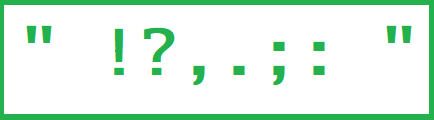
Do you know what grammatical duo are complete bullies? Quotation marks and punctuation. I hold this to be true because I feel like my editing journey can sometimes be entirely derailed by the gaslighting they provide. There are 6-ish rules for using them. There are 15-ish situations where you may have to stop and think about what you are doing and what the punctuation is saying. Here I’ll talk a little more about the ones that are most relevant to my day-to-day writing.

The first word in a direct quote should be capitalized, even when it doesn’t look like the punctuation suggests it should be. For example,

It was hardly a whisper, “Did you hear that?”

Except when you are splitting it up, of course, and are continuing a quotation already started earlier in the sentence.

“I was just thinking,” it was more to himself than her, “we’re not very well hidden.”

To boot, the above example also illustrates another point. When you are breaking up someone talking to interject additional information or context, induce a mental pause for people by slapping a comma at the end of the break. More clearly:

“Could you,” slowly the idea was coming to her, “reach behind that box,” her nod indicated which one she was talking about, “and get that board loose?”

Okay, okay, it’s not the most eloquent I’ve ever been, but it belabours the point and repetition is the key to remembering.

The comma continues to take the spotlight as we continue. When you have a direct reference to the person speaking, even if you think you want to use a full stop, it is not a full stop. It’s only a full stop after your preferred synonym for ‘said’.

“I think so,” he replied.

This comma rule *might* not apply if you are using the quotations for when the speaking character is quoting another character – quoteception, if you will. In this case, it’s entirely possible that there’s no punctuation at all until you are well away from whatever the quote within a quote is.

“Are you serious? There’s no ‘I think so’ about it! Yes or no!”

Now that I’ve spent an obnoxious amount of time talking about commas, let’s shift gears for a little bit. Let’s talk about more specialized punctuation, like question marks.

A question mark! Where do you put it? Always inside the quotation marks? Where all good punctuation gets tucked in? Not always.

If the speaker is asking specifically about a quote, then the question mark goes on the outside of the quote. So, what if you are questioning or seeking clarification about a question?

“Wasn’t it you that said ‘How bad could it be?’?”

Look how stupid that looks. I regret typing it with my own fingers. Luckily, that is not proper. Not the capitalization part, that’s proper, because ‘How bad could it be’ is a full and complete sentence by itself. If it was a fragmented thought or a partial quote, then it would NOT be capitalized. So, to accommodate the proper punctuation, it should have been:

“Wasn’t it you that said ‘How bad could it be’?”

The punctuation at the end, because it would legitimately be a double question mark, is just removed. If the quotation ends the speaking line, then typically, as a courtesy, you would end the quotation with the single quotation, leave a space, then end with the double quotation mark. Are you with me still? There are three things I want to talk about left, and I promise I’ll tie it up in a neat bow after.

“I can’t believe you’re blaming me! YOU’RE the one who suggested it! ‘It’ll be fun,’ you said!”

See that there? You thought we were done with commas, but they really are the star of the show here.

She adjusted herself as best she could against her bindings, and peered out through the slatted closet door. “Of course I said it would be fun! I was flirting with you! I was happy you seemed receptive!
“Besides. Don’t you think it’s kind of romantic to go somewhere scary? With someone you like, who offers to protect you from anything bad that might happen?” There was a chill to her tone.

When you’re splitting a person’s speech over a paragraph break, you leave the initial paragraph with open double quotations and begin the next paragraph with quotation marks again. This, as far as I can tell, is a simplified indicator to the reader that it is still the same person droning on. Like when you have them delivering an evil villain speech.

The last point is something I want to be careful about. Using quotation marks to indicate something’s name, or to indicate sarcasm. Too many times, people use quotation marks to emphasize things. Please never use quotation marks for emphasis. A great man said that. Weird Al Yankovic. If you go against those wise words, it makes people think there’s something wrong with the thing you are emphasizing.

“I can’t help it if my ‘friend’ hyped it up! She said it was popular! ‘Teen Scene’ ran a whole article on it,” his cries echoed loudly. Footsteps, heavy on the old wooden floors, started approaching.

When you read that, you didn’t think that the person who recommended this was *really* a friend, did you? ‘Friend’ being in quotations immediately implies sarcasm. Hopefully, I can hammer home my point with the following example:

If you put out a cup of bucatini (a long spaghetti-like pasta with a hole running all the way down the middle) in a cup, it would be perfectly acceptable to label it “straws” WITH quotation marks. Why? Well, they sure as hell AREN’T straws, but they’ll work like a straw!

The difference between single and double quotation marks is for reasons of clarity. Since things within the speaking line still need punctuation to indicate that it is a quote or emphasized within the line, using the single markings is common practice.

Now! Remember when I said I would tie it all up for you in a nice little bow? This whole thing makes a passage. It includes most instances of quotation marks and their associated punctuation frequently used in creative writing exercises.

It was hardly a whisper, “Did you hear that?”
“I was just thinking,” it was more to himself than her, “we’re not very well hidden.”
“Could you,” slowly the idea was coming to her, “reach behind that box,” her nod indicated which one she was talking about, “and get that board loose?”
“I think so,” he replied.
“Are you serious? There’s no ‘I think so’ about it! Yes or no!”
“Wasn’t it you that said ‘How bad could it be’?”
“I can’t believe you’re blaming me! YOU’RE the one who suggested it! ‘It’ll be fun,’ you said!”
She adjusted herself as best she could against her bindings, and peered out through the slatted closet door. “Of course I said it would be fun! I was flirting with you! I was happy you seemed receptive!
“Besides. Don’t you think it’s kind of romantic to go somewhere scary? With someone you like, who offers to protect you from anything bad that might happen?” There was a chill to her tone.
“I can’t help it if my ‘friend’ hyped it up! She said it was popular! ‘Teen Scene’ ran a whole article on it,” his cries echoed loudly. Footsteps, heavy on the old wooden floors, started approaching.

So tell me! Is something like this helpful? Do you have your own ways of remembering the many rules of punctuation and quotation mark bullies? If you have a clear way of explaining the dreaded colon and semi-colon, I’m looking forward to hearing it!

Resources

Make a “Top 5 Tracks” List

Jobs that pay by the word are common. In those cases, bust out your inner Victor Hugo or Kronk from the Emporer’s New Grove. “And here you have a moment of confirmation – the poison. The poison for Kuzco. The poison chosen especially to kill Kuzco. Kuzco’s poison. That poison?” Some companies pay 3 CENTS a word. THREE cents. If they’re going to be like that, pull out all the stops. Craft beautifully written, 12-line sentences.

I want to talk about one of my favourite editing techniques for when the word count does not influence your pay. The “Top 5 Tracks” technique.

By default, I am a fairly wordy writer. I write things out like I am talking to someone face to face. My punctuation tends to indicate where, in my mind, a speaking voice would pause. I’m sure my university professors loved receiving my essays that were NOT concise and NOT succinct.

Please take a moment of silence for the head writer in my department. She is likely one more instance of a comma splice away from throwing her whole computer at me.

So what is this editing technique that from the sounds of things, has nothing to do with punctuation?

Have you ever been speaking with someone and suddenly noticed they say ‘um’ or ‘like’ a lot? This technique is like calling yourself out for exactly that behaviour.

Pick five words that “weaken” your writing. Ones you know you are bad for. Here are mine:

WORD:WHY’S IT BAD:
ThatNine times out of ten, when I delete it, the sentence doesn’t change. At all.
Sort ofNine times out of ten, when I delete it, the sentence doesn’t change. At all.
JustNine times out of ten, when I delete it, the sentence doesn’t change. At all.
VeryNine times out of ten, when I delete it, the sentence doesn’t change. At all.
ReallyNine times out of ten, when I delete it, the sentence doesn’t change. At all.

Do you see where I’m coming from?

If we were to talk in person, I’m SURE a quarter of my vocabulary would be those five. (Not really, but it feels like it.)

Now, you may be thinking to yourself “yes. There are many words that water down sentences.”

I agree! A quick google search of “weak words” will show you hundreds of articles detailing which words you should or should not use, ways to catch yourself, things to replace, etc. I have a problem with absolutes, so I don’t like this. Case in point, many guides out there will tell you not to use adverbs ending in -ly. At all. Because it’s telling instead of showing. Okay, but sometimes it fits the tone! Sometimes I’m going for a tone! Or sometimes, the moment is not important enough for me to expect the reader to pick up on the subtleties of the context cues! For example, what if the maid gently excused herself? What if I just want to say that and move on, rather than describing her movements when she’s not an important character?

With that being said, this is where the Top 5 Tracks comes in. Review your writing. Read a few articles about weak words. I’m sure you will find one or two you KNOW you overuse. If you don’t, try using CTRL + F on something you’ve written recently, and start testing words. The results might SHOCK you.

The articles you may read during your research will outline anything from 4 to 600+ words experts and professionals caution not to use. Know what’s going to be impossible to remember? An arbitrary number of words you may or may not be in the habit of using. This is why you pick the biggest offenders.

Biggest offenders are going to fluctuate depending on genre and style, but should be fairly (Adverb ending in -ly, take that list!) stable for each individual. Pick five of the ones you have trouble with, and focus on those.

CTRL + F within your document for each of the 5 offenders and delete them, or judge them an exception.

“What? Don’t just delete them!?” No! Because look! There’s a “just” in that sentence, and if you deleted it, you’d lose your meaning! “Don’t delete them” implies that you keep them all! “Don’t just delete them” implies that there are additional steps to consider before the action is taken. I guess you could reword it. “What? Don’t delete them without consideration!?” Which I guess gets the point across, but all this to avoid the word ‘just’? Why?

Especially when the words you are using are common, you can’t wholesale delete things.

So.

Read a bunch of your work, pick your Top 5 Tracks, and happy editing!

References

English – Why Are You Like This?

Would you like to know what this post was supposed to be about? This post was supposed to do a bit of an outline on when to use spacing in your words versus when you should leave them together. I spent a little while brainstorming what kind of words I wanted to use as examples and I was all prepared to write them up and discuss if there was some hard and fast rule of when to use them together versus spaced out.

Instead, I found myself down this rabbit hole of word definitions.

Let me explain.

The words that my brain goblin really likes to second guess are things like into/in to, onto/on to, altogether/all together, ahold/a hold, setup/set up, onboard/on board, and nevermind/never mind.

So first. Things like in and on are usually prepositions. For those that need a reminder, a preposition is the part of a sentence that will explain where in relation to another thing the subject is. For example, Mary is on the bed. Mary is the subject, and ‘on’ dictates where she is in relation to the bed. If we change the preposition to ‘in’, that adjusts our understanding of where Mary is. In the first example, she exists on the bed as a whole. Once it is changed to ‘in’, this implies that she is likely under the covers as she is now inside the bed as a whole. Unless there was an unfortunate murder, it is safe to say that ‘in’ the bed would only be comfortable if you were in amongst the blanket parts.

Okay sweet. Now how about in to vs into? Well, into is also a preposition. Usually. If we stick with the example from the last paragraph, Mary can get into bed, just as she is in bed. This is just the difference between whether it is an action that you are talking about, or whether it is the location you are talking about. Can you bring the groceries into the house? Otherwise, if you want to know where the groceries are, they are in the car, because no one’s brought them inside yet.

I have two rules of thumb here because there are always exceptions to the rules of how you use these words and using the two of them together is ALMOST foolproof. (Except for English deciding that to shapeshift, or to undergo metamorphosis is to change into something else. That’s a rant for another day.)

Rule ONE: Is the space, concept, object, or state something you can abstractly or concretely put your subject in or access? Shock, kitchen, desk drawer, meditation. She went into shock. She went into the kitchen. She went into the desk drawer. She went into meditation.

Rule TWO: Can you put a comma between ‘in’ and ‘to’ and it still makes sense as proper English and doesn’t change the meaning? Shock, kitchen, desk drawer, meditation. She went in, to shock. To shock what? Not a sentence. She went in, to the kitchen. She went inside the house. She stood like a sim, aimless at the kitchen border, not entering, just staring. Okay, I’m sure someone somewhere used that as a real sentence, but hopefully, you’re picking up what I’m putting down? She went in, to the desk drawer. Again, she goes there and just stands, staring at the drawer. Maybe she doesn’t have a key. She went in, to meditation. This isn’t conjugated properly so is not a sentence.

Happily, everything I’ve said above applies to ‘onto’ vs ‘on to’ with the adjustment of instead of the subject being abstractly or concretely being able to be in or access, the subject can be placed abstractly or concretely on top of something.

This sadly does not carry over to altogether, all together, ahold, a hold, setup, set up, onboard, on board, nevermind, and never mind!

Before anyone says anything about these all being conjugated words versus prepositions, no. Up and on are prepositions.

So let’s take all together and altogether. Different words. Because sometimes language be like that. Altogether is an adverb. If you can replace it with ‘wholly’ or ‘completely’, you are using the right form. All together is an adverb, modified by a determiner. If you remove “all” and the sentence still more or less makes sense, then you’ve got it. If it no longer makes sense, perhaps you should be using ‘altogether’.

Example! Mary was altogether fed up with John’s behaviour. Mary was all together fed up with John’s behaviour. Mary was ‘completely’ fed up with John’s behaviour sounds okay, but Mary was together fed up with John’s behaviour doesn’t make much sense. The correct usage is then ‘Mary was altogether fed up with John’s behaviour.’

Example again! The group was excited to be altogether again. The group was excited to be all together again. The group was excited to be ‘completely’ again does not make sense, but the group was excited to be together again makes sense. The correct usage is then ‘The group was excited to be all together again.’

Are you still with me? This is turning out to be a long one. In an effort not to waste your time with filler and fluff, I’m heading right into talking about ‘setup and set up’.

Setup is the noun. Person place or thing. Set up is the verb. Action, occurrence, or state of being. You can be set up because you are the subject and the thing is happening to you. You can’t be setup. You are not a computer, and you do not need all your settings adjusted to function. A smart toaster that is voice-activated can be set up (placed upright on a surface) and requires setup (programming to toast your toast and recognize your voice). If you yourself are not this toaster, you can’t be both.

Now for another relatively straightforward one with a bonus hyphenated occurrence! Onboard has the corporate definition of training people and amalgamating them into a company’s structure and ideologies. On-board reflects the location of something within a vessel that travels over land, through the sea, or in the air. On board is the term for being present in the vessel whether it is moving or stationary at the time. If you are thinking you don’t see that much difference between the last two, the third example is when it is used as a preposition, and the second is when it is used as an adjective. I don’t have a trick for this one. I looked for a few days to see if the internet had anything better to say but came up empty. I’d love to hear from you if you have something that works for you!

I will start the next section with a little filler and fluff. This choice might have been made because there’s no point in pretending I’m perfect and just know all this stuff. Guess what I learned while I was researching my little trouble phrasings?

That I should not be using ‘nevermind’. Like, ever. Why? Because it currently belongs specifically to the turn of phrase ‘no nevermind’. Haven’t heard of it? No. Me neither. Apparently, if something is bothering you, someone may tell you to pay it ‘no nevermind’. I’ll let you draw your own conclusions on this one. I personally don’t know how I feel about it.

The last combo I had on my little list was ‘a hold’ vs ‘ahold’. I debated leaving it out because it’s a slippery slope between accepting ‘ahold’ as a word, and accepting ‘alot’ as a word which I am absolutely against.

In fact, please see exactly how I feel in the timeless Hyperbole and a Half blog.

http://hyperboleandahalf.blogspot.com/2010/04/alot-is-better-than-you-at-everything.html

Ahold is an informal word that has been recognized by dictionaries. You can use it in the context of grabbing ahold of something or getting ahold of someone. What I want you to notice is that in both cases, the ‘ahold’ is followed by an ‘of’. This is it. This is the whole trick. If the phrasing is ‘This television show has a hold on me’, you can’t replace ‘a hold’ with ‘ahold’, there is no ‘of’! Since ‘ahold’ is informal anyway, if you are ever unsure, err on the side of ‘a hold’!

So there you have it. Something that was supposed to take me a few hours this weekend to type up and get ready for you ended up taking much longer and now has me questioning everything English does. I hope you found this interesting or useful, and I would love to hear about the words that sometimes give you trouble, or if you have any tricks to share about the above!

REFERENCES

Change Paragraphs Every Time You SPIT

Have you heard the “Tip Top” trick for knowing when to break paragraphs? Create new paragraphs each time you change – TIme, Place, TOpic, Person.

TIme – Make a new paragraph any time that you are skipping either forward or backward in time.

Place – Make a new paragraph any time that you are moving to a new place. If your piece was a film, this would be a transition. If your piece was a play, this would be a set change.

TOpic – Any new topics, ideas, or subjects need to have their time to shine and grab the reader’s attention. Do this by introducing them in their own paragraph.

Person – When you are writing in an omnipotent point of view and change focus to a different person change paragraphs. When a new person is speaking, new paragraph. When you are introducing a new character then guess what? New paragraph.

I have one I like a little better than that.

Change paragraphs every time you SPIT.

Or, for a catchier/morally questionable option –

SPLIT WHERE YOU SPIT.

S – Speaker

You HAVE to break paragraphs each time a new speaker takes the spotlight, or every time the speaker changes within a dialogue. I know this is a modern rule but it was implemented for clarity. Dante did not follow this rule. I never knew if he or Virgil were speaking in the Divine Comedy. I would punch Dante if I had that power. It’s hard to follow and in modern writings can stall the flow of the text.

P – Place

Please change a paragraph when the focus of your narrative moves to a different place. Place is not just geographical. It can also be emotional or a state of mind, if you care to debate philosophy. This point is nearly identical to the one in TIP TOP. If your piece was a film, a new paragraph would happen every time there was a scene transition. If your piece was a play, a new paragraph would happen every time you struck the stage. When I refer to the emotional place or state of mind, I have found that it can be helpful to really accent and emphasize that change or difference between the two states when you break.

I – Introduce

“Introduce” is kind of my cheater point. If you are introducing a speaker, a place, a state of mind etc you likely already have made the necessary paragraph breaks. Consider this though, I needed a vowel to make my acronym work.

Okay but on a more serious note, I wanted a catch all for introducing new ideas, new plot points, new non-speaking characters, and anything else that you would care to bring into your work in progress. “Introduce” is a fairly good way to emphasize that everything in your writing, if it is worth mentioning, is worth a proper introduction and should be relevant to your work. If you are struggling to give the element its own paragraph, consider if it is really necessary or if there is a way to acknowledge it in an alternate way.

T – Time

This point is the same as the one in TIP TOP. Any time you are moving either forwards or backwards in time, you should be creating a new paragraph. If nothing else, the new paragraph will force your reader to pause which can create enough mental space for you to ease your reader into the alternate time stream.

I used a couple of references to help me lay out the above thoughts.

I would love to hear thoughts on the above, or what other writers (regardless of genre) have found helpful in their paragraph splitting journeys!