Last Chance to See – Douglas Adams & Mark Carwardine
I am a sucker for Douglas Adams. Every time I read one of his books I feel as though it is similar to having a visit from that one friend who has you in stitches on and off for hours. It would have to be on and off otherwise the constant laughter would stop your ability to get enough oxygen. It doesn’t matter if you’ve heard a version of the story eight times at this point, it’s the way that it’s told to you, the quirky eyebrows (I never met Mr. Adams but I am SURE that he had quirky eyebrows) and the tonality of the delivery. All in all I don’t have the time nor can I be bothered to judge his writing from a stiff and awful analytical standpoint. Pieces like this you have to enjoy with your heart.
For those of you that have never heard of Last Chance – it was this wonderfully strange idea by a wonderfully confused Observer Colour Magazine to send Douglas Adams, shortly after writing about hitchhiking around the galaxy and the importance of 42, to Madagascar to look for aye-ayes with a group of people whom it actually made sense to send. Aye-ayes are hard to find. Google them. If I looked like that I would be hard to find too. This leaves us with the knowledge of the population of aye-ayes in a very ¯\_(ツ)_/¯ state. There could be 1,000 left. There could be 10,000 left. We don’t know. Madagascar is hard.
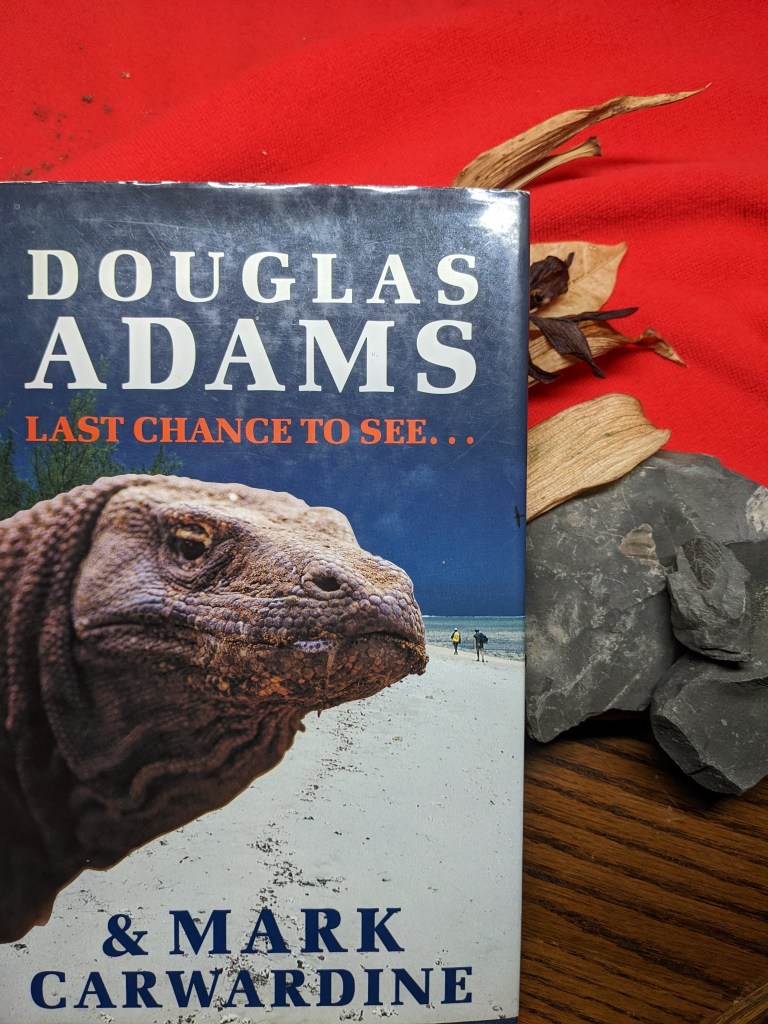
When the project picked up again, they went looking for Komodo Dragons. Komodo Dragons are scary. There are still between 4,000 and 5,000 left in the wild. This is more or less the same quantity as there were when Douglas Adams and Mark Carwardine were looking. This is largely due to their natural habitat being turned into amusement parks where people can pay to see them eat a goat. There are times where I am rudely reminded that my idea of a good time and other peoples’ are vastly different. With some quick digging, I found that you can actually still visit this park in 2022. They seem to have overhauled the bit with the goat in favour of a more ‘natural’ and terrifying discovery of dragons.
Next on this very rare bingo card is the Northern White Rhino. At the time the book was written, there were 22. The text makes it sound like there were high hopes for the programs and the conservation efforts. I have bad news on that. Only 2 remain at the time of me writing this. And they’re both girls. And unable to carry calves to term even if we pulled some sweet science cloning magic. In this particular species, we have failed.
The bit about the Mountain Gorillas, within the chapter filled with amusing English politeness kerfuffles, was very nice to read. They remark that there are 208 ish individuals at that point. Now, there are approximately 1000. We are doing much better with the gorillas than we are with the rhinos.
Kakapos. Weird little fat flightless parrots. Have you ever heard about them? I personally love quirky evolutionary adaptations. Kakapos have a wonderful one. They make a hole and scream at the ground for a mate. “Love me!” The hole cannot love them back, but as a quiet introvert I can relate to the tactics. There’s 202 left at the time of me writing this. There WERE 40.
Yangtze River Dolphin. Stupid looking. Totally gone. Haven’t seen one despite expeditions. The last known one died in captivity in 2002. They didn’t know how many there were to start. At this point, they have become the fisherman’s tale of the Yangtze, along with their friends (or… former friends?) the Yangtze Porpoise. I’m quite sure that old men sit around and dazzle the younger generations with “I saw one of them once… It was THIIIIIIIIIIIIIIIIS big!”
The last chapter was about Mauritius. Honestly? It made me a little bit sad for the state of the world and how people view conservation. There were four species that were looked at, Pink Pigeons in which 350 have escaped the fate of their ancestors of being made into pie, Echo Parakeets which have managed to increase to 700 from a mere 15 individuals, and the Mauritius Kestrel. The Kestrel was a victim of DDT. The pesticide made its way up through the food chain and softened the eggs of this small bird of prey. Without intervention and hands on breeding programs it is unclear whether they would have come back. Instead they are sitting at a population of around 800.
You may be looking at the above paragraph and wondering ‘where’s the fourth?’ Well, following the SPIT rule, (see previous post) I am changing paragraphs when I am introducing a new idea. The fourth species, unlike the other beings that I have spoken about here, is a tree. A coffee tree, to be exact.
I wanted to end on this because it was the passage that resonated with me the loudest.
In 1981, a teacher on Mauritius was speaking about an extinct kind of coffee bean tree. One of the students piped up and said to the teacher “Please, that’s not extinct, I have one in my backyard!”
Needless to say this caused quite the flap amongst the educated-about-trees crowd who immediately sent a sample off for testing. The testing did nothing but prove that this was indeed a specimen of the previously thought to be extinct coffee tree. Well, word gets around, doesn’t it? The tree was in danger of being cut down for firewood, or hit by a car that was on a nearby road, so they put a fence around it.
The problem with this is that the fence flagged it as special so people started acting, taking bits and pieces of it for luck, or medicine, or charms. What action did this prompt? The tree got a bigger fence. One with barbed wire. This made people more determined. So they put up more fence. They hired a guard.
ALL I CAN THINK ABOUT when I read this is this little tree, doing its best, then all of a sudden it gets a bunch of fences and its OWN GUARD! Because people heard that it was rare and wonderful so they determined to destroy it, handful by handful!
Ask why you can’t go up and touch Stonehenge anymore. There’s a rope around. Ask why you can’t climb the stairs or go into the ruins proper at Chichen Itza. There’s ropes, and this time guards – which are scarier than the deterrents in England. Please, read this book if you are like me. If you like to have a good giggle with your friends, if mild and silly politeness kerfuffles at someone else’s expense make you smile, and if you too want to scream at the general population “STOP WRECKING EVERYTHING!”
I promise you you won’t have a bad time.
References
- https://national-parks.org/indonesia/komodo
- https://en.unesco.org/courier/2021-3/protecting-cetaceans-yangtze
- https://wildlifepreservation.ca/pink-pigeon-2/
- https://www.peregrinefund.org/explore-raptors-species/falcons/mauritius-kestrel
- https://www.npr.org/templates/story/story.php?storyId=5307047
- https://www.zsl.org/conservation/species/birds/echo-parakeet-management-programme
- https://a-z-animals.com/animals/aye-aye/
- https://www.worldwildlife.org/species/mountain-gorilla
- https://rhinos.org/about-rhinos/rhino-species/white-rhino/
- https://www.doc.govt.nz/news/media-releases/2022-media-releases/its-a-pearl-first-kakapo-chick-of-2022-hatches/
 Winters Writer